
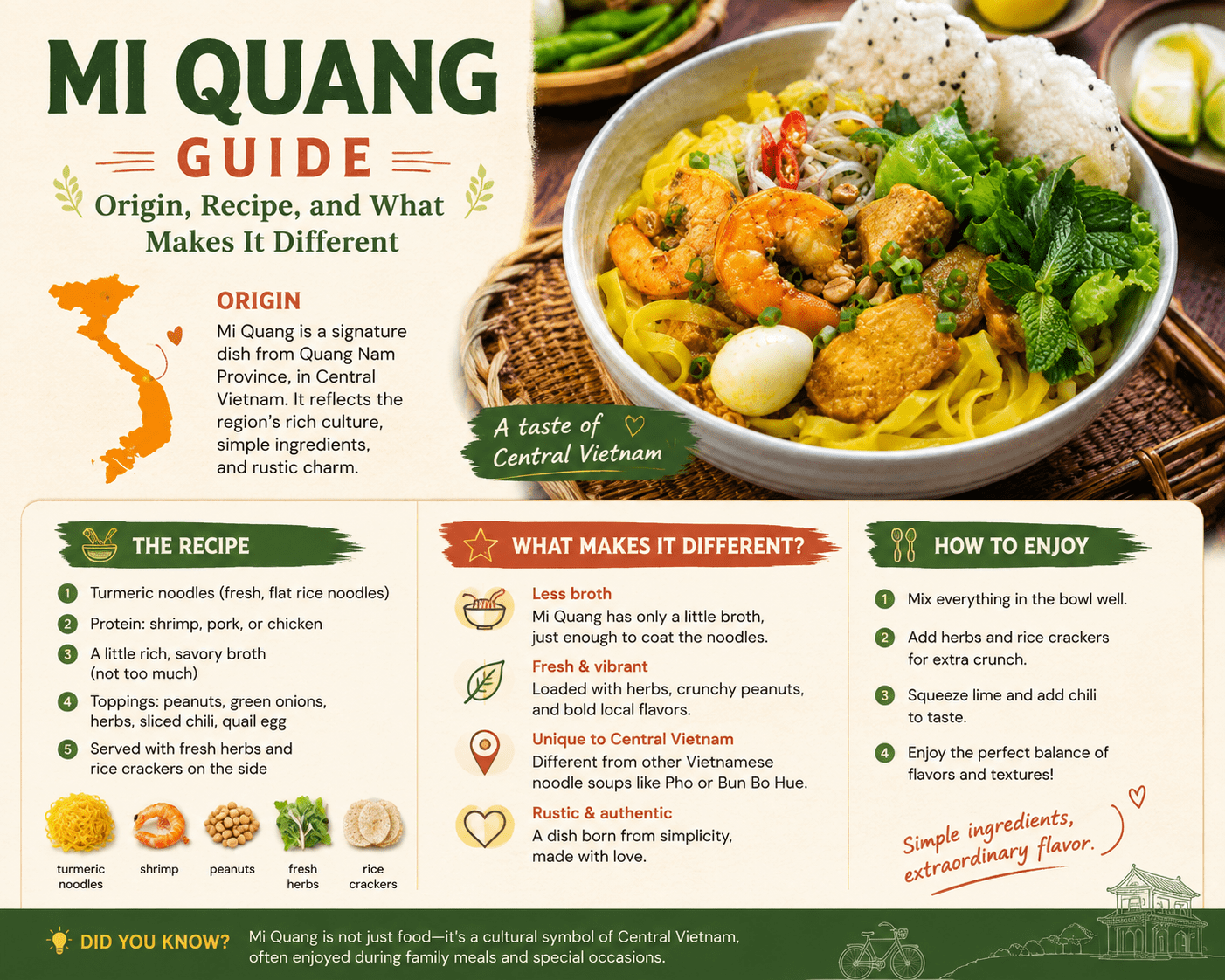
Mi Quang Guide: Origin, Recipe, and What Makes It Different
Mi quang is a rice noodle dish from Quang Nam province in Central Vietnam, made with turmeric-yellow noodles, a small amount of concentrated broth, and toppings like shrimp, pork, or chicken. Unlike pho, it’s barely a soup at all — the broth just coats the noodles instead of drowning them.
That’s the short version. Here’s the longer one, and why the name itself is a small piece of culinary trivia.
What Is Mi Quang, Exactly?
“Mi” in Vietnamese usually means wheat noodles. “Quang” refers to Quang Nam province, home to Hoi An’s old town. So the name literally promises wheat noodles from Quang Nam. It doesn’t deliver on that promise — the noodles are 100% rice flour, flat and wide, closer in shape to pho noodles but thicker and chewier.
Why the mismatch? Trade history. In the 16th century, Hoi An was a major port swarming with Chinese and Japanese merchants. They brought wheat-noodle dishes with them. Local cooks adapted the idea using what they actually had — rice flour — and kept the old name anyway. It stuck for centuries, long after anyone remembered the wheat.
https://guide.michelin.com/vn/en/article/features/what-is-da-nang-mi-quang
Most people assume a “noodle dish” from Vietnam means a big steaming bowl like pho. The data — or really, just tasting it once — says otherwise. Mi quang uses just enough broth to sit at the bottom of the bowl, not cover the noodles. Think concentrated sauce, not soup base.
Mi Quang vs. Pho: Quick Comparison
| Option | Best For | Key Benefit | Limitation |
|---|---|---|---|
| Mi Quang | Bold, herb-heavy flavor | Rich turmeric broth, varied toppings | Less broth means less “soupy” comfort |
| Pho | Classic, mild comfort food | Familiar, widely available | Less textural variety |
| Bun Bo Hue | Spice lovers | Intense, lemongrass-chili broth | Can be too heavy for some |
Mi quang vs pho: pho is better suited for a warming, brothy meal because it’s built around a full bowl of soup. Mi quang works better when you want texture and contrast — crunchy rice crackers, peanuts, fresh herbs — with just enough sauce to tie it together. The key difference is broth volume, not flavor intensity.
What Goes Into a Bowl of Mi Quang
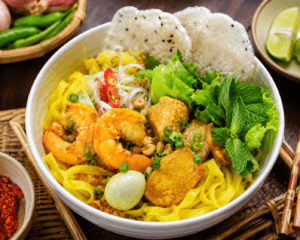
A standard bowl includes:
- Turmeric rice noodles, flat and wide
- A protein — shrimp, pork, chicken, or sometimes a mix
- A quail egg or two
- Toasted sesame rice crackers (banh trang nuong) for crunch
- Roasted peanuts, scattered on top
- Fresh herbs and greens — perilla, banana blossom, lettuce
- A small ladle of turmeric-infused broth
That’s a lot of components for one bowl. Somehow it doesn’t feel cluttered once you’re eating it — everything has a job.
One classic home recipe from Cooking Therapy clocks in around 642 calories per bowl, with roughly 90g of carbohydrates and 25g of fat per serving. That’s heavier than a typical pho bowl, mostly thanks to the peanuts, egg, and richer broth base. Worth knowing if you’re tracking intake, though this isn’t medical or dietary advice — just a rough benchmark from one recipe version.
Why the Da Nang vs. Quang Nam Confusion Exists
Here’s the thing: you’ll see mi quang described as a Da Nang specialty in some places and a Quang Nam specialty in others, and both are technically right. Quang Nam and Da Nang were a single province until 1997, when Da Nang split off into its own centrally-governed city. Mi quang predates that split by centuries. The dish didn’t move — the map did.
What most guides skip is that this administrative detail is the actual reason for the “where’s it really from” arguments online. It’s not a culinary dispute. It’s a paperwork one.
How to Make Mi Quang at Home
To make a basic mi quang, follow these steps:
- Simmer a concentrated turmeric-pork or chicken broth.
- Cook flat rice noodles separately, then rinse.
- Sauté shrimp and pork with turmeric and fish sauce.
- Assemble noodles in a bowl, add protein and quail egg.
- Ladle a small amount of broth over the top.
- Top with herbs, peanuts, and rice crackers before serving.
Fresh turmeric noodles can be hard to find outside Vietnam or a well-stocked Asian grocer. Dried flat rice noodles (banh pho, the same used for pho) work as a substitute — just toss them with a bit of turmeric powder after cooking to get the color and mild flavor close to right. Sesame rice crackers are sometimes sold as “banh trang nuong” or plain sesame rice crackers in Vietnamese markets; if you can’t find them, toasted rice paper brushed lightly with oil and broiled for a minute or two gets you something close enough.
Where to Actually Eat It
If you’re traveling rather than cooking, Da Nang and Hoi An are the places to try it — it’s sold everywhere, often more common than pho stalls in the area. According to Helen Le, a Da Nang-based cookbook author, locals eat mi quang for breakfast, lunch, or dinner without much thought to “meal appropriateness” the way some other dishes get treated. It’s just food, all day.
Quick Q&A
Q: What’s the best protein for mi quang?
A: Shrimp and pork together is the most traditional combo. Chicken works fine as a lighter alternative.
Q: How do I pronounce mi quang?
A: Roughly “mee kwahng” — the “quang” rhymes with “long,” not “twang.”
Q: Should I add more broth if I like soupier noodles?
A: You can, but it changes the dish. Traditional mi quang is meant to be light on broth by design.
Q: Why does mi quang use rice noodles despite the name meaning “wheat noodles”?
A: Cooks adapted a Chinese wheat-noodle idea using local rice flour, then kept the old name out of habit.
Q: When should I try mi quang over pho while in Vietnam?
A: If you’ve already had pho and want something texturally different — try mi quang in Central Vietnam specifically, where it’s freshest.