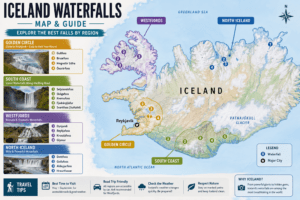

Iceland waterfalls aren’t scattered randomly across the map — they cluster by region, and knowing that clustering is what separates a smooth road trip from a day spent backtracking. This guide sorts the best falls by area, notes which ones charge parking fees in 2026, and flags which access roads actually hold up outside summer.
Iceland waterfalls refers to the thousands of cascades formed by the country’s glacial meltwater, heavy rainfall, and volcanic terrain. Most travelers only need to know a dozen or so — the ones near major routes like the Golden Circle and Ring Road.
Golden Circle and South Coast: The Essentials
If you’re short on time, this stretch covers the highest concentration of famous falls per kilometer driven. Gullfoss anchors the Golden Circle loop — a two-tiered drop into a canyon, free to visit, and genuinely worth the hype. Seljalandsfoss and Skógafoss sit further along the south coast, both walkable from the parking lot within minutes.
Here’s the thing: these three names show up on every list, and for good reason, but they’re also the most crowded. As of 2026, popular stops including Seljalandsfoss and Skógafoss now charge parking fees, roughly 1,000 ISK per visit, while Gullfoss remains free. Bring coins or a card — most machines now run through checkit.is rather than cash.
To visit the Golden Circle waterfalls efficiently: 1. Start at Þingvellir, then drive to Gullfoss. 2. Continue south to Seljalandsfoss for the behind-the-falls walk. 3. End at Skógafoss before sunset for the best light.
Skógafoss also connects to a long staircase hike along the Skógá river, which most day-trippers skip entirely. That’s a mistake if you have even an extra hour — the upper falls thin out the crowds almost completely.
Westfjords: Dynjandi and the Road Question
Dynjandi sits apart from the rest of this list, both geographically and in scale. It’s a series of seven cascading falls, the largest shaped like a wide bridal veil, and many travelers consider it the most beautiful of all Iceland’s waterfalls.
Getting there used to be the catch. As of 2026, the West Bank access road (Road 862) is fully paved, making it reachable even by small rental cars in summer, while the East Bank (Road 864) stays a rough gravel route that rewards drivers with the classic front-on view. Some experts argue the gravel route is worth the extra time for photographers. That’s fair for anyone chasing a specific shot — but if you’re on a tight itinerary or driving a compact car outside summer, the paved West Bank is the safer call.
Quick note: the Westfjords region overall gets a fraction of the Ring Road’s traffic, so don’t expect facilities at every stop.
North Iceland: Goðafoss and the Diamond Circle
Goðafoss — the “waterfall of the gods” — sits right on the Ring Road near Akureyri, making it an easy stop rather than a planned detour. It’s roughly 12 meters high and 30 meters wide, and it’s still free to visit, unlike several south coast falls.
Goðafoss carries real historical weight too. Around the year 1000, Iceland’s Lawspeaker reportedly threw Norse god statues into the falls to mark the country’s conversion to Christianity — which is where the name comes from. It’s a quiet, five-minute stop that somehow outshines names three times its size.
Golden Circle vs. North Iceland falls: Golden Circle waterfalls are better suited for first-time visitors on a short trip because they’re clustered and easy to reach. North Iceland falls work better for travelers doing the full Ring Road, since the drive itself justifies the distance.
Hidden and Highland Waterfalls Worth the Detour
Most people assume the famous names are automatically the best ones. The data — or at least consistent traveler feedback — says otherwise. Smaller falls like Gljúfrafoss and Kvernufoss get a fraction of the visitors and, in some cases, a more dramatic setting.
Gljúfrafoss hides almost entirely behind a rock face near Seljalandsfoss, and most people walking to the main falls never notice the sign. Kvernufoss requires a short farm-track walk but rewards you with a private-feeling canyon and a walk-behind view without the crowds. Neither charges parking as of this writing.
Glymur, Iceland’s second-highest waterfall at 198 meters, sits about an hour from Reykjavík near Hvalfjörður. This one isn’t a drive-by stop — it’s a proper hike, river crossing included, and it’s not for anyone short on time or wearing the wrong shoes.
Costs, Road Rules, and What Most Guides Skip
What most guides skip is the actual cost of driving between all these falls, not just the parking fees at each one. Iceland now applies a per-kilometer road tax, roughly 6.95 ISK/km, which your rental company adds automatically to the final bill. It’s small per trip, but it adds up fast on a full Ring Road loop.
The Parka app covers most paid parking sites across the country and saves you from fumbling with unfamiliar payment machines at each stop. Download it before you land — cell service gets patchy in the Westfjords and Highlands, exactly where you’re most likely to need it.
Quick Comparison
| Region | Best For | Key Benefit | Limitation |
|---|---|---|---|
| Golden Circle / South Coast | First-time visitors | Highest concentration of famous falls | Crowded, paid parking at most stops |
| Westfjords (Dynjandi) | Photographers, slower trips | Dramatic scale, fewer crowds | Longer drive, gravel road on East Bank |
| North Iceland (Goðafoss) | Full Ring Road travelers | Free, easy Ring Road stop | Less dramatic scale than southern falls |
| Highlands / Hidden falls (Glymur, Kvernufoss) | Hikers, repeat visitors | Quiet, no crowds | Requires hiking gear and time |
This guide covers the falls most reachable by rental car on a standard Golden Circle or Ring Road itinerary. It doesn’t cover Highland F-road waterfalls that require a 4×4 and river crossings — those need a separate, more technical guide.
Frequently Asked Questions
Q: What’s the best waterfall in Iceland for a first visit?
A: Gullfoss, for scale and easy free access, though Seljalandsfoss and Skógafoss are close seconds on the same route.
Q: How do I avoid paying parking at Iceland waterfalls?
A: Not all falls charge — Gullfoss and Goðafoss remain free in 2026. For paid stops, the Parka app or checkit.is covers most locations.
Q: Should I visit Dynjandi if I’m short on time?
A: Only if you have a spare half-day, since it’s in the remote Westfjords — otherwise stick to the Golden Circle and south coast falls.
Q: Why does Road 864 to Dynjandi stay unpaved while Road 862 got paved?
A: The West Bank (862) sees more traffic and was prioritized for improvement, while the East Bank (864) remains gravel by design for scenic, low-traffic access.
Q: When should I visit Iceland waterfalls for the best photos?
A: Golden hour in late spring or summer gives the softest light, though winter offers dramatic ice formations at falls like Goðafoss.