Are Cooper Tires Good? Honest 2026 Review
Short answer: yes, for most drivers. Cooper tires are a mid-range brand built for buyers who want solid tread life, dependable wet and winter grip, and a price tag that doesn’t sting. They’re not going to out-corner a Michelin Pilot Sport on a track day. But that was never the point.
Cooper tires refers to a line of passenger, truck, and SUV tires made by Cooper Tire & Rubber Company, now a subsidiary of Goodyear. The brand is positioned as a value-focused alternative to premium names like Michelin or Bridgestone, prioritizing tread longevity and warranty coverage over top-end performance specs.
If you’ve just gotten a quote from a tire shop and Cooper wasn’t the brand you expected to hear, that hesitation makes sense. Here’s what actually holds up when you look past the marketing.
Who Cooper Tires Are Actually For
Cooper built its reputation on being the tire you buy when you drive a lot but don’t want to spend luxury-brand money doing it. Commuters, road-trippers, small fleet owners, and truck drivers make up most of the customer base — people who care more about mileage and reliability than shaving a tenth of a second off a lap time.
The company has been around since 1914, originally founded in Akron, Ohio, before relocating to Findlay, Ohio in 1917, where it’s still based today. That’s over a century of manufacturing history, and it shows in how methodically the product line is organized: specific tires for specific jobs, rather than one “do everything” tire stretched across every vehicle type.
Quick answer for skimmers: Cooper tires are best for daily commuters and road-trip drivers who want long tread life and a manageable price. They’re not the pick for track-focused performance driving or ultra-luxury handling feel.
Did the Goodyear Acquisition Change Quality?
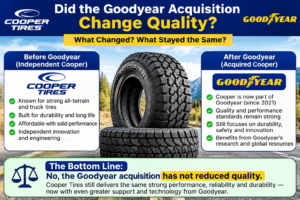
This is the question a lot of people are actually Googling, even if they don’t phrase it that way. In 2021, Goodyear completed its acquisition of Cooper Tire & Rubber Company for roughly $2.5 billion, folding Cooper into its broader manufacturing and R&D network.
Some buyers assume that means Cooper got quietly downgraded into a house brand with a different name slapped on. I’ve seen conflicting takes on this online — some longtime Cooper customers swear the tires feel identical to pre-acquisition models, while others insist compound quality shifted slightly. My read: the core manufacturing and testing infrastructure didn’t disappear, and Cooper still runs distinct model lines rather than becoming a Goodyear clone. If anything, being backed by Goodyear’s resources gives Cooper more R&D muscle than it had as a standalone company.
What most guides skip entirely is that Cooper still operates under its own brand identity in showrooms and still designs tires for its own model naming conventions — Discoverer, Evolution, Cobra. That’s not what a company does when it’s phasing a brand out.
How Cooper Performs by Category
Not all Cooper tires are the same tire in different tread patterns. Performance varies a lot by model, and that’s exactly where most reviews get lazy.
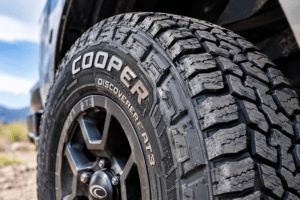
All-terrain and truck tires: The Discoverer AT3 line shows up constantly in owner reviews for holding up well under normal driving conditions, and the Discoverer Stronghold AT is built specifically for trucks and SUVs splitting time between highway and trail use. Drivers running these on work trucks tend to report solid mileage as long as rotation schedules are followed.
Winter tires: This is arguably where Cooper earns the most consistent praise. The Evolution Winter line gets strong marks for cold-weather grip without the rapid wear that plagues some budget winter options.
Off-road: The Evolution M/T is built for mud, sand, and rock — deep shoulder bite, aggressive mud-clearing lugs — the kind of tire nobody buys for a quiet commute.
Wet-weather performance: Several Cooper lines lean on silica-rich rubber compounds specifically to improve wet traction, which is a real engineering trade-off — better wet grip sometimes costs a bit of tread longevity. That’s not a Cooper-specific compromise; it’s physics every tire brand deals with.
Cooper vs Michelin: Michelin tires are better suited for buyers chasing the absolute best in longevity data and refined ride quality, because Michelin invests more heavily in premium compound research. Cooper works better when the priority is upfront cost and solid-not-spectacular performance. The key difference is price-to-performance ratio, not raw capability.
Quick Comparison
| Option | Best For | Key Benefit | Limitation |
|---|---|---|---|
| Cooper Discoverer AT3 | Trucks/SUVs, mixed terrain | Strong tread life, all-around grip | Not ideal for extreme off-road |
| Cooper Evolution Winter | Cold-climate drivers | High-rated cold-weather traction | Wears faster outside winter use |
| Cooper CS5 | Daily commuters | Balanced comfort and price | Won’t match premium handling feel |
| Michelin (general) | Performance/longevity chasers | Industry-leading compound R&D | Noticeably higher price |
What the Warranty Tells You
Tire warranties are one of the more honest signals a brand gives you, because they’re a financial bet the company is making on its own product. Cooper’s tread warranties typically run in the tens of thousands of miles depending on the model, with more premium lines covering the most mileage. A company that expected its tires to wear out early wouldn’t back them that aggressively — it would eat too many warranty claims.
That said, warranty length alone doesn’t guarantee real-world performance. Read it as one data point, not the whole picture.
Where Cooper Falls Short
Look — if you’re chasing genuinely premium handling, high-speed stability, or ultra-low road noise at the absolute top tier, Cooper isn’t that tire, and it was never trying to be. Some all-season Cooper lines also aren’t built for genuinely severe winter conditions, though that criticism honestly applies to most all-season tires from any brand, not just Cooper’s.
This guide covers passenger, truck, SUV, and off-road Cooper lines for typical drivers. It does not address commercial fleet contracts or racing-spec performance tires, which involve a completely different buying calculus.
Voice Search Q&A
Q: What’s the best Cooper tire for daily driving?
A: The Cooper CS5 and Discoverer AT3 are the most commonly recommended for everyday commuting and mixed-use driving.
Q: How long do Cooper tires typically last?
A: Most models are built for tens of thousands of miles, with exact tread warranties varying by specific tire line.
Q: Should I buy Cooper tires or Michelin?
A: Choose Cooper if price-per-mile matters most; choose Michelin if you want the highest-tier performance and are willing to pay for it.
Q: Why does Cooper cost less than premium brands?
A: Cooper positions itself as a value brand, prioritizing cost-efficient manufacturing and tread durability over cutting-edge performance compounds.
Q: When should I avoid Cooper tires?
A: Skip them if you need track-level performance handling or the absolute lowest road noise available on the market.
Bottom Line
Are Cooper tires good? For the driver who wants dependable mileage, decent wet and winter grip, and a price that doesn’t require financing — yes, without much hesitation. For someone chasing the last 10% of performance that only premium brands deliver, probably not. Match the tire to what you actually drive, and Cooper holds up exactly where it’s supposed to.