
The Real Guide to What to See in NY City in 2026
This guide covers Manhattan and Brooklyn’s top 15 attractions for first-time visitors. It does NOT address day trips outside the city, nightlife, or borough-specific guides for Queens, the Bronx, or Staten Island beyond the ferry.
This works best for visitors staying 3 to 5 days with a mix of budget and mid-range spending. It won’t help if you’re a repeat visitor looking for hidden local spots.
What to See in NY City: The Short Answer
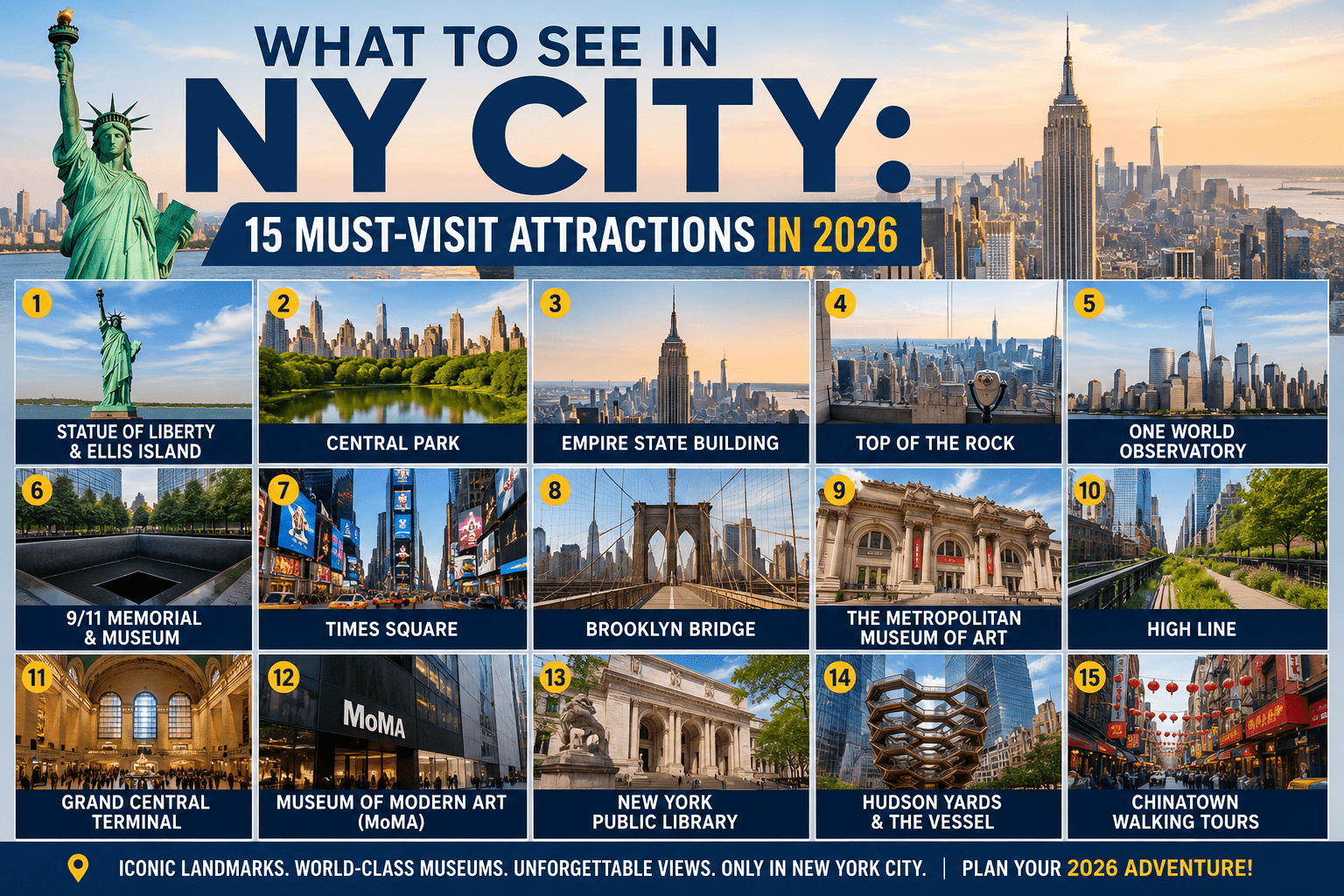
What to see in NY City comes down to three tiers: iconic landmarks you shouldn’t skip (9/11 Memorial, Central Park, Brooklyn Bridge), observation decks worth paying for (Top of the Rock over Empire State Building for first-timers), and free neighborhood walks that most guides bury at the bottom of the list.
According to NYC Tourism + Conventions’ March 2026 Annual Report, the city welcomed 65 million visitors in 2025 and is projecting 66.3 million in 2026 — generating $84.7 billion in total economic impact. People keep coming back. There’s a reason for that.
The problem isn’t that NYC lacks things to see. It’s that every list online drops 50 attractions on you with zero framework. You end up spending 40 minutes on the subway getting between places that are two miles apart because nobody told you to plan by neighborhood.
Plan by area. That single change will save you hours.
Plan by Neighborhood First — Then Pick Attractions
Most first-time visitors treat New York like a theme park — they bounce from one end to the other every day. Manhattan is 13 miles long. That’s expensive and exhausting.
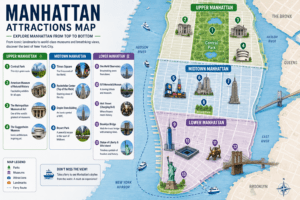
Here’s a structure that actually works for a 3-day visit:
To see New York City efficiently in 3 days, follow this sequence:
- Day 1 — Lower Manhattan and Brooklyn: 9/11 Memorial, One World Observatory or Staten Island Ferry, Brooklyn Bridge walk, DUMBO waterfront.
- Day 2 — Midtown: Top of the Rock, Times Square at night, High Line, Chelsea Market for lunch.
- Day 3 — Upper Manhattan: Central Park, The Metropolitan Museum of Art or American Museum of Natural History, Fifth Avenue.
For 5 days, add a Statue of Liberty cruise on Day 4 and a full afternoon in Greenwich Village on Day 5.
Quick note: Download Google Maps offline for New York City before you leave home. Subway signal cuts out underground constantly, and you’ll need it at the worst possible moments.
Lower Manhattan and Brooklyn: Where to Start
9/11 Memorial and Museum
The outdoor memorial is free. Full stop. The twin reflecting pools occupy the exact footprints of the Twin Towers, with the names of nearly 3,000 victims inscribed in bronze. It’s quiet, even when crowded — which says something about how it’s designed.
The underground museum (around $33 for adults, 2026 pricing) runs about 2 to 3 hours. Book in advance — it sells out on weekends. Arrive when it opens at 9am if you want the outdoor space to yourself.
One World Observatory
The 100th floor observation deck at One World Trade Center offers 360-degree views and, on a clear day, visibility up to 50 miles. Tickets run around $44 for adults.
Look — if you’re watching your budget closely, skip this and take the Staten Island Ferry instead. It’s completely free, passes directly in front of the Statue of Liberty, and gives you a full view of lower Manhattan from the water. Take it at sunset. You won’t regret it.
Top of the Rock vs. Empire State Building — which should you choose?
Quick Comparison:
| Option | Best For | Key Benefit | Limitation |
|---|---|---|---|
| Top of the Rock | First-time visitors | Empire State Building visible in skyline | Closes earlier in winter |
| Empire State Building | Iconic experience, evening visits | Stays open until 2am | Can’t see itself in the view |
| One World Observatory | Lower Manhattan views | Most modern facility | Furthest from Midtown hotels |
| Staten Island Ferry | Budget travelers | Completely free, Statue of Liberty views | No step-off access to the island |
| CityPASS bundle | 5+ attraction visitors | Covers Top of Rock, ESB, Met, AMNH, and ferry | Upfront cost of ~$142 per adult |
Brooklyn Bridge Walk and DUMBO
Free. One of the genuinely great experiences in the city.
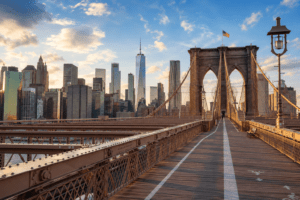
The pedestrian walkway runs above the traffic lanes — start from the Manhattan side at the Brooklyn Bridge–City Hall subway station and walk toward Brooklyn. It takes 30 to 40 minutes. Once you cross, walk down into DUMBO. The view of the bridge framed between the buildings on Washington Street at Front Street is exactly as good as it looks in photos.
Grab a slice at Juliana’s. Sit on the Brooklyn waterfront. Look back at Manhattan.
Or maybe I should say it this way — this is the one hour of the trip that’ll feel most like a movie. It costs nothing.
Midtown Manhattan: The Big Ticket Attractions
Top of the Rock
The best observation deck in the city for first-time visitors. The view from the 70th floor of 30 Rockefeller Plaza includes the Empire State Building sitting dead center in the Manhattan skyline — which you can’t see from the Empire State Building itself, for obvious reasons.
Tickets cost around $40 for adults. Book the sunset slot weeks in advance — it sells out. If it’s overcast when you arrive, most ticket providers offer free rebooking.
I’ve seen conflicting recommendations on this one — some travel writers insist the Empire State Building is the better pick for the history and iconic status. That’s valid if the building itself is what you’re after. But if you’re choosing based purely on the view, the Top of the Rock wins.
The New York CityPASS (around $142 for adults in 2026) bundles the Top of the Rock, Empire State Building, The Met, American Museum of Natural History, and a Statue of Liberty ferry cruise. If you’re hitting three or more of those, the math works in your favor.
https://www.citypass.com/?srsltid=AfmBOop8jFM4DRLVBVBV7Kr9bKCbuHoyqyC4FbZkUKwQa5v9u1ef97QJ
Times Square
Go at night. Don’t eat there.
The restaurants within two blocks of Times Square charge Midtown tourist prices for food that wouldn’t survive a Yelp review anywhere else. Walk one street in any direction and the options improve dramatically at half the cost.
Times Square itself costs nothing to walk through. The lights, the scale, the noise — it’s overwhelming and weirdly thrilling for about 20 minutes. That’s usually enough.
The High Line
A 1.45-mile elevated park built on a disused freight rail line running along the west side of Manhattan from Gansevoort Street to 34th Street. Free entry. Best visited on a weekday morning before it fills up.
Start at the southern end near the Whitney Museum of American Art and walk north. The views of the Hudson River and the city’s west side are unlike anything else in Manhattan. Chelsea Market sits directly beneath the southern entrance — good for lunch before or after.
https://travelnestworld.com/best-experiences-in-nyc/
Central Park and Upper Manhattan
Central Park
843 acres. Completely free. One of the best things to see in NY City regardless of how much you’re spending on the rest of the trip.
The essential stops within the park: Bethesda Fountain and Terrace, the Bow Bridge (most photographed bridge in the city), Strawberry Fields near the West 72nd Street entrance, and the Jacqueline Kennedy Onassis Reservoir if you want a quieter walk.
A full loop is about 6 miles. Most visitors spend 1 to 2 hours in the southern section. In spring, the cherry blossoms near the Reservoir are worth planning around.
The Metropolitan Museum of Art
One of the five greatest museums in the world — and that’s not an overstatement. The permanent collection covers 5,000 years of human civilization across 17 departments. You could spend three days here.
Admission runs around $30 for adults and includes same-day entry to The Met Cloisters. For a focused 2-hour visit: Egyptian Wing first (the Temple of Dendur alone justifies the ticket), then European Paintings, then the rooftop garden if it’s open — the views of Central Park from up there are genuinely surprising.
According to the Met’s own attendance data, the museum sees around 6 million visitors annually, making it the most visited art museum in the Western Hemisphere.
American Museum of Natural History
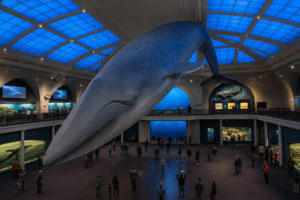
Directly across Central Park on the Upper West Side. The dinosaur halls on the fourth floor are world-class — genuinely among the best paleontology displays anywhere. The Hall of Ocean Life, with its 94-foot blue whale suspended from the ceiling, is unforgettable.
Tickets cost around $28 for adults. Budget 2 to 3 hours minimum.
The Statue of Liberty, the Waterfront, and Two More Worth Your Time
Statue of Liberty and Ellis Island
Ferry tickets that include both Liberty Island and Ellis Island run around $24 for adults (2026 pricing). Crown access requires a separate ticket booked months in advance — don’t expect to get one on short notice in summer.
Some experts argue the Ellis Island immigration museum is the more historically significant stop. That’s valid. But the experience of standing at the base of the statue itself, having seen it from a distance your whole life, is different from what you expect.
Free alternative: The Staten Island Ferry remains the best free view of the statue in the city. It won’t give you access to the island, but the 25-minute crossing is scenic, completely free, and runs every 30 minutes.
Brooklyn Bridge Park and the NYC Ferry
The NYC Ferry runs from lower Manhattan to Brooklyn Bridge Park for $4 each way. That’s a waterfront ride with skyline views that would cost $25 by rideshare. Take the ferry.
Brooklyn Bridge Park itself is one of the better-designed waterfront parks in any American city — lawns, playgrounds, and an unobstructed view of the Manhattan skyline and both bridges.
The Oculus at the World Trade Center
Free. No queue. No ticket.
The Santiago Calatrava-designed transit hub adjacent to the 9/11 Memorial is one of the most architecturally striking interiors in New York City. Visit at midday — sunlight comes in through the spine of the roof and the effect is genuinely beautiful. Most visitors walk past it without going inside.
Greenwich Village
The most walkable neighborhood in Manhattan. The tree-lined streets, Federal-era townhouses, and independent restaurants feel nothing like Midtown. Washington Square Park is the center of it — street performers, chess players, NYU students, and a marble arch that’s been there since 1892.
Joe’s Pizza on Carmine Street is an institution. Magnolia Bakery is nearby if you want to understand what the banana pudding conversation has been about.
This is the neighborhood for a slow afternoon when your feet need a break from sightseeing.
Q&A: What People Actually Ask About Visiting NYC
Q: What’s the best free thing to see in New York City? A: The Brooklyn Bridge walk, followed by Central Park and the High Line. All three are free, take under 2 hours each, and deliver views that rival anything you’d pay for.
Q: How do I get around NYC without spending a fortune on taxis? A: Buy a 7-day MetroCard for $34 or tap your contactless bank card directly on subway turnstiles. The subway reaches almost every attraction on this list and runs 24 hours.
Q: Should I buy the New York CityPASS? A: Yes, if you plan to visit at least three of the five included attractions — Top of the Rock, Empire State Building, The Met, American Museum of Natural History, and a Statue of Liberty cruise. At around $142 per adult, the savings are real.
Q: Why does everyone say Top of the Rock is better than the Empire State Building? A: Because from the Top of the Rock, you can see the Empire State Building sitting in the center of the Manhattan skyline. From the Empire State Building, you can’t see itself. For a first-timer who wants that classic skyline view, the Top of the Rock wins.
Q: When should I visit the 9/11 Memorial to avoid crowds? A: Arrive at 9am when the museum opens, or on a weekday morning. Weekends between 11am and 3pm are the busiest periods. The outdoor memorial is always open and always free.
Practical Tips That Actually Matter
Getting around: A 7-day MetroCard costs $34 and covers unlimited subway and bus rides. Contactless bank card payment also works on all MTA turnstiles. Avoid rideshares for any journey under 2 miles in Midtown — traffic makes them slower and far more expensive than the subway.
Book in advance: The 9/11 Museum, Top of the Rock at sunset, One World Observatory, and any Statue of Liberty crown access sell out. Book before you arrive. Walking up on a Saturday in July and expecting availability is optimistic.
Offline maps: Download the NYC region on Google Maps before your flight. Subway platforms have no signal and you’ll need navigation at exactly the moment it cuts out.
Here’s the thing: a first-rate day in New York City can cost almost nothing. The Staten Island Ferry, the High Line, Central Park, the Brooklyn Bridge walk, Times Square, and the Oculus are all free. Budget your money for one or two paid experiences that genuinely matter to you — and walk the rest.
New York rewards the visitor who comes with a plan. The neighborhood framework above is that plan. Use it.