
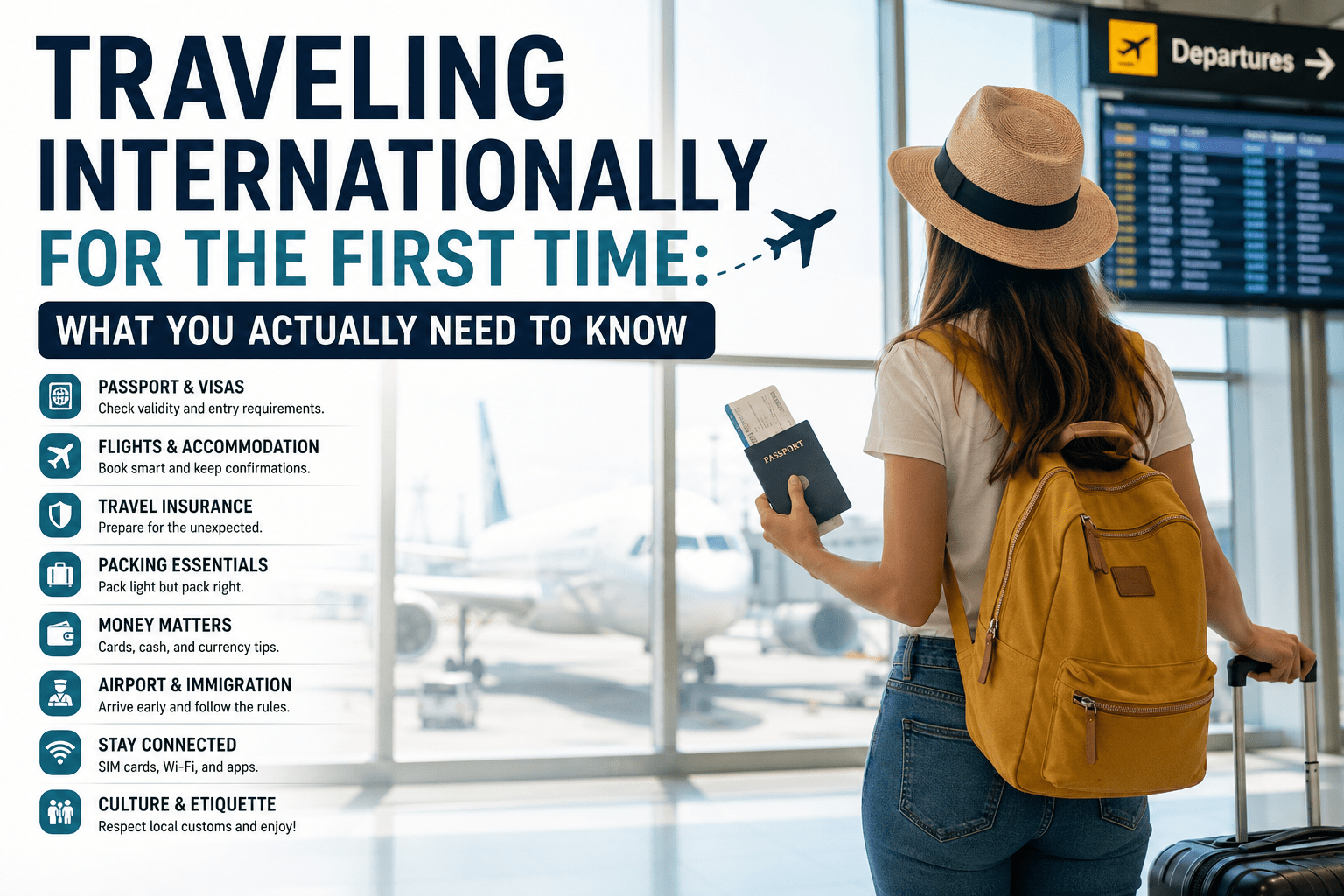
Traveling Internationally for the First Time: What You Actually Need to Know
This guide is for: Americans taking their first international trip — whether it’s a week in Mexico, a European vacation, or a flight to Southeast Asia. It does NOT cover long-stay visas, work abroad programs, or travel for unaccompanied minors.
Most Americans don’t travel internationally until their late 20s or 30s. That’s not a knock — it’s just geography. The US is enormous, domestic travel is easy, and for a long time there wasn’t much pressure to get a passport.
Then suddenly there is. A friend’s wedding in Italy. A honeymoon in Thailand. A work trip to London. And you’re standing in a Walgreens getting your passport photo taken, wondering what you’ve gotten yourself into.
According to UNWTO Tourism Highlights 2023, international tourist arrivals rebounded to 88% of pre-pandemic levels — with first-time American travelers among the notable growth segments. A lot of people are figuring this out for the first time, all at once.
This guide is the one you’d want a well-traveled friend to hand you.
What does “traveling internationally for the first time” mean? Traveling internationally for the first time refers to crossing a national border by air or land for the first time — requiring a valid US passport, possible destination visa depending on the country, and clearance through customs and immigration at both departure and arrival. The experience involves pre-trip preparation, airport procedures, and arrival formalities that differ from domestic travel.
Step 1: Do You Need a Visa? (Most Americans Don’t Realize How Easy This Is)
Here’s the good news most first-timers don’t know: the US passport is one of the strongest in the world. Americans can enter 186+ countries without a pre-arranged visa — including most of Europe, Japan, Mexico, the UK, Canada, Australia, and much of Southeast Asia.
What you do need for visa-free countries is a passport with at least 6 months of validity beyond your return date. This catches people off guard. If your passport expires in August and you’re returning from Paris in June, some airlines will deny boarding. Check the expiration date right now.
For the handful of destinations that do require advance visas — India, China, Russia, Brazil (reciprocity-based), Vietnam (unless using the e-visa) — apply through that country’s official embassy website or a reputable visa service like iVisa. Not a random Google result, not a travel Facebook group.
Here’s the thing: the ESTA (Electronic System for Travel Authorization) isn’t a visa — it’s the US equivalent of what foreign visitors need to enter America. You won’t need one as a US citizen. But if you’ve ever heard someone mention it, that’s what it is.
Some travel agents argue that using a full-service agency for your first trip removes the stress. That’s fair for complex multi-country itineraries. But for a first trip to Europe or Mexico? You genuinely don’t need one.
Step 2: Getting Your Passport — And What to Do If You’re Running Out of Time
If you don’t have a passport yet, apply now. Processing through the State Department runs 6–8 weeks for routine service, or 2–3 weeks for expedited (an extra $60). If your trip is under 5 weeks away, you’ll need to book an appointment at a regional passport agency.
The documents you need to apply: proof of US citizenship (birth certificate), a valid photo ID (driver’s license), a completed DS-11 form, one passport photo, and the fee ($130 for a book, $160 with card).
Don’t use a photo taken on your phone and printed at home. Go to a Walgreens, CVS, or AAA — they know the exact specs and will retake it if it doesn’t pass.
Quick note: passport books and passport cards are different things. The card only works for land and sea crossings to Mexico, Canada, Bermuda, and the Caribbean. For any international flight, you need the book.
https://travel.state.gov/content/travel/en/passports/get-fast.html
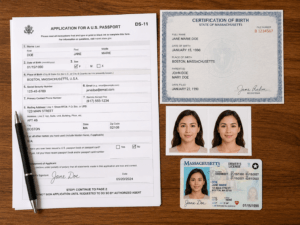
Step 3: The Documents Checklist Before You Leave
Get this wrong and nothing else matters.
Passport (valid, with 6+ months past your return date). Return flight confirmation. Hotel booking or host address — you’ll write this on the customs form on the plane. Travel insurance certificate if you bought it. Any required visas printed or saved to your phone. Emergency contacts written somewhere that isn’t just your phone.
Make one physical photocopy of your passport’s photo page. Store it in a different bag from the original. Take a phone photo of it too — if your passport is lost or stolen abroad, that photo helps the nearest US Embassy issue an emergency replacement faster.
I’ve seen conflicting advice on whether to bring physical copies or just rely on phone photos. My read is: do both. It takes three minutes and costs nothing.
Travel insurance deserves a real mention here. A medical emergency abroad — a broken leg, appendicitis, a bad food reaction requiring hospitalization — can cost $20,000–$80,000 out of pocket if you’re uninsured. Most US health insurance plans (including employer plans) don’t cover international care. A week-long travel insurance policy from a reputable provider like Allianz, Travel Guard, or World Nomads runs $40–$120 depending on your trip cost and age.
https://www.usnews.com/insurance/travel/best-travel-insurance
Step 4: Money — Cards, ATMs, and the Airport Exchange Counter Trap
The currency exchange kiosk inside the international arrivals terminal offers some of the worst exchange rates you’ll encounter on your entire trip. Sometimes 12–18% worse than the actual market rate.
Most first-timers exchange $200 at the airport “just to have local cash,” lose $25–35 in hidden margin, and then find perfectly good ATMs in the city five minutes later.
Here’s what actually works: notify your bank and credit card companies before you leave that you’re traveling internationally. Then use a Charles Schwab debit card (refunds all ATM fees worldwide), a Wise card, or a no-foreign-transaction-fee credit card like the Chase Sapphire Preferred or Capital One Venture at ATMs and merchants abroad. These give you close to the real exchange rate.
Or maybe I should say it this way: the single best financial move for international travel is getting a card that doesn’t charge foreign transaction fees before your first trip. Most standard US debit and credit cards charge 1–3% on every international purchase — it adds up silently across a two-week trip.
To manage money on your first international trip:
- Notify your bank and credit card company before departure
- Bring $100–$200 in local currency for arrival day expenses — get it from your US bank, not the airport
- Use a no-foreign-fee card for most purchases and ATM withdrawals
- Keep airport exchange counters as a last resort only
Quick Comparison: Managing Money Abroad
| Option | Best For | Key Benefit | Limitation |
|---|---|---|---|
| Schwab Debit Card | ATM withdrawals everywhere | Refunds all ATM fees | Need to open account in advance |
| No-fee Credit Card | Daily purchases | Real exchange rate | Not all vendors accept cards |
| Wise Card | Mixed spending + ATMs | Mid-market rate, transparent | Requires setup 5–7 days early |
| Airport Exchange Kiosk | Absolute last resort | Available on arrival | Worst rates, always |
Step 5: Packing Smart — The Carry-On Mistakes That Cost People Their Trips
The TSA liquids rule applies internationally — but it’s often stricter at foreign airports on the return flight. Each liquid must be 3.4 oz (100ml) or less, all in one clear quart-sized bag, removed at security. Many first-timers lose full-size shampoo, nice skincare, or a bottle of wine bought in the city because they forgot this applies on the way home too.
Power banks must go in your carry-on, not checked luggage. This is a federal aviation regulation about lithium batteries — airlines will confiscate them from checked bags.
What actually matters in your carry-on: all travel documents, phone charger and power bank, one change of clothes (for delayed or lost luggage), prescription medications in their original bottles, headphones, and a snack for long connections.
Pack your checked bag lighter than you think you need to. Most first-timers overpack for the trip and end up buying a second bag to get souvenirs home.
Look — if you’re unsure whether something is allowed in carry-on, the TSA has a searchable “Can I Bring?” tool at tsa.gov. Use it the night before you pack.
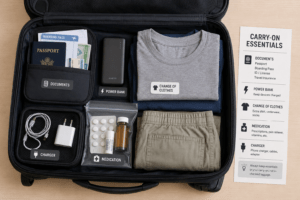
Step 6: At the Airport — What Actually Happens, In Order
Arrive 3 hours before an international flight. Domestic habits will tell you 90 minutes is fine. Ignore them. International check-in lines, baggage drop, and customs processing take longer — and missing an international flight is an expensive problem.
The sequence at a US departure airport: check in at the airline counter or kiosk → drop checked bags → clear TSA security → find your gate → board.
At the gate, have your passport out. The gate agent will check it against your boarding pass before you board. This is standard on international flights — it’s not a secondary screening.
On the plane, flight attendants will hand out a customs declaration form (or it’s done digitally via an app like MPC — Mobile Passport Control). Fill it out completely. You’ll need your destination address. If you’re staying at a hotel, write the hotel’s address. If you’re staying with someone, use their address.
Step 7: Landing Abroad — Customs, Immigration, and Getting to Your Hotel
You’ve landed. Here’s the exact sequence.
Follow the signs for “Arrivals” or “Immigration.” As a US passport holder, you’ll typically join a general queue or a separate line for non-citizens of that country. Have your passport open to the photo page and your completed declaration form ready.
The immigration officer will stamp your passport and may ask basic questions: purpose of visit, how long, where you’re staying. Answer briefly and honestly. “Vacation. I’m staying at [hotel] in [city] for [X] days.” That’s all they need.
Some officers ask nothing at all. Don’t interpret questions as suspicion — it’s routine screening for everyone.
After immigration, collect your bags from the baggage carousel — check the screens for your flight number and the correct belt. Then you’ll pass through customs. In most countries, US tourists use the green “nothing to declare” channel. If you’re carrying over $10,000 in cash or certain agricultural products, you must declare them.
Outside the arrivals hall: use the official taxi rank, pre-booked airport transfer, or a ride-hailing app (Uber works in most major cities, though local alternatives like Bolt in Europe or Grab in Southeast Asia are often cheaper). Avoid anyone inside the terminal offering you a “good price” on a taxi. That’s the arrival airport scam, and it exists in every country.
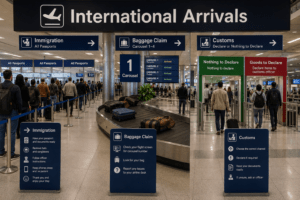
The Most Common First-Timer Mistakes (Skip These)
Most people assume the hardest part of their first international trip is the long flight. The actual costly mistakes happen before you leave home.
Passport expiring within 6 months of the return date — and finding out at check-in. Getting a passport photo rejected because it was taken at home against the wrong background. Not notifying the bank, which causes the card to get flagged for fraud and blocked in a foreign city. Packing a full-size bottle of something through security and having it confiscated. Bringing only one payment method and having it fail.
The overlooked one: not downloading offline maps before landing. Google Maps and Apple Maps both allow offline map downloads for a specific city or region. Download yours at home on Wi-Fi. Your first 20 minutes in a foreign city are stressful enough without also having no navigation.
Voice Search Q&A
Q: What’s the best credit card for traveling internationally for the first time? A: A no-foreign-transaction-fee card is essential. The Chase Sapphire Preferred, Capital One Venture, and Charles Schwab debit card are strong options — they don’t charge the 1–3% foreign fee that most standard US cards do.
Q: Do I need a visa to travel internationally from the US? A: For most popular destinations — Europe, Mexico, Japan, UK, Canada, Australia — no. The US passport allows visa-free entry to 186+ countries. Check the State Department’s travel website for your specific destination before assuming.
Q: How much cash should I bring for my first international trip? A: Bring $100–$200 converted to local currency before you leave (from your US bank, not the airport). Use a no-fee card for most spending. Avoid airport exchange kiosks — their rates are significantly worse than city ATMs.
Q: Should I buy travel insurance for my first international trip? A: Yes. Most US health insurance plans don’t cover international medical care. A week-long policy from Allianz, World Nomads, or Travel Guard costs $40–$120 and covers medical emergencies, trip cancellation, and lost luggage.
Q: When should I arrive at the airport for an international flight? A: Three hours before departure. International check-in, baggage drop, and TSA screening take longer than domestic — and you can’t rush an international departure the way you might a domestic one.