
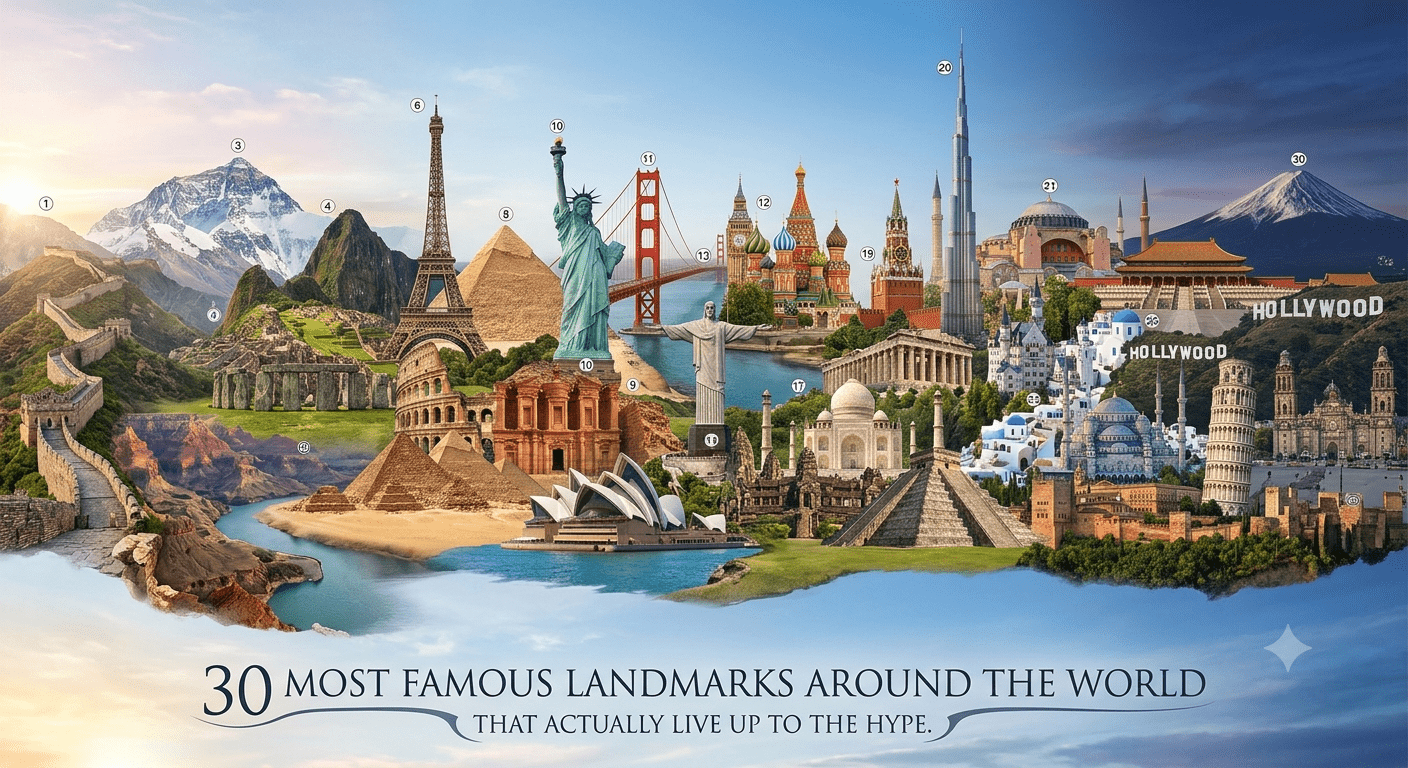
30 Most Famous Landmarks Around the World That Actually Live Up to the Hype
Landmarks around the world are the physical punctuation marks of human civilization — structures, natural formations, and monuments so culturally significant that millions of people rearrange their entire travel calendars just to stand in front of them.
Some disappoint. Most don’t.
According to the UNWTO World Tourism Barometer 2024, heritage and landmark tourism motivated 68% of international travelers when choosing their destination — making it the single most influential travel driver globally. That’s not a small number. That’s nearly 7 in 10 people saying: I’m going somewhere because something iconic is there.
This list covers 30 of the most famous, most visited, and most historically loaded landmarks on earth — with real visitor context, practical tips, and the things competitor guides consistently skip.
What Counts as a World Landmark (And Why It Matters)
Landmarks around the world are defined as sites of exceptional cultural, historical, architectural, or natural significance that hold recognized importance beyond their home country’s borders. A landmark isn’t just old or big — it’s a place where human meaning has accumulated over generations.
UNESCO’s World Heritage List currently recognizes over 1,100 such sites across 167 countries, though not every iconic landmark holds that designation. The Eiffel Tower, for example, is not a UNESCO site — yet nobody debates its status as the most photographed structure on earth.
Here’s the thing: the word “landmark” gets diluted fast. Every tourism board wants to claim one. So for this list, the filtering criteria were global recognition, cultural staying power, and the experience of actually being there — not just a high Instagram count.
Quick note: natural landmarks like the Grand Canyon and man-made monuments like the Colosseum are both included. The world doesn’t separate them, and neither should a useful travel guide.
The Most Famous Landmarks in Europe
Europe is, fairly or not, where most people’s mental image of “world landmark” begins. And for good reason — the continent holds an extraordinary concentration of UNESCO sites, ancient ruins, and architectural icons within relatively short travel distances of each other.
1. Eiffel Tower — Paris, France
Built in 1889 as a temporary exhibition structure, the Eiffel Tower was almost torn down after 20 years. Today it welcomes roughly 6 million visitors annually, making it the most visited paid monument on earth. Most people don’t realize the upper observation deck at 276 meters offers a genuinely different experience from the second floor — the lines are shorter, the views are sharper, and the sense of scale finally clicks.
Book tickets through the official Eiffel Tower website at least 2–3 weeks in advance. Walk-up queues in summer can exceed 3 hours.
2. Colosseum — Rome, Italy
The Colosseum is Rome’s most visited site — and also its most misunderstood. Most visitors enter, walk the main floor, and leave feeling slightly underwhelmed. The underground hypogeum, where gladiators and animals were held before combat, is the part that actually makes the history feel visceral.
It held between 50,000 and 80,000 spectators at peak capacity — an engineering achievement that influenced stadium design for the next 2,000 years.
https://www.unesco.org/archives/multimedia/document-1058
3. Sagrada Família — Barcelona, Spain
Antoni Gaudí’s basilica has been under construction since 1882. It’s still not finished. That fact alone makes it one of the most unusual landmark experiences anywhere — you’re visiting a masterpiece that’s actively being completed around you, with a projected completion date of 2026.
Some experts argue that visiting an unfinished building diminishes the experience. That’s valid if you want a static, complete monument. But if you want to witness architectural ambition in real time, there’s nothing else like it.
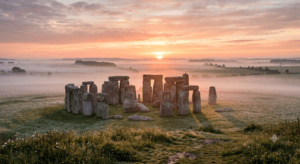
4. Stonehenge — Wiltshire, England
Stonehenge is smaller than photographs suggest. That surprises almost every first-time visitor. The stones average around 4 meters in height — impressive in person, but not the towering megalith the camera angle implies.
What no photo captures is the surrounding landscape — the flat Salisbury Plain stretching in every direction, the silence, and the genuine inability of archaeologists to fully explain how or why it was built around 3000 BCE.
5. Acropolis of Athens — Greece
The Parthenon sits on top of the Acropolis, but the Acropolis is the whole fortified hill — a distinction that matters when you’re planning your visit. Budget at least 2.5 hours. The Acropolis Museum at the base is, genuinely, one of the best archaeological museums in the world and most visitors skip it entirely.
Or maybe I should say it this way: if you visit the Acropolis and skip the museum, you’ve seen the shell without understanding what was inside it.
Iconic Landmarks in Asia
Asia contains some of the most visited and most spiritually significant landmarks on earth — and also some of the most severely overcrowded. Timing matters here more than anywhere else.
6. Great Wall of China — China
The Great Wall isn’t one wall — it’s a series of walls built across different dynasties, stretching over 21,000 kilometers in total. The Badaling section near Beijing is the most visited and the most restored. The Mutianyu section offers a more authentic experience with significantly fewer crowds.
I’ve seen conflicting data on this — some sources cite 70 million annual visitors to the Great Wall, others put the figure closer to 10 million for ticketed sections specifically. The UNESCO figure is the more conservative and likely more accurate estimate. Either way, go early or go in October.
7. Taj Mahal — Agra, India
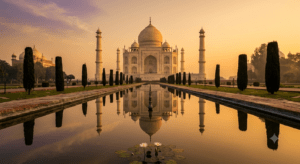
Built between 1631 and 1648 by Mughal Emperor Shah Jahan as a mausoleum for his wife Mumtaz Mahal, the Taj Mahal is widely considered the world’s greatest example of Mughal architecture. The white marble changes color across the day — pinkish at dawn, bright white at noon, golden at sunset.
The garden’s reflecting pool is the iconic shot. Get there before 7 AM.
8. Angkor Wat — Siem Reap, Cambodia
Angkor Wat is the largest religious monument ever built. The temple complex covers over 400 acres. Most visitors spend a day — ideally you want three. The outer temples (Bayon, Ta Prohm) are often more visually striking than the main structure itself.
9. Mount Fuji — Japan
Mount Fuji is a 3,776-meter active stratovolcano that last erupted in 1707. It’s also Japan’s most painted, photographed, and culturally venerated natural landmark. The climbing season runs July through early September — outside that window, the summit trails are officially closed.
Viewing from Kawaguchiko Lake on a clear morning is the classic experience, and you don’t need to climb anything to get it.
10. Petra — Jordan
Petra was carved directly into rose-red sandstone cliffs by the Nabataean civilization around the 4th century BCE. The Treasury — Al-Khazneh — is what everyone photographs, but it represents less than 1% of the total site. The Monastery, a 45-minute hike further in, is larger and far less crowded.
Look — if you’re planning to visit Petra with limited time, go straight to the Monastery first. Everyone else will be at the Treasury.
Quick Comparison: Top Landmarks by Visitor Experience
| Landmark | Best For | Key Benefit | Limitation |
|---|---|---|---|
| Eiffel Tower | First-time Europe travelers | Instantly iconic, easy access | Very crowded in summer |
| Machu Picchu | Adventure + history seekers | Spectacular mountain setting | Altitude sickness risk |
| Taj Mahal | Cultural + architectural depth | Stunning at multiple times of day | Agra city itself underwhelms |
| Colosseum | History enthusiasts | Guided underground access available | Surface-level without context |
| Grand Canyon | Nature and scale seekers | South Rim accessible year-round | Requires a car or tour |
Must-See Landmarks in the Americas
11. Machu Picchu — Peru
Machu Picchu sits at 2,430 meters above sea level in the Andes — high enough that altitude sickness is a genuine concern for visitors arriving directly from sea-level cities. The Inca citadel was built in the 15th century and was largely unknown to the outside world until 1911.
The site limits daily visitors to 4,500 to manage conservation pressure. Book the Huayna Picchu hike separately if you want the elevated view — tickets sell out weeks in advance through the official Peruvian Ministry of Culture portal.
12. Grand Canyon — Arizona, USA
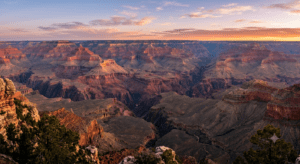
The Grand Canyon is 446 kilometers long, up to 29 kilometers wide, and over 1,800 meters deep. Those numbers mean nothing until you’re standing at the South Rim and your brain genuinely fails to process the scale.
The South Rim is open year-round. The North Rim closes in winter. And despite what most travel blogs say, the inner canyon hike is not a day trip — the National Park Service explicitly warns against attempting to hike to the river and back in one day.
13. Statue of Liberty — New York, USA
The Statue of Liberty was a gift from France, dedicated in 1886. Access to the crown requires a separate reservation, often booked months in advance. Most visitors who don’t pre-book end up viewing from the ferry or Liberty Island’s grounds — which is still worthwhile, but a different experience.
14. Christ the Redeemer — Rio de Janeiro, Brazil
At 38 meters tall and standing atop the 700-meter Corcovado Mountain, Christ the Redeemer has overlooked Rio since 1931. The statue was named one of the New Seven Wonders of the World in 2007 — a poll-based designation, not an official body’s ruling, which is a distinction worth making.
Cloud cover is the main enemy of a good visit. Check the forecast and go on a clear day; the panoramic city view is as much the attraction as the statue itself.
15. Chichen Itza — Mexico
The pyramid of El Castillo at Chichen Itza was engineered so precisely that twice a year — at the spring and autumn equinoxes — the shadow of a serpent appears to descend its northern staircase. That’s not myth. That’s intentional astronomical alignment built in stone around 900 CE.
Natural Wonders That Count as Landmarks
Not all world-famous landmarks are built. Some of the most awe-inducing sites on earth are the result of geology, time, and weather — not human hands.
16. Aurora Borealis — Iceland / Norway / Finland
The Northern Lights aren’t a fixed location landmark, but Iceland’s Þingvellir National Park and Norway’s Tromsø are the most reliable viewing locations. The phenomenon is caused by solar particles colliding with Earth’s atmosphere — and solar activity forecasts, available through NOAA’s Space Weather Prediction Center, have become essential tools for aurora chasers.
Peak season: September through March. Clear, dark skies away from city light are non-negotiable.
17. Victoria Falls — Zambia / Zimbabwe
At 1,708 meters wide and 108 meters tall, Victoria Falls produces a spray cloud visible from 50 kilometers away. The Zimbabwean side offers the wider frontal view; the Zambian side gives closer access and the famous Devil’s Pool — a natural infinity pool at the edge of the falls, swimmable only in dry season (roughly September to December).
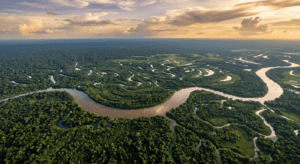
18. Amazon Rainforest — South America
The Amazon represents approximately 40% of the world’s remaining tropical forest and generates 20% of the world’s freshwater flow into the ocean. It’s a landmark in the geological sense — the largest biome of its kind, and one that’s actively shrinking.
Manaus, Brazil, is the primary gateway city for organized Amazon tours.
19. Great Barrier Reef — Australia
The Great Barrier Reef stretches over 2,300 kilometers and is the world’s largest coral reef system. It’s also the world’s largest living structure — and it’s under serious climate pressure. Approximately 50% of its coral coverage has been lost since 1995, according to Australian Institute of Marine Science data from 2022.
Cairns and the Whitsundays are the main access points. Snorkeling at the outer reef — beyond the tourist boats — offers substantially better visibility and coral health.
20. Mount Everest — Nepal / Tibet
Everest’s summit stands at 8,849 meters — updated by a joint Chinese-Nepalese survey in 2020 from the previous figure of 8,848 meters. Most people will never climb it. The Everest Base Camp trek (5,364 meters) is the accessible version — a 12–14 day round trip from Lukla that still requires acclimatization days and genuine physical preparation.
Landmarks in Africa and the Middle East
21. Pyramids of Giza — Egypt
The Great Pyramid of Giza is the only surviving structure of the original Seven Wonders of the Ancient World. It was built around 2560 BCE, using an estimated 2.3 million stone blocks. Engineers still debate the exact construction method used.
What most guides skip: the Solar Boat Museum at the base of the Great Pyramid houses a 4,600-year-old intact cedarwood boat — one of the oldest complete vessels ever discovered. Most visitors walk past the sign for it.
22. Serengeti — Tanzania
The Serengeti’s annual Great Migration involves over 1.5 million wildebeest, 200,000 zebras, and 500,000 gazelles moving in a clockwise circuit across the Serengeti and Maasai Mara ecosystems. The river crossings — where crocodiles wait — happen primarily between July and October.
This is arguably the most spectacular natural event on earth, and it happens on a predictable schedule.
23. Mount Kilimanjaro — Tanzania
Kilimanjaro is the world’s highest free-standing mountain at 5,895 meters. Unlike Everest, no technical climbing skills are required — it’s a high-altitude trek. The success rate for summit attempts on the most popular route (Marangu) is around 65%, largely because people underestimate the acclimatization requirement.
24. Dead Sea — Jordan / Israel
The Dead Sea sits at 430 meters below sea level — the lowest point on earth’s surface. Its salinity is approximately 10 times that of ocean water, making it impossible to sink. The experience of floating horizontally without effort is one of those things that genuinely has to be felt; no description prepares you for it.
25. Burj Khalifa — Dubai, UAE
At 828 meters, the Burj Khalifa is the world’s tallest building. It opened in 2010 and held the record through 2025. The At the Top observation deck on the 124th floor and the SKY observation deck on the 148th floor offer two distinctly different perspectives — and two different ticket prices.
Oceania and the Pacific
26. Sydney Opera House — Australia
Jørn Utzon’s Sydney Opera House was completed in 1973 after 16 years of construction and massive cost overruns — the original estimate was AUD $7 million; the final cost was AUD $102 million. It was designated a UNESCO World Heritage Site in 2007, one of the fastest buildings to receive that designation after completion.
The harbor view from the ferry is free. Performances inside are bookable through the official Sydney Opera House website.
27. Uluru — Northern Territory, Australia
Uluru is a 348-meter-tall sandstone monolith of enormous spiritual significance to the Anangu people, the Traditional Owners of the land. Since October 2019, climbing Uluru has been permanently prohibited — a decision the Anangu people had requested for decades.
The base walk is 10.6 kilometers and offers shifting perspectives of the rock across all times of day.
28. Fiordland National Park — New Zealand
Milford Sound within Fiordland is frequently described as the world’s most beautiful fjord — a claim that’s obviously subjective, but one that’s hard to argue on a clear day when the waterfalls are running. The area receives an average of 7 meters of rainfall per year, which is simultaneously the reason for those waterfalls and the reason many visits are obscured by cloud.
Two More Worth Knowing
29. Red Square — Moscow, Russia
Red Square is a 73,000 square meter public space flanked by the Kremlin, St. Basil’s Cathedral, and Lenin’s Mausoleum. It has been the stage for military parades, political speeches, and public celebrations for centuries. Travel access from Western countries has been significantly restricted since 2022 — visitors should check current government travel advisories before planning.
30. Hagia Sophia — Istanbul, Turkey
Built as a Christian cathedral in 537 CE, converted to a mosque in 1453, converted to a museum in 1934, and reconverted to a mosque in 2020 — the Hagia Sophia’s history is essentially a compressed version of world religious and political history. It’s open to all visitors outside of prayer times, free of charge.
The interior dome, at 55 meters high, was the largest in the world for nearly a thousand years.
What Most Guides Miss About Visiting World Landmarks
Most people assume the biggest landmarks are the most rewarding to visit — the data says otherwise. Visitor satisfaction surveys consistently show that mid-tier landmarks with better crowd management, context-rich interpretation, and proximity to good food and accommodation score higher on post-visit satisfaction than the “number one” sites.
What most guides skip entirely is this: the experience of a landmark is inseparable from when you go, how long you stay, and what you know before you arrive. A well-read visitor at a minor landmark will leave more satisfied than an underprepared visitor at the Eiffel Tower at 2 PM in August.
Practical tools worth using: Viator for pre-booked guided tours (particularly valuable at history-dense sites like Petra and the Colosseum), Google Maps for real-time crowd data via the popular times graph, and the official UNESCO World Heritage website for understanding a site’s specific significance before arrival.
Voice Search Q&A
Q: What’s the most famous landmark in the world?
A: The Eiffel Tower in Paris is consistently ranked the world’s most recognized landmark, attracting around 6 million paid visitors annually — more than any other paid monument on earth.
Q: How do I visit Machu Picchu without altitude sickness?
A: Spend at least two days acclimatizing in Cusco (3,400m) before visiting Machu Picchu. Stay hydrated, avoid alcohol on arrival, and consider altitude sickness medication — consult a doctor before traveling.
Q: Should I visit the Taj Mahal in the morning or afternoon?
A: Go at sunrise. The Taj Mahal opens at dawn, crowds are thinnest in the first hour, and the marble takes on a warm pink tone in early light that disappears by mid-morning.
Q: Why does the Colosseum feel disappointing to some visitors?
A: Without historical context, the Colosseum reads as a ruined shell. Booking a guided tour or visiting the underground hypogeum transforms the experience — that’s where the real history becomes tangible.
Q: When should I visit Iceland to see the Northern Lights?
A: September through March offers the longest dark hours. Clear sky nights away from city light are essential — use NOAA’s aurora forecast tool or local tour operators who monitor conditions daily.