
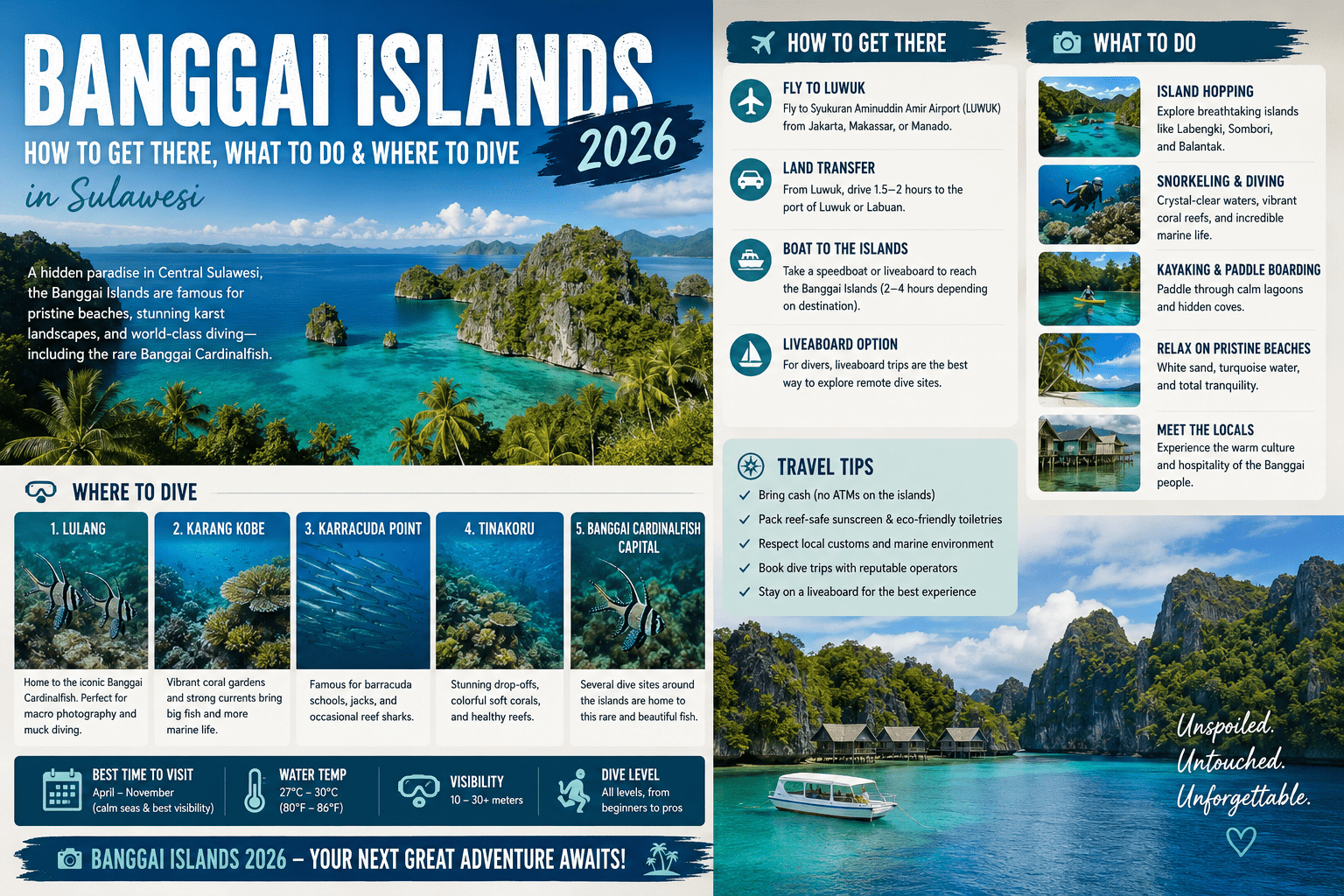
Banggai Islands 2026: How to Get There, What to Do & Where to Dive in Sulawesi
This guide covers independent travel to the Banggai archipelago from Makassar or Bali. It does NOT address live-aboard dive itineraries or group tours departing from Manado.
The Banggai Islands are a remote Indonesian archipelago off the eastern coast of Central Sulawesi — roughly 120 islands scattered across the Banda Sea, most of them unnamed on tourist maps. They sit about 100 km southeast of Luwuk, the nearest mainland town with an airport.
Most travelers have never heard of them. The ones who have usually stumbled across two words: cardinalfish and jellyfish lake.
That’s a fair summary. But there’s quite a bit more going on here.
What Are the Banggai Islands and Why Do Travelers Go?
The Banggai Islands are an archipelago of approximately 120 islands in Central Sulawesi, Indonesia, best known for world-class snorkeling, endemic wildlife, and near-total absence of mass tourism.
The barrier reef surrounding the islands holds over 600 species of marine life (Travel Noire, 2023). The headliner is the Banggai cardinalfish — a black-and-white striped reef fish that exists nowhere else on Earth and is classified as endangered. Divers fly in specifically for it.
But that’s not the only draw.
There’s a stingless jellyfish lake on Mbuang-Mbuang Island that most guides mention in a single line and move on from. There are tarsiers in the forests of Peleng Island — tiny, enormous-eyed primates that locals will take you to see after dark for next to nothing. The Piala Waterfall near Luwuk runs year-round and usually has no queue. White-sand beaches on Labobo and Pasir Panjang sit genuinely empty on weekdays.
Or maybe I should say it this way: Banggai is what travelers mean when they say they want Indonesia without the Instagram crowds, except they usually end up in Lombok instead.
How to Get to the Banggai Islands
This is where most guides get vague. Here’s the actual route.
Step 1 — Fly to Luwuk (LUW) Luwuk’s Syukuran Aminuddin Amir Airport is the gateway. Batik Air runs daily direct flights from Makassar (Sultan Hasanuddin Airport) — roughly 1 hour 25 minutes. Wings Air connects Palu to Luwuk once daily, around 1 hour 15 minutes. From Bali or Jakarta, you’ll connect through Makassar.
Step 2 — Get from Luwuk to Banggai Town Taxis and ride-hailing apps cover the 25-minute trip from the airport to Luwuk town center. From Luwuk, public ferries depart for Banggai town and the outer islands. The crossing to Banggai town takes roughly 6–8 hours on the slow ferry; speed boat options cut that down depending on conditions.
Step 3 — Island hop from Banggai town Local wooden boats (ojek laut) connect the smaller islands. Prices are negotiable and very low by international standards — most short crossings run under 50,000 IDR. Schedules are loose. Bring patience and cash.
Quick note: there are no ATMs on the outer islands. Withdraw everything you need in Luwuk before you leave the mainland.
Best Things to Do in the Banggai Islands
Snorkeling and Diving for the Banggai Cardinalfish
The Banggai cardinalfish doesn’t live anywhere else in the world. That alone justifies a detour for any serious marine life enthusiast. You can spot them snorkeling from shore at Kia Homestay on Peleng Island — the coral is shallow, the water is clear, and you don’t need a boat.
For scuba divers, sites like Tanjung Pasirpanjang and the George’s Wall site deliver soft corals, gorgonian fans, eagle rays, turtles, and occasional shark sightings. The pinnacle sites can run strong current, which pushes in the pelagic species — mackerel, tuna, barracuda. Visibility often exceeds 30 meters between September and February, which is the peak dive window.
Most people assume the dry season (April–November) is the best time for everything in Indonesia. The data says otherwise for Banggai. Dive conditions peak September–February. Waterfalls, on the other hand, start drying out around September–October. Plan around your priority — you probably can’t optimize both in one trip.
The Jellyfish Lake on Mbuang-Mbuang Island
This deserves more than a footnote. The lake on Mbuang-Mbuang holds two species of stingless jellyfish — both harmless to humans. The Banggai cardinalfish also lives in it, which makes it the only place in the world where you can snorkel alongside both in the same body of water.
Because Mbuang-Mbuang is genuinely remote, the lake sees a fraction of the traffic that Kakaban in the Derawan Islands or Jellyfish Lake in Palau receives. Waves can close the sea crossing — the World Travel Guy team had to skip the island entirely on one visit due to conditions. That’s the honest reality of traveling here.
Peleng Tarsier Trekking
The Peleng tarsier is endemic to Peleng Island. These are not zoo animals — you trek into the forest after dark with a local guide and use a red-light torch so you don’t disturb them. Most stays in the area can arrange this for a modest guide fee. Budget an evening for it.

Lake Paisupok
Travelers consistently describe this as the clearest freshwater lake they’ve ever seen. It’s a day trip from Luwuk with local guide support. The homestays nearby handle logistics easily.
Where to Stay in the Banggai Islands
Options are basic. That’s not a complaint — it’s a genuine description of the infrastructure.
Kia Homestay (Peleng Island): Simple wooden rooms, mattress on the floor, mosquito net, fan. Snorkel directly from the beach. Scooters for rent on-site. WhatsApp: +62 821-2633-4667. This is genuinely the most practical base for independent travelers wanting cardinalfish access without booking a tour.
Banggai Town guesthouses: A handful of small penginapan (basic guesthouses) serve as stopovers before island hopping. Don’t expect hot water or reliable WiFi.
Luwuk (mainland): If you want a hotel with AC, a proper bed, and restaurant options, stay in Luwuk and day-trip. You’ll lose flexibility on the outer islands, but you won’t lose sleep on a thin mattress.
Some experts argue that the lack of tourism infrastructure is a barrier to visiting Banggai. That’s valid for travelers who need predictable logistics. But if you’ve done DIY trips in Flores or the Banda Islands, Banggai is the same category of effort — and the reward-to-crowd ratio is arguably better.
Quick Comparison: Banggai Islands vs Similar Indonesian Destinations
| Destination | Best For | Key Benefit | Limitation |
|---|---|---|---|
| Banggai Islands | Endemic marine life, solitude | Cardinalfish, jellyfish lake, near-zero crowds | Very remote, basic infrastructure |
| Raja Ampat | World-class diving | Highest marine biodiversity on Earth | Expensive, increasingly busy |
| Derawan Islands | Jellyfish lake, turtles | More accessible, established tourism | More visited than Banggai |
| Togean Islands | Budget diving, slow travel | Laid-back, diverse dive sites | Inconsistent transport |
Bajau Sea Nomad Culture — What Most Guides Skip
Here’s the thing: the Bajau people have lived on and around these islands for centuries. They’re among the world’s most accomplished free-divers — genetic adaptations allow them to hold their breath far longer than average humans. Several eco-operators, including Nomad Archipelago, now offer experiences where you can observe Bajau fishing techniques and traditional boat-building as part of a cruise itinerary.
This dimension — the living human culture of the archipelago — is almost entirely absent from the top-ranking travel guides for Banggai. The fish get all the attention. The people who’ve shared the water with those fish for generations barely get a paragraph.
Practical Info: Budget, SIM Cards, and What to Know Before You Go
Costs are low even by Indonesian standards. A homestay night runs roughly 150,000–250,000 IDR. A boat charter for a half-day of island hopping can be negotiated for 300,000–500,000 IDR split between travelers. Restaurant meals in Luwuk cost what you’d pay in any mid-sized Indonesian town.
Look — if you’re arriving on a tight timeline expecting everything to run on schedule, here’s what actually works: build two buffer days into any Banggai itinerary. Ferries run late. Waves cancel crossings. That’s not a flaw in the destination — it’s the texture of genuine off-grid travel.
Bring a local SIM (Telkomsel has the best coverage in remote Sulawesi). Download offline maps before you leave Luwuk. Pack a dry bag.
I’ve seen conflicting data on whether the Peleng tarsier population is stable or declining — some conservation sources flag habitat pressure while local guides report healthy sightings. My read is that guided treks with responsible operators are fine and may actually support local incentives for forest conservation, but it’s worth asking your guide where they take visitors and whether they maintain distance protocols.
Banggai Islands: Common Questions
Q: What’s the best time to visit the Banggai Islands?
A: Dive season peaks September through February with visibility often exceeding 30 meters. For waterfalls, visit April to August. The weather doesn’t follow standard Indonesian dry-season patterns, so flexibility helps.
Q: How do I get to the Banggai Islands from Bali?
A: Fly Bali to Makassar, then Makassar to Luwuk on Batik Air. Total travel time is roughly 5–7 hours including connections. Then take a ferry from Luwuk to Banggai town.
Q: Should I visit Banggai Islands or Raja Ampat for diving?
A: Raja Ampat has greater overall biodiversity. Banggai wins for the endemic cardinalfish, lower cost, and near-zero crowds. Choose Banggai if solitude and endemic species matter more than dive site variety.
Q: Why is the Banggai cardinalfish special?
A: It’s found nowhere else on Earth and is listed as endangered. The species lives in the shallow reefs and even inside the islands’ jellyfish lake — snorkelers can spot it without scuba gear.
Q: When should I book a boat charter in the Banggai Islands?
A: Negotiate directly in Banggai town or through your homestay. No advance online booking is typically needed — but build buffer days in case weather delays crossings.
Final Word
The Banggai Islands won’t be undiscovered forever. The infrastructure is improving slowly, and the cardinalfish alone guarantees growing diver interest. Right now, the window where you can have a pristine jellyfish lake mostly to yourself, sleep in a homestay that costs less than a Jakarta lunch, and share a boat with fishermen rather than tour groups — that window is open.
It won’t stay open indefinitely.