
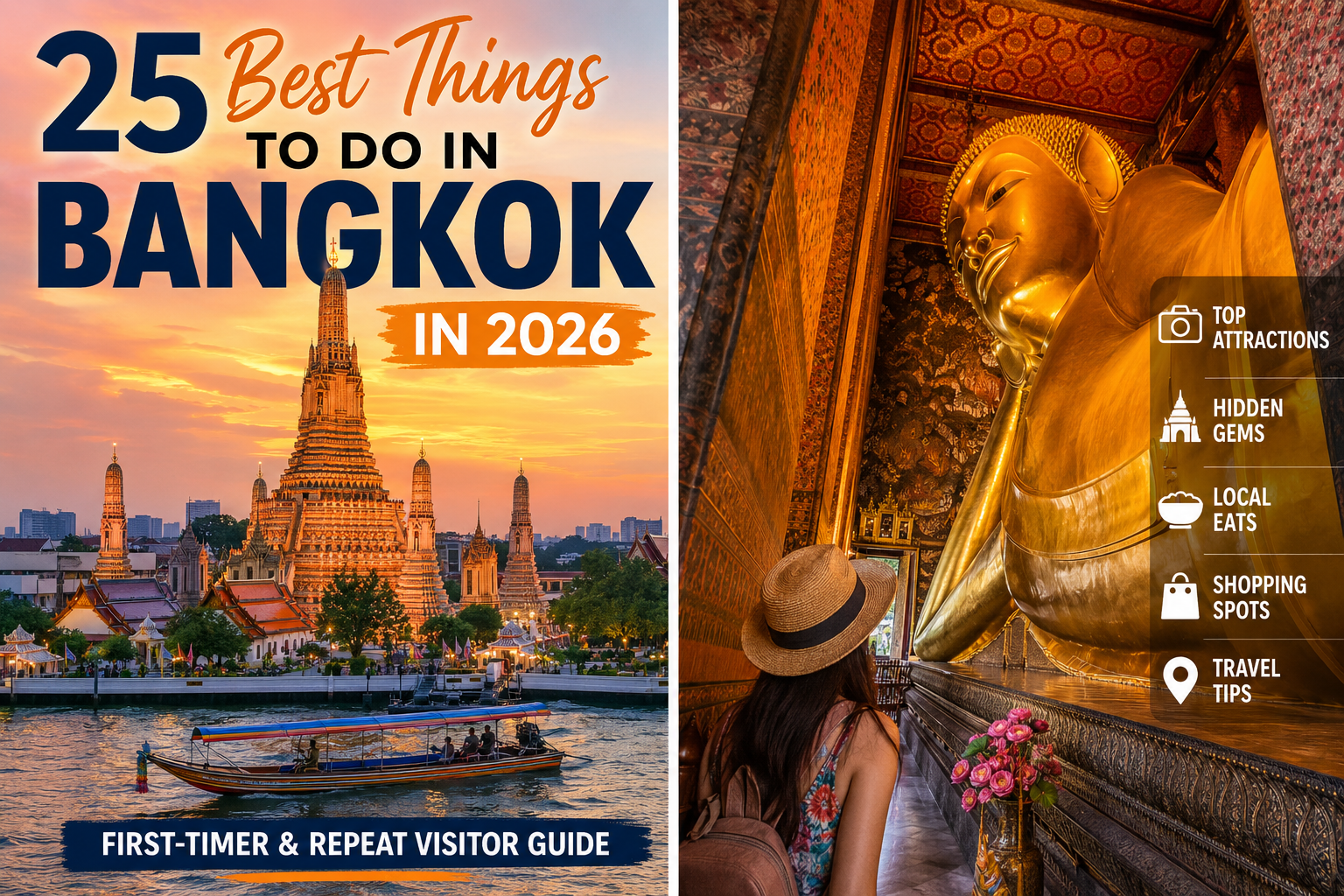
Bangkok is, statistically, the most visited city on Earth. And yet first-timers still land at Suvarnabhumi, open their saved Instagram spots, and immediately feel overwhelmed. The heat is real. The distances between landmarks are deceptive. And every travel blog seems to paste the same five temples into a list and call it a guide.
This article is different. Below you’ll find 25 genuinely worthwhile things to do in Bangkok — organized by category, with honest time estimates, BTS Skytrain and Chao Phraya Express Boat routing, and a clear flag on which “must-do” experiences are actually tourist traps worth skipping.
32.4 Million international visitors arrived in Bangkok in 2024 — making it the world’s #1 most visited city, ahead of London and Paris. Source: Euromonitor International, “World’s Top 100 City Destinations” (2024)
Temples Worth Your Time
Bangkok has hundreds of temples. You don’t need to see all of them — and you genuinely cannot in 4–7 days. These four are the ones that reward the effort. Everything else is optional.
Dress code reality: Shoulders and knees must be covered at every temple. In 38°C heat, that’s brutal. Bring a lightweight linen shirt or sarong — don’t rely on the rentals at the entrance, which have inconsistent quality and long queues, especially at the Grand Palace.
01. Grand Palace & Wat Phra Kaew
The most visited site in Thailand — over 8 million visitors per year — and for good reason. The Emerald Buddha inside Wat Phra Kaew is genuinely stunning, and the scale of the palace complex is unlike anything else in the city. Budget 2–3 hours minimum. Go first thing when doors open at 8:30am to beat the heat and the tour groups.
Pro Tip: Book skip-the-line entry through GetYourGuide to avoid the 45–90 minute queue at the main gate, especially November through February.
Getting there: Take the Chao Phraya Express Boat (orange flag line) to Tha Chang Pier (N9). The BTS doesn’t reach here — ignore anyone at Saphan Taksin pier offering “temple tours.”
02. Wat Pho — Temple of the Reclining Buddha
A 5-minute walk from the Grand Palace, Wat Pho contains the enormous 46-metre gold reclining Buddha and is also the birthplace of traditional Thai massage. Get a massage at the on-site school after touring the temple — 30 minutes costs around 260 baht. One of the best value-for-money experiences in Bangkok.
Pro Tip: Visit Wat Pho before the Grand Palace. It opens at 8am (30 minutes earlier) and is far less crowded at that hour.
03. Wat Arun — Temple of Dawn
Directly across the Chao Phraya from Wat Pho, Wat Arun’s distinctive spire is covered in fragments of Chinese porcelain and ceramics that catch the light differently at every hour. Climb to the second terrace for a clear view across the river to the Grand Palace. Best photographed at golden hour (5–6pm) from the opposite bank at Tha Tien pier.
Getting there: Cross from Tha Tien Pier by the 3-baht cross-river ferry — one of the great cheap travel moments in Bangkok.
04. Wat Saket (The Golden Mount)
Far fewer tourists, and the 300-step climb earns you one of the best panoramic views of Bangkok’s old town. Best visited early morning when it’s cool and uncrowded. Entry is 20 baht.
Street Food & Eating
05. Yaowarat Road — Bangkok’s Chinatown
Come hungry after 6pm when the street stalls set up. Pad see ew, grilled seafood, mango sticky rice, durian — all within 300 metres. Bangkok’s food scene is world-class; five city restaurants feature in the 2025 World’s 50 Best Restaurants orbit, but the street stalls on Yaowarat are the main attraction. Take the MRT to Hua Lamphong or the Chao Phraya boat to Yodpiman River Walk pier.
Pro Tip: Go on a weekday. Weekend evenings are wall-to-wall tourists and the stalls nearest the entrance are tourist-priced. Walk two blocks deeper in.
06. Or Tor Kor Market
Bangkok’s best fresh market — spotless, air-conditioned, and used almost entirely by locals and professional chefs. Durian, rambutan, mangosteen, and cooked dishes of a quality you won’t find in tourist markets. Located next to Chatuchak Weekend Market; BTS Mo Chit station.
07. Take a Thai Street Food Tour
Navigating Bangkok’s street food solo is entirely possible, but a 3-hour guided evening food tour through a neighborhood like Bang Rak or Bang Kok Yai delivers 8–10 dishes you’d never find independently, plus context on each one. Book through GetYourGuide for vetted options with English-speaking guides, from around $35 USD.
Markets
08. Chatuchak Weekend Market
One of the world’s largest outdoor markets — 15,000 stalls, 200,000 visitors every weekend. Arrive at 9am before the heat makes it unbearable (by noon it is exhausting). Sections 2–4 have vintage clothing and antiques; sections 7–8 are pets; sections 26–27 are handmade homeware. Download the Chatuchak map app before you go. BTS Mo Chit or MRT Chatuchak Park. Open Saturday and Sunday only, 9am–6pm.
Skip This: The “floating market tours” sold near Chatuchak are overpriced and take you to markets built almost entirely for tourists. Skip them entirely.
09. Amphawa Floating Market
The real floating market experience is a 90-minute drive from Bangkok, at Amphawa. Vendors sell from boats, the food is genuinely local, and the firefly boat tours after sunset are magical. If you do only one market trip outside the city, make it this one — but go on a weekend when it is fully operational.
10. Talad Neon / Ratchada Train Night Market
A photogenic night bazaar beloved by locals for cheap food and street fashion. Less touristy than Chatuchak and with better food than most night markets in the tourist belt. MRT Thailand Cultural Centre station.
Modern Bangkok
11. Icon Siam
Bangkok’s most spectacular mall isn’t really a mall — it’s a cultural statement. The indoor floating market (SookSiam) on the ground floor recreates 77 Thai provincial markets under one air-conditioned roof, and the building’s riverside location makes it a genuine attraction in its own right. Free boat shuttle from Sathorn pier. Come for the SookSiam food court, stay for the river views.
12. Siam Paragon & the Shopping Belt
Bangkok’s air-conditioned retail spine runs along the BTS Sukhumvit and Silom lines from Mo Chit to Asok. During peak afternoon heat (12–4pm), this is where locals actually spend their time. Siam Paragon has the best food court in Bangkok on the basement level, an ocean aquarium, and a cinema. Use BTS Siam station as your hub.
13. MOCA Bangkok (Museum of Contemporary Art)
Five floors of Thai contemporary art in a stunning building — genuinely world-class and almost always crowd-free. One of Bangkok’s best-kept secrets for anyone with even passing interest in art. Use Grab (Bangkok’s dominant rideshare app — always choose Grab over negotiated tuk-tuks for fixed, fair pricing) from Mo Chit BTS.
Green Spaces & the River
14. Benchakitti Forest Park
A 450-rai green lung in the heart of Bangkok — elevated walkways through wetlands, bird life, and surprising quiet even on weekdays. Best visited at 7–9am before the heat peaks. MRT Queen Sirikit National Convention Centre station.
15. Chao Phraya River by Express Boat
The orange-flag express boat is Bangkok’s best-value transit experience — 15 baht takes you along the entire old town riverside past Wat Arun, the Grand Palace waterfront, and Chinatown’s piers. Take it point-to-point rather than renting a longtail boat tour, which covers the same ground at 30 times the cost.
Rooftop Bars & Nightlife
16. Vertigo & Moon Bar — Banyan Tree Hotel
Bangkok’s most photogenic rooftop bar — 61 floors up, open-air, with a 360-degree city panorama. Drinks run 500–700 baht, there’s a smart casual dress code, and reservations are recommended for weekends. Worth it for one evening of the trip.
17. Radio Rooftop — Local Alternative
If you want skyline views without Lebua-level prices, Radio Rooftop at the Marriott on Sukhumvit Soi 57 offers comparable vistas at roughly half the cost, with a younger crowd and better music most nights.
18. RCA (Royal City Avenue)
Bangkok’s main clubbing strip — local, loud, and genuinely fun if you stay past midnight. Levels Club is the biggest venue; Onyx draws a house music crowd. Cover charges are usually 200–300 baht including a drink.
Skip This: Khao San Road is a rite of passage for some, but it is almost entirely foreign tourists at this point. If that energy is what you’re after, go. If not, skip it entirely and don’t feel guilty about it.
Unique Experiences
19. Traditional Thai Massage at Wat Pho School
The birthplace of formal Thai massage offers treatments in a setting no commercial spa can replicate. A 1-hour traditional massage costs around 480 baht — half the price of hotel spas and meaningfully more authentic. Book in advance; it fills up by mid-morning.
20. Morning Alms Giving Ceremony
At dawn in Bangkok’s old neighborhoods — particularly near Wat Saket and along the riverside — saffron-robed monks walk their daily alms route. Watch respectfully from a distance. Do not participate without proper instruction, and avoid commercial “tourist alms giving” setups, which are exploitative. One of Bangkok’s most genuinely moving sights if you catch it organically.
21. Muay Thai at Lumpinee Stadium
Lumpinee Stadium — the Muay Thai world’s most prestigious venue — hosts bouts every Tuesday, Friday, and Saturday. Ringside tickets are around 2,000 baht. This is real professional Muay Thai, not the tourist-facing shows in Patpong. Book through the official stadium website.
22. Jim Thompson House
The preserved 1960s home of the American silk merchant who revived Thai silk is a beautiful, strange, and atmospheric museum tucked in the middle of Silom. Guided tour only, included in the entry price. BTS National Stadium.
Day Trips from Bangkok
23. Ayutthaya — Ancient Capital
A UNESCO World Heritage Site 80km north of Bangkok — ruins of the Siamese kingdom spanning the 14th through 18th centuries. Take the train from Hua Lamphong station (80 baht, roughly 1.5 hours) and hire a tuk-tuk locally to circuit the ruins. Don’t rent bikes in the midday heat. You can be back in Bangkok easily by dinner.
24. Kanchanaburi — Bridge on the River Kwai
A sobering, moving day trip — the Death Railway, WWII cemeteries, and the original Bridge on the River Kwai. Take the minibus from Victory Monument (100 baht, about 2 hours). More historically significant and emotionally resonant than most tourists expect.
25. Amphawa or Damnoen Saduak Floating Markets
If you want the floating market experience as a day trip, Amphawa (weekends only) is far more authentic than Damnoen Saduak, which has been fully commercialized for decades. Book a shared minibus tour that includes the Mae Klong Railway Market for maximum efficiency on the same trip.
Suggested 3-Day Bangkok Itinerary
This schedule is built around Bangkok’s heat patterns. Do outdoor temples and markets before noon; use the 12–4pm window for malls, museums, and rest; go back out after 5pm when temperatures drop and the city comes alive.
Day 1 — Old Town & The River
7:30am — Breakfast near Tha Tien pier, then walk to Wat Pho (opens 8am) 9:00am — Grand Palace & Wat Phra Kaew, before tour buses arrive at 10am 12:30pm — Lunch at a riverside restaurant; retreat indoors for the afternoon heat 4:30pm — Cross-river ferry to Wat Arun; climb and stay for golden hour 6:30pm — Chao Phraya Express Boat to Chinatown (Yodpiman pier); street food dinner on Yaowarat Road
Day 2 — Modern Bangkok & Markets
9:00am — Or Tor Kor Market for breakfast and fresh fruit 10:00am — Chatuchak Weekend Market (Saturday and Sunday only) — 2 hours maximum before the heat builds 12:30pm — BTS to Siam; Siam Paragon food court lunch and afternoon cool-down 4:00pm — Free boat to Icon Siam; SookSiam indoor food market 7:30pm — Rooftop bar (Vertigo or Radio Rooftop) for the city panorama at night
Day 3 — Day Trip or Unique Experiences
7:00am — Train to Ayutthaya from Hua Lamphong (or spend the morning at Wat Saket + Jim Thompson House) 2:00pm — Return to Bangkok; traditional Thai massage at Wat Pho school 6:30pm — Evening street food tour or Muay Thai at Lumpinee Stadium
Getting Around Bangkok
BTS Skytrain is your primary tool. Two lines — Sukhumvit and Silom — connect the main tourist zones: Siam, Asok, Silom, Chatuchak. Buy a Rabbit Card (150 baht deposit, reloadable) for faster gates. Single-journey fares run 16–59 baht.
Chao Phraya Express Boat (orange flag) runs frequently and cheaply at 15 baht most stops along the river. Use it to connect Old Town temples to Chinatown and Icon Siam — these destinations are not served by BTS or MRT, and this is the most practical and scenic way to reach them.
Grab is the dominant rideshare app in Bangkok — metered, air-conditioned, no fare negotiation. Download it before you arrive and use it for any trip the BTS and boats don’t cover. Never negotiate a price with a tuk-tuk driver near tourist sites. The classic scam involves agreeing on a “special price” and being taken to a gem shop, tailor shop, or strip club. Grab eliminates this entirely.
Heat Strategy: Bangkok averages 33–38°C year-round. Do all outdoor activity before noon and after 5pm. The 12–4pm block is for malls, museums, indoor markets, or a hotel pool. This is not optional — it’s how locals live, and respecting it will save your trip.
Frequently Asked Questions
What is Bangkok most known for? Bangkok is best known for its ornate Buddhist temples, vibrant street food scene, world-class rooftop bars, and massive shopping malls. It is also the gateway city for most Thailand trips, which is why it regularly ranks as the world’s most visited city — 32.4 million international arrivals in 2024 alone.
Is 3 days enough for Bangkok? Three days is enough to cover the essential temples, one market, one day trip, and sample the food and nightlife. It is not enough to see everything — Bangkok rewards longer stays. Five days is the sweet spot for a first visit. If you only have 3 days, follow the itinerary above and prioritize ruthlessly.
What is the best time of year to visit Bangkok? November to February is Bangkok’s cool season — temperatures drop to around 25–30°C with minimal rain, and this is the most popular window. March through May is very hot (38–40°C). June through October is monsoon season: afternoon downpours are frequent but temperatures are lower and hotel prices are noticeably cheaper. There is no truly bad time to visit — every season has honest trade-offs.
Is Bangkok safe for solo travelers? Yes. Bangkok is generally very safe for solo travelers, including solo women. The main risks are common tourist scams — overpriced tuk-tuks, gem shop cons, the “closed today” temple redirect — not violent crime. Use Grab instead of negotiated rides, book tours through reputable platforms like GetYourGuide, and be skeptical of anyone who approaches you unsolicited near a major tourist site.
What should I not miss in Bangkok as a first-timer? Grand Palace and Wat Phra Kaew, Wat Pho, Wat Arun, an evening on Yaowarat Road in Chinatown, one rooftop bar, and a traditional Thai massage. Those six experiences are the irreducible core of a first Bangkok visit. Everything else is bonus.
How do I get around Bangkok cheaply? Combine the BTS Skytrain, the Chao Phraya Express Boat, and Grab. A full day of transport using all three modes typically costs under 150 baht — roughly $4 USD. Avoid metered taxis with the meter off and always avoid price-negotiated tuk-tuks near tourist sites.
Final Thoughts
Bangkok is not an easy city — the heat, the scale, and the sensory overload can genuinely wear you down if you don’t plan around them. But it rewards the effort generously. The temples are some of the most beautiful structures in Asia. The food is extraordinary at every price point. The contrast between golden spires and glass skyscrapers, between a monk’s alms walk at dawn and a 61st-floor cocktail at midnight — that contrast is the city.
Use this guide not as a checklist, but as a framework. Pick the 10–12 activities that match your travel style, build your days around the heat, download Grab, and go.