
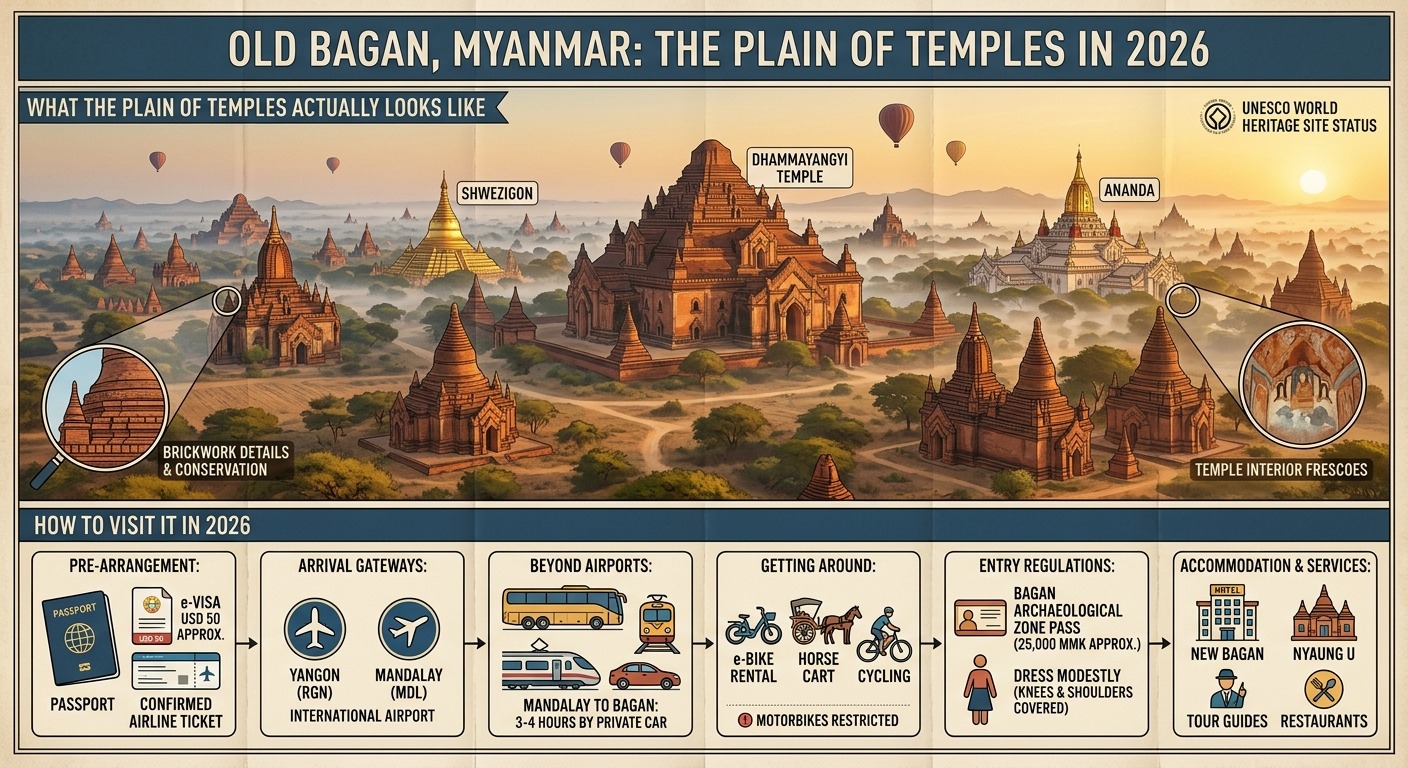
Old Bagan Myanmar: What the Plain of Temples Actually Looks Like and How to Visit It in 2026
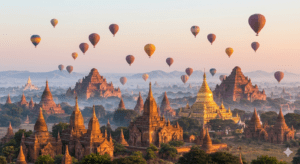
Old Bagan is one of those places that photographs have been underselling for decades. You’ve seen the images — a flat, hazy plain stretching to the horizon with hundreds of brick temples rising out of the grass, a hot air balloon drifting past a pink sunrise sky. What the photos don’t prepare you for is the scale. Or the silence, if you time it right.
This guide gives you the honest version: what Old Bagan is, what’s changed since the 2021 coup, how to get there, what to actually see, and what the current safety picture looks like for independent travelers.
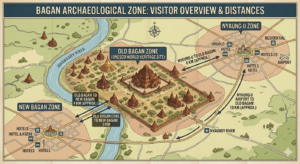
Old Bagan Myanmar refers to the ancient walled city at the heart of the Bagan Archaeological Zone — a 26-square-mile plain in the Mandalay Region containing over 3,500 Buddhist temples, pagodas, and monasteries built primarily between the 9th and 13th centuries during the Pagan Kingdom. It is distinct from New Bagan, a modern township 4 kilometers to the south where most budget accommodation is now located.
This guide works best for independent travelers planning a Bagan visit as part of the core “Tourist Kite” circuit (Yangon, Bagan, Mandalay, Inle Lake). It does NOT address overland travel between cities, conflict-affected border regions, or travel to areas beyond the established tourist infrastructure.
Is Old Bagan Still Open to Tourists in 2026? The Honest Answer
The short answer is yes — with important caveats that most travel articles are still not stating clearly.
Bagan remains accessible to tourists in 2026. The ancient temple plain continues attracting both domestic and international visitors, and tourist infrastructure operates normally within the area. That’s the reassuring part. Here’s the complicated part: Myanmar remains under Level 4 “Do Not Travel” advisories from multiple governments as of April 2026, including the US State Department, citing civil unrest and armed conflict.
Those two facts coexist. They’re both true. Bagan sits within what experienced travelers describe as the “Tourist Kite” — the four-point circuit of Yangon, Bagan, Mandalay, and Inle Lake — and travelers who stay within this zone report not being affected by issues elsewhere in the country.
Or maybe I should say it this way: visiting Bagan in 2026 isn’t reckless, but it requires you to arrive informed, not naive. You can only enter Myanmar by air, through Yangon International Airport or Mandalay International Airport — land borders are currently closed to tourists. That single logistical fact eliminates most of the overland risk that makes other parts of Myanmar genuinely dangerous.
I’ve seen conflicting accounts on this across recent traveler reports — some sources emphasize the functioning hotels and normal daily life in Bagan; others point to checkpoint encounters and social media scrutiny. My read is that Bagan specifically is one of the lower-risk zones for tourists who stay on the established circuit, exercise basic judgment, and carry comprehensive travel insurance that includes emergency medical evacuation.
According to UNESCO, the Bagan Archaeological Zone was inscribed as a World Heritage Site in 2019, and restoration work on key temples has been ongoing with international support. That institutional investment is part of why the site remains maintained and accessible even as broader Myanmar policy remains volatile.
https://travel.state.gov/en/international-travel/travel-advisories/burma.html
Old Bagan vs. New Bagan vs. Nyaung-U — What’s the Actual Difference?
This confuses nearly every first-time visitor. They’re three separate areas, and where you stay versus where you sightsee matters.
Old Bagan vs. New Bagan: Old Bagan is better suited for travelers wanting to be inside the archaeological zone itself, because it sits directly among the ancient temples. Accommodation here is more expensive — boutique hotels and upscale lodges primarily. New Bagan works better for budget and mid-range travelers, as it has the widest range of guesthouses, restaurants, and local shops. The key difference is that New Bagan is a purpose-built township with none of the ancient atmosphere; you’ll e-bike 4 kilometers to the main sites every day.
Nyaung-U is the largest town in the area, roughly 5 kilometers north of Old Bagan. It’s the transport hub — buses, the airport, and the train station are all here. Most independent backpackers base themselves in Nyaung-U for the better budget guesthouse options and the more authentic market street.
Quick Comparison:
Area | Best For | Key Benefit | Limitation Old Bagan | Luxury stays inside the zone | Temple access at dawn and dusk without travel | Expensive; limited dining options New Bagan | Mid-range travelers | Widest accommodation choice | No ancient atmosphere; daily ride to sites Nyaung-U | Budget travelers, transport access | Cheap guesthouses, local markets, airport nearby | Furthest from the major southern temples
The Best Temples in Old Bagan — and What Makes Each Worth Visiting
Bagan has 3,500+ structures. You’re not seeing all of them. The art is in picking which dozen or so will stay with you.
Ananda Temple — The Most Impressive Single Structure
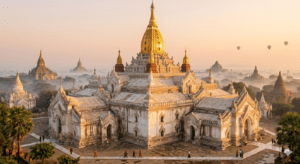
Ananda Pahto, built in 1105 AD, is considered the finest example of Mon architecture in Bagan. It’s a working temple, not just a monument — monks live and pray here, and the interior is dense with gilded Buddha images, lacquerware panels, and intricate stone carvings that have survived nearly a thousand years.
It was damaged in the 1975 earthquake and later restored with support from the Archaeological Survey of India. One of those restorations is controversial — some conservationists argue the whitewash applied during the 1990s renovation changed the structure’s authentic aged patina permanently. That debate is worth knowing before you arrive, because what you’re seeing is partly a restored temple, not a ruin.
Dhammayangyi Temple — Bagan’s Largest and Most Haunted
Dhammayangyi is the largest temple in Bagan by footprint. It was never completed — according to local legend, the king who ordered its construction was assassinated before it was finished, and the inner passageways were intentionally bricked up. Walking around it at dusk is a different experience from every other temple on the plain.
Most guide-free visitors miss the inner corridors entirely. Ask at the entrance about access to the partially sealed passageways.
Shwezigon Pagoda — The Religious Center, Not Just a Tourist Sight
Shwezigon was built to enshrine a tooth relic and frontal bone of the Buddha. It’s the spiritual prototype for most of the pagodas you’ll see across Myanmar, and it’s a fully active place of worship. Arrive during a morning offering or festival and the difference between this and a museum piece becomes immediately clear.
Shoes off before you enter. Always.
Sulamani Temple — Best for Sunrise
Sulamani, built in 1183 AD, sits in the central plain with clean sightlines in every direction. It’s a two-story temple with well-preserved frescoes inside — some of the best surviving examples of 12th-century Bagan painting. The sunrise light hits it from the east and wraps the brick in a copper-orange glow for about 20 minutes before the haze burns off.
Get here before 6 AM if you want that. After 8 AM, the tour groups arrive.
Htilominlo Temple — Tallest Standing Structure
Standing 46 meters tall, Htilominlo is one of the last great temples built before the Mongol invasions ended the Pagan Kingdom’s golden period in 1287. The plasterwork on the exterior still shows traces of original paint in places — faint reds and greens — if you look carefully at the sheltered upper sections.
[INTERNAL LINK: Full Bagan temple map → anchor text: “printable map of Bagan’s major temples”]
Hot Air Balloons Over Bagan — Is It Worth the Cost?
This is the most asked question about Bagan, and the honest answer is: yes, but only for a specific kind of traveler.
Balloons Over Bagan is the main operator, running flights from mid-October through mid-April (dry season only). A standard 45-minute shared flight costs approximately USD 370–420 per person as of 2025–2026. Private basket options run significantly higher.
Here’s the thing: the balloon experience is legitimately extraordinary. Floating 300 meters above a plain of ancient temples at sunrise, with mist in the valleys and no sound except wind, is one of those travel moments that justifies the price tag — if that price tag is in your budget. If it’s not, watching the balloons from the top of a temple at dawn is nearly as visually spectacular and costs nothing.
To book a hot air balloon flight over Bagan, follow these steps:
- Book directly through Balloons Over Bagan — at least 2–3 months ahead in peak season (Nov–Feb)
- Confirm your hotel pickup time the evening before — flights leave before sunrise
- Check weather via the operator the morning of — flights cancel in poor visibility
- Bring a light layer — the basket altitude is noticeably cooler than ground level
- Tip your pilot if the experience delivers
Quick note: cancellations due to weather are common in November and March. Most operators offer rebooking but not guaranteed refunds. Read the policy before you pay.
Getting to and Around Old Bagan in 2026
Getting There
Entry into Myanmar is currently only possible by air, through Yangon International Airport or Mandalay International Airport. From Yangon, domestic flights to Nyaung-U Airport take around 1 hour 15 minutes with Air KBZ or Myanmar National Airlines. The flight is the only realistic option for most international visitors — overland routes have significant risk outside the Tourist Kite and are not recommended.
Myanmar Railways’ overnight train from Yangon to Bagan exists and some travelers use it. Journey time is 10–14 hours. It’s slow, occasionally late, and the track quality is rough. For budget travelers who want the experience of watching the Irrawaddy plains at sunrise through a train window, it has its appeal. For everyone else, fly.
Getting Around the Archaeological Zone
E-bikes (electric scooters) are the near-universal choice. Rental is available throughout Nyaung-U and New Bagan for approximately USD 6–10 per day. No license is required. Ranges are adequate for a full day across the zone on a single charge.
Look — if you’re planning to cover a serious number of temples in a day, here’s what actually works: start before 5:30 AM, hit your sunrise temple first (Sulamani or Shwesandaw for the unobstructed views), then methodically work east-to-west or cluster by area. The midday heat between 11 AM and 2 PM is brutal from October through April. Rest, eat, drink water. Resume at 4 PM for the golden-hour temples.
Horse carts are available and some travelers enjoy them for a slower half-day circuit. They cover less ground. Taxis exist for airport runs and longer transfers. Bicycles are available but the distances across the archaeological zone make them genuinely hard work in the heat.
Practical Questions Travelers Ask Out Loud
Q: What’s the best time of year to visit Old Bagan Myanmar?
A: November through February — cool, dry, and clear skies. Hot air balloons operate only during this season. Avoid May through September when temperatures exceed 40°C and dust storms reduce visibility.
Q: How do I get from Yangon to Old Bagan?
A: Fly from Yangon International to Nyaung-U Airport — roughly 1 hour 15 minutes. Domestic flights run daily. Overland is possible but carries higher risk given current conditions.
Q: Should I stay in Old Bagan, New Bagan, or Nyaung-U?
A: Old Bagan for luxury and direct temple access; New Bagan for mid-range comfort; Nyaung-U for budget and transport convenience. All three are within e-bike distance of the major sites.
Q: Why does Old Bagan have so many temples?
A: The Pagan Kingdom built temples as acts of religious merit over roughly 250 years, from the 9th to 13th centuries. According to UNESCO, over 3,500 structures were built during this period — what remains today represents perhaps a quarter of the original number.
Q: When should I book a hot air balloon over Bagan?
A: Book 2–3 months ahead for November through January flights. The balloon season runs mid-October to mid-April. Last-minute availability exists in shoulder months but not in peak season.
Some experts argue that visiting Myanmar in the current political climate is ethically complicated — that tourist dollars flow partially into military-controlled enterprises. That’s a valid concern and deserves honest consideration, not dismissal. The counterargument is that most money spent in Bagan goes directly to locally owned guesthouses, food stalls, e-bike rental shops, and individual guides whose livelihoods depend entirely on tourism. Both things are true simultaneously. Where you spend money in Bagan — and how deliberately — matters more than whether you go.