
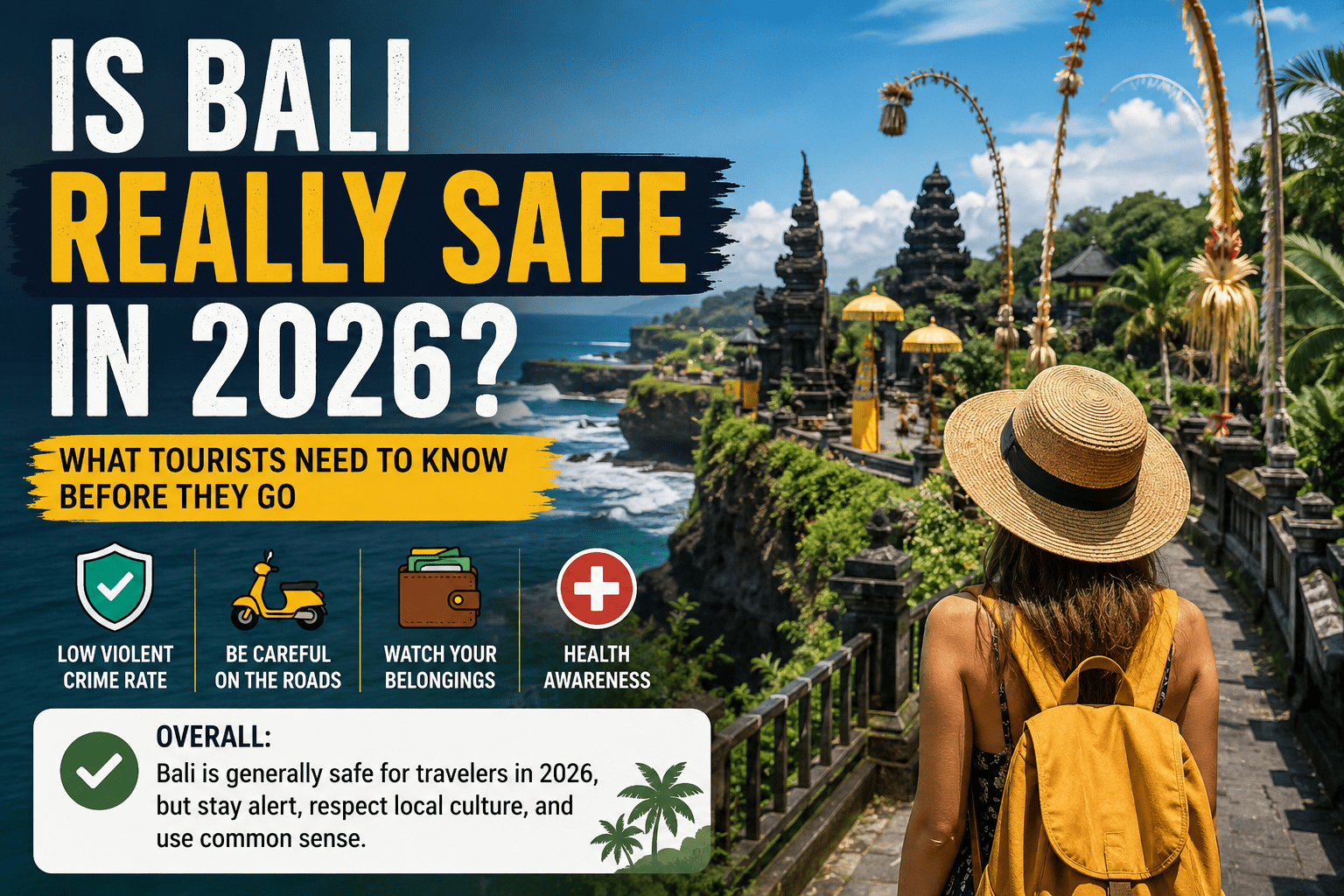
Is Bali Really Safe in 2026? What Tourists Need to Know Before They Go
Bali is safe. That’s the short answer. But “generally safe” doesn’t prepare you for a motorbike accident on the Legian strip, a drug arrest that ruins your life, or getting robbed at Kuta Beach because nobody told you how bag-snatching actually happens here.
This guide gives you the full picture — not reassurance dressed up as advice.
What “Safe in Bali” Actually Means
Is it safe in Bali? For most tourists, yes — Bali is a low-risk destination for violent crime. Serious offences targeting foreigners are rare, and the island’s tourism economy depends on keeping it that way. According to Indonesia’s Central Statistics Agency (BPS, 2023), over 5.2 million foreign tourists visited Bali that year, and the most commonly reported tourist incidents were petty theft and road accidents — not violent crime.
That said, “safe” is doing a lot of heavy lifting in most travel articles. The real risks in Bali aren’t violent muggings. They’re motorbike crashes, currency exchange scams, opportunistic bag-snatching in crowds, and — the one risk almost nobody adequately covers — Indonesia’s drug laws, which can turn a bad night into a decades-long prison sentence.
Most guides tell you to “be careful.” This one tells you what that actually means.
The Risk Nobody Talks About: Indonesian Drug Laws
Here’s the thing: this section alone is worth reading the whole article for.
Indonesia has some of the harshest drug laws in the world. Under Indonesia’s Narcotics Law No. 35 of 2009, possession of even small amounts of cannabis, MDMA, or cocaine can result in four to twelve years in prison. Distribution or trafficking carries a mandatory minimum of five years — and the death penalty remains on the table for serious trafficking cases under Indonesian law.
It doesn’t matter what your home country’s laws are. It doesn’t matter if you only brought a small amount “for personal use.” Foreign tourists have served multi-year sentences in Bali’s Kerobokan Prison for amounts that would earn a fine elsewhere.
Quick note: this isn’t theoretical. The UK Foreign, Commonwealth and Development Office (FCDO) explicitly warns British nationals that Indonesian authorities take a zero-tolerance approach and that consular assistance is limited once charges are filed. Australia’s Smartraveller advisory says the same.
What most guides skip is how the risk often starts — not at a club, but at your accommodation. Dealers sometimes target tourist areas and guesthouses in Kuta and Legian specifically. If you’re offered anything, leave. Don’t negotiate. Don’t be polite about it.
This works best as a warning for first-time visitors to the island. It applies regardless of where you’re staying.
Bali Crime Rate: What the Numbers Say
Counter-intuitive insight: most people assume tourist areas have higher crime. In Bali, the opposite is often true. Areas like Seminyak and Nusa Dua have visible security presence and tourist police precisely because they’re high-value zones. It’s quieter, less patrolled nightlife areas where opportunistic theft spikes.
The crime you’ll actually encounter:
Petty theft and bag snatching — primarily in crowded areas like Kuta Beach, Legian Street markets, and Ubud’s Monkey Forest. Theft from motorbike bags or open tote bags is the most common method. Use a cross-body bag with a zip. Don’t keep your phone in your back pocket.
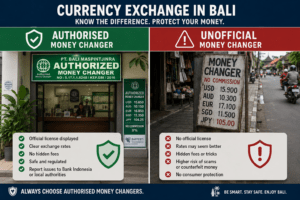
Currency exchange scams — still common at unofficial changers. Some use sleight-of-hand when counting notes; others advertise inflated rates and quietly deduct “fees.” Use licensed changers only, marked with a Bank Indonesia authorisation sign. Count your money before you walk away. Every time.
Taxi and transport scams — less of an issue since Grab and Gojek became dominant. Using either app removes haggling entirely and shows you a fixed fare before you confirm. For airport transfers, book in advance through your hotel or a licensed operator.
Fake tour bookings — mostly via Instagram DMs or WhatsApp. Fake villa listings and “too cheap” tour packages disappear with your deposit. Book through established platforms: Airbnb, Booking.com, Viator, or directly with the hotel.
Safe Areas in Bali: A Neighbourhood-by-Neighbourhood Breakdown
This is the gap every competitor article misses. “Bali is safe” tells you nothing useful when you’re trying to decide where to actually stay.
Seminyak — best for: first-timers, couples, mid-range to luxury travellers. Low street crime. Busy beach strip can have bag-snatching from scooters at dusk; don’t walk with a dangling bag after dark. Generally very tourist-friendly with good infrastructure.
Canggu — best for: digital nomads, solo travellers, younger crowd. Traffic is the real hazard here — Canggu’s roads were not built for the volume they now carry. Motorbike accidents involving tourists happen regularly. If you ride, rent a semi-auto rather than manual if you’re not experienced. The social scene is lively; the drug risk mentioned above applies here as much as Kuta.
Ubud — best for: families, wellness travellers, culture-seekers. Safest area for walking. The Monkey Forest is genuinely risky for loose items — monkeys are fast and will take sunglasses, phones, and food from your hands without warning. Keep bags closed and phones in pockets around the temple areas.
Kuta — highest tourist density, highest petty crime rate. Not dangerous, but requires more awareness than other areas. Beach touts are persistent. Nightlife is concentrated and can get chaotic. Bag security matters more here than anywhere else on the island.
Nusa Dua — resort enclave; extremely safe and controlled. Limited authentic local experience, but essentially zero street crime. Good for families or anyone who prioritises security over atmosphere.
Quick Comparison: Bali Neighbourhoods by Safety Profile
| Neighbourhood | Best For | Key Safety Benefit | Main Risk |
|---|---|---|---|
| Seminyak | Couples, first-timers | Well-patrolled, tourist police | Evening bag snatching |
| Canggu | Nomads, solo travellers | Relaxed atmosphere | Traffic / motorbike accidents |
| Ubud | Families, culture trips | Low crime, walkable | Monkey theft, uneven roads |
| Kuta | Budget, nightlife | Central location | Highest petty theft rate |
| Nusa Dua | Luxury, families | Resort security, enclosed | Limited local experience |
Is Bali Safe for Solo Female Travellers?
Some experts argue Bali is genuinely one of Southeast Asia’s safest destinations for women travelling alone. That’s valid for daytime exploration in Ubud or Seminyak. But if you’re navigating Kuta nightlife alone after midnight, the calculation changes.
Or maybe I should say it this way: Bali is safe for solo female travellers who plan their transport home before they go out. The risk isn’t the destination — it’s the unplanned walk back.
Specific points worth knowing:
Harassment is uncommon by regional standards, but persistent touts — especially at Kuta Beach — can be tiresome. A firm “no” without eye contact usually ends it. Don’t engage in conversation; it escalates the interaction.
After dark, use Grab or Gojek rather than walking or flagging street transport. Share your live location with someone. It’s not Bali-specific advice, but it’s the thing that actually matters.
Women travelling alone in Ubud and Seminyak consistently report feeling comfortable and welcomed. I’ve seen conflicting data on harassment rates in Kuta specifically — some sources categorise it as low, others flag nightlife areas as higher-risk — so err toward extra caution there.

Travel Insurance for Bali: What You Actually Need
You need it. Motorbike accidents alone make this non-negotiable.
Medical care in tourist areas has improved significantly, but serious trauma or illness will likely require evacuation to Singapore or Australia, which costs tens of thousands of dollars without coverage. Basic public hospitals in Bali are underfunded; private facilities like BIMC or Siloam are decent but expensive without insurance.
Two reliable options worth considering: World Nomads covers adventure activities including motorbike riding (check policy terms — some require a valid licence from your home country), and SafetyWing offers flexible monthly coverage suited to longer stays. Neither is sponsored; both come up consistently in genuine traveller communities.
Don’t go without it. That’s not a hedge. It’s the one piece of advice with no caveat.
https://www.gov.uk/foreign-travel-advice/indonesia
Natural Risks: Earthquakes, Volcanoes, and the Ocean
Bali sits on the Pacific Ring of Fire. Mount Agung is an active stratovolcano and erupted as recently as 2019. Minor tremors are common and most pass unnoticed. The Indonesian Centre for Volcanology (PVMBG) monitors activity continuously and issues alert levels publicly — Level I (normal) through Level IV (danger). Check current status before visiting areas near Agung.
Ocean currents are Bali’s most underrated physical danger. Kuta and Seminyak beaches have strong rip currents, particularly outside of the April-October dry season. Drownings happen every year — some involving experienced swimmers. Swim between the flags where lifeguards are present. If you’re caught in a rip, don’t fight it; swim parallel to shore until you’re clear.
Rabies exists in Bali. A significant monkey bite or dog bite requires immediate medical attention and a post-exposure vaccination series. Don’t let the Monkey Forest animals climb on you; don’t hand-feed stray dogs.
AEO Quick Answers
Q: What’s the biggest safety risk for tourists in Bali? A: Traffic accidents, particularly on motorbikes, are the most common serious incident. Petty theft in tourist-heavy areas is a close second. Violent crime against tourists is rare.
Q: How do I avoid getting scammed in Bali? A: Use Grab or Gojek for transport, only exchange money at Bank Indonesia-licensed changers, book accommodation through established platforms, and ignore WhatsApp deals that seem too cheap.
Q: Should I worry about drugs in Bali? A: Yes. Indonesian drug laws are among the harshest in Asia. Even small amounts of recreational drugs can result in years in prison. This applies equally to tourists and residents.
Q: Is Bali safe for solo female travellers? A: Generally yes — particularly in Ubud and Seminyak. Plan your transport before going out at night, use Grab instead of street taxis, and apply standard solo travel awareness in busy nightlife areas.
Q: When is the safest time to visit Bali? A: The dry season, April to October, reduces road accident risk (wet roads are a major factor in motorbike crashes) and avoids the strongest ocean currents. It’s also peak season — book early.
The Bottom Line
Bali earns its reputation as a safe destination. The infrastructure is tourist-friendly, serious crime is genuinely rare, and millions of visitors leave without incident every year.
The risks that do exist are specific and largely avoidable: motorbike accidents if you ride without experience, petty theft if you carry valuables carelessly, drug-related legal consequences if you make one very bad decision, and ocean currents if you swim without checking conditions.
Know those four things. Get travel insurance that covers motorbike riding. Use Grab for transport. And go enjoy the island — it really is as good as people say.