
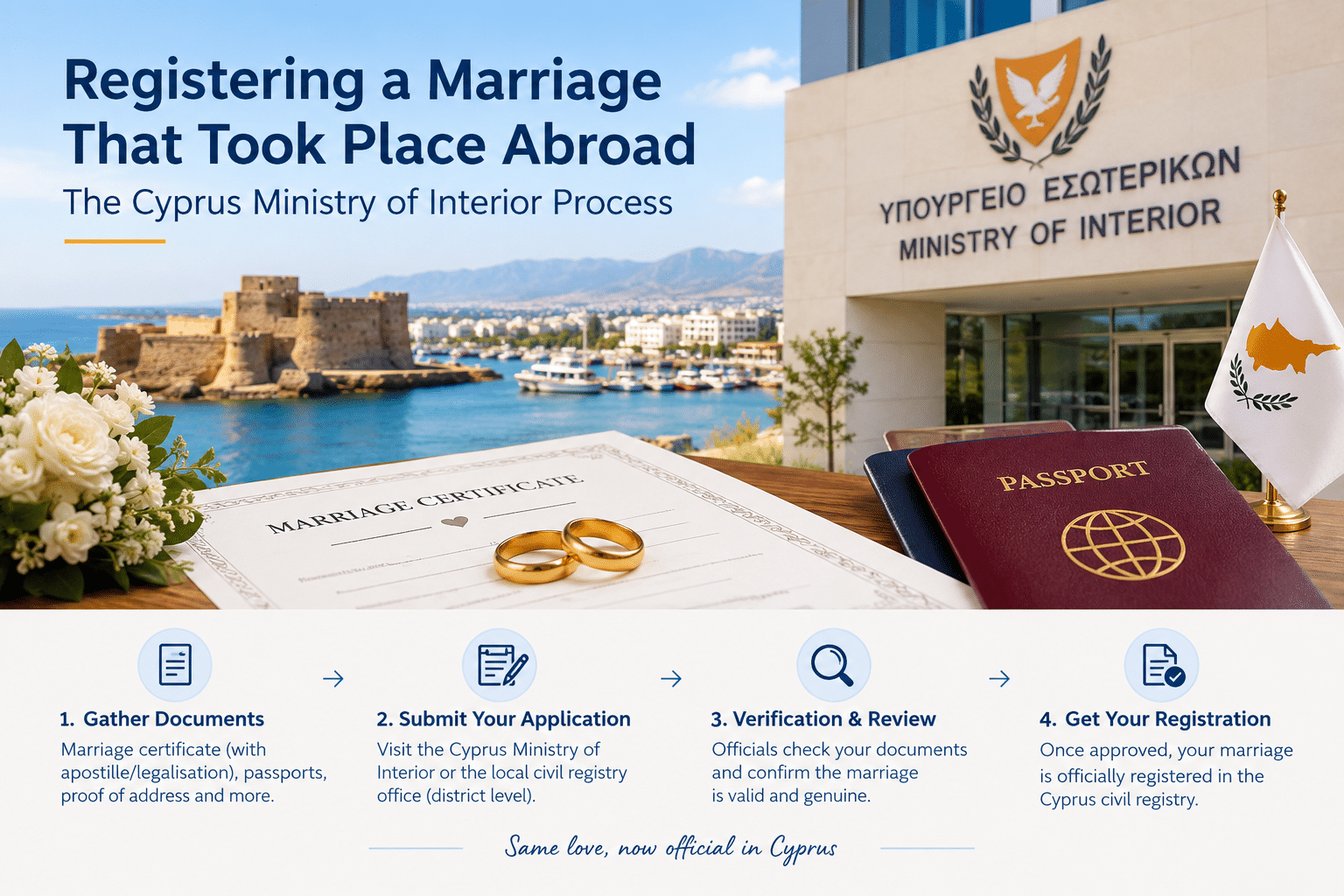
Registering a Marriage That Took Place Abroad: The Cyprus Ministry of Interior Process
Short answer: yes, register it. Anyone asking how to register a foreign marriage in Cyprus with the Ministry of Interior is up against a process that isn’t automatic. A wedding that’s valid overseas doesn’t slot itself into Cypriot civil records, and the Civil Registry and Migration Department (CRMD) is the office that records it. Below are the documents, the sequence and the spots where files stall.
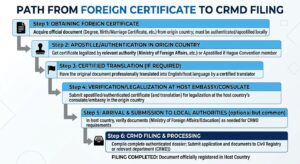
Registering a foreign marriage in Cyprus means submitting your apostilled, translated marriage certificate to the Civil Registry and Migration Department (CRMD), part of the Ministry of Interior, so the marriage is recorded in Cypriot files. Cypriot citizens must do it. Foreign couples typically need the certificate accepted for residence.
Do you have to register a foreign marriage in Cyprus?
You must register a foreign marriage in Cyprus if you’re a Cypriot citizen. According to Hatzidimitriou Virtual Law’s 2025 guide to recognising foreign marriages, Cypriot citizens who marry abroad are required to register with the CRMD, and skipping it can complicate civil status records, inheritance, taxation and children’s registration.
For foreign nationals, it depends on why you need the marriage recognised. A residence application, a family-reunification file or an employer’s paperwork will usually ask for the same apostilled, translated certificate, even when no Cypriot record is being updated.
It isn’t automatic.
Or maybe I should say it this way: valid abroad doesn’t mean recorded here.
This guide covers civil marriages that were valid where they took place. It does NOT cover weddings held inside Cyprus or religious-only ceremonies with no civil record. It works best when your certificate comes from an Apostille Convention country. It won’t help if the marriage was polygamous or involved a minor, since Cyprus can refuse those on public-order grounds.
https://hatzidimitriouvirtuallaw.com/category/acquisition-of-cypriot-citizenship/
Which documents does the CRMD expect?
The documents needed to register a foreign marriage in Cyprus are the original certificate, an apostille or legalization, and an official translation. According to the Asylum Information Database’s 2026 Cyprus report, Hague Convention countries need an apostille, other countries need legalization by their foreign ministry or a Cypriot embassy, and translation into Greek or English applies in both cases.
That report covers beneficiaries of international protection, but its apostille rule matches what Cypriot law firms describe for everyone else.
Photocopies won’t do. Prepare these:
- The original marriage certificate, as a certified true copy if the issuer offers one
- An apostille or embassy legalization, depending on the issuing country
- A translation by a recognised translator into Greek or English
- Passports or Cypriot ID cards for both spouses
Most people assume the certificate of no impediment belongs in this file. On the sources I checked, it doesn’t. That document is for marrying inside Cyprus, where lawyers-cyprus.com says it can’t be older than three months. Skip it here unless a specific office asks.
What most guides skip is the document-version problem. Some countries issue a decorative or religious certificate alongside a government-registered one, and only the government-issued civil record can be apostilled. Confirm which one you hold before you queue at the apostille office.
How do you register the marriage, step by step?
To register a foreign marriage in Cyprus, follow these steps:
- Get the original marriage certificate from the issuing authority.
- Obtain an apostille or embassy legalization.
- Have it translated into Greek or English.
- Gather passports or IDs for both spouses.
- Submit to the CRMD in Nicosia, a District Administration Office, or a Cypriot embassy.
Here’s the thing: submission is the easy part. You’ve got the certificate, it’s apostilled, and the translation isn’t ordered yet. That gap is where most delays begin.
Look — if you’re living abroad, don’t book a flight to Nicosia. A Cypriot embassy or consulate can take the application, and so can an authorised lawyer in Cyprus. Embassy processing times vary by mission, so ask before you rely on one.
Nicosia isn’t your only option.
How do apostille rules change by country?
India, the UK and Romania are Apostille Convention members, so their certificates follow the single-stamp route. Pakistan joined in 2023, which should simplify things, but check with the CRMD before assuming a standard apostille clears without extra steps.
Apostille vs embassy legalization: an apostille is better suited for certificates from Apostille Convention countries because a single stamp settles authenticity. Legalization works better when the issuing country isn’t a party. The key difference is the number of offices your certificate passes through.
Quick Comparison
| Option | Best For | Key Benefit | Limitation |
|---|---|---|---|
| Apostille | Certificates from Convention countries | One stamp, no embassy chain | Issuing country must be a party |
| Embassy legalization | Non-Convention countries | Works where apostilles don’t exist | Slower, several offices |
| Self-filing | Cypriot citizens with clean documents | No legal fees | You own every error |
| Lawyer-filed | Applicants abroad, mixed-nationality cases | Remote filing, error checks | Legal fees |
Some experts argue you should hire a lawyer from day one. That’s valid for non-Convention countries and mixed-nationality files. But if you’re a Cypriot citizen holding a clean UK or Romanian certificate, filing yourself is realistic.
Here’s an opinion some readers will resist: order two apostilled copies. The extra stamp costs little compared with restarting the chain if one copy is returned or a residence file needs its own.
How long does it take, what does it cost, and which mistakes get files returned?
Fees vary, and I’d rather not quote figures I couldn’t check against a current CRMD schedule. Budget for the apostille fee in the issuing country, translator rates per page, and legal fees if you hire help.
I’ve seen conflicting timelines. Some law-firm pages promise four to eight weeks, while others describe waits that depend on the file. My read is to plan for two months and treat anything faster as a bonus.
Applicants in expat forums often describe the home-country apostille queue as the slowest step, not the Cypriot filing. These mistakes get files sent back:
- Submitting a photocopy instead of the certified original
- Reversing the order: apostille first, then translation
- Using a translator who isn’t officially recognised
- Assuming a religious or decorative certificate counts
Small errors, big delays.
Quick answers
Q: What’s the best way to register a foreign marriage if I live outside Cyprus?
A: File through a Cypriot embassy or consulate, or hire an authorised lawyer in Cyprus. Both avoid a trip to Nicosia.
Q: How do I know if I need an apostille or embassy legalization?
A: Check whether the issuing country is an Apostille Convention party. If yes, get an apostille. If not, use foreign-ministry and Cypriot embassy legalization.
Q: Should I translate the certificate before or after the apostille?
A: The usual order is apostille first, then translation. Confirm with the CRMD if your translator wants to certify the apostille page too.
Q: Why does Cyprus refuse some foreign marriages?
A: Cyprus recognises marriages valid where performed unless they’re contrary to public order, such as polygamous or underage unions. Missing or unofficial documents also stall files.
Q: When should I register after marrying abroad?
A: As soon as you hold the apostilled, translated certificate. I couldn’t verify a fixed deadline, so don’t wait. Delays complicate records, inheritance and children’s registration.