
Canggu, Bali — Is It Still Worth Visiting in 2026?
The honest, no-filter breakdown of what Canggu actually is, which pocket of it suits you, and how to get there without being fleeced at the airport.
Our verdict: 8.2 / 10. Canggu is genuinely worth visiting — but only if you know which part of it suits you. It’s got a world-class café scene, consistent surf, and an energy unlike anywhere else in Southeast Asia. The Instagram version is real, just not the whole story.
What Canggu Actually Is
Canggu (pronounced “Chong-goo”) is a coastal village in Badung Regency on Bali’s southwest coast, roughly 9km north of Seminyak. Once a quiet stretch of black-sand beach and rice paddies, it’s now Bali’s most talked-about neighbourhood — a loose cluster of sub-villages with surf breaks, specialty cafés, and a dense digital nomad community.
The draw has always been a specific combination: a real surf break, rice paddy scenery, strong café culture, and a pace that sits somewhere between Kuta’s chaos and Ubud’s spiritual retreat. That mix attracted a wave of digital nomads from around 2016 onward, and the infrastructure built around them — co-working spaces, fast fibre internet, flat-white coffees at 7am — never really left.
According to the Bali Tourism Board, Bali received over 5.27 million international tourists in 2023, with Canggu consistently ranking among the top three most photographed coastal neighbourhoods on the island.
Here’s the thing: most travel articles treat Canggu as one coherent place. It isn’t.
Getting the neighbourhood wrong is the single biggest mistake first-time visitors make. Base yourself in the wrong pocket and you’ll spend every morning in a gridlocked scooter queue wondering why everyone raves about this place.
The Four Neighbourhoods — And Why It Matters
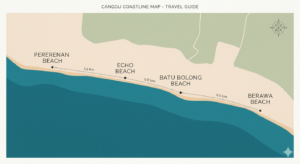
Most articles lump Canggu together as though it’s a single destination. It’s not. There are four distinct pockets, and they feel completely different from each other.
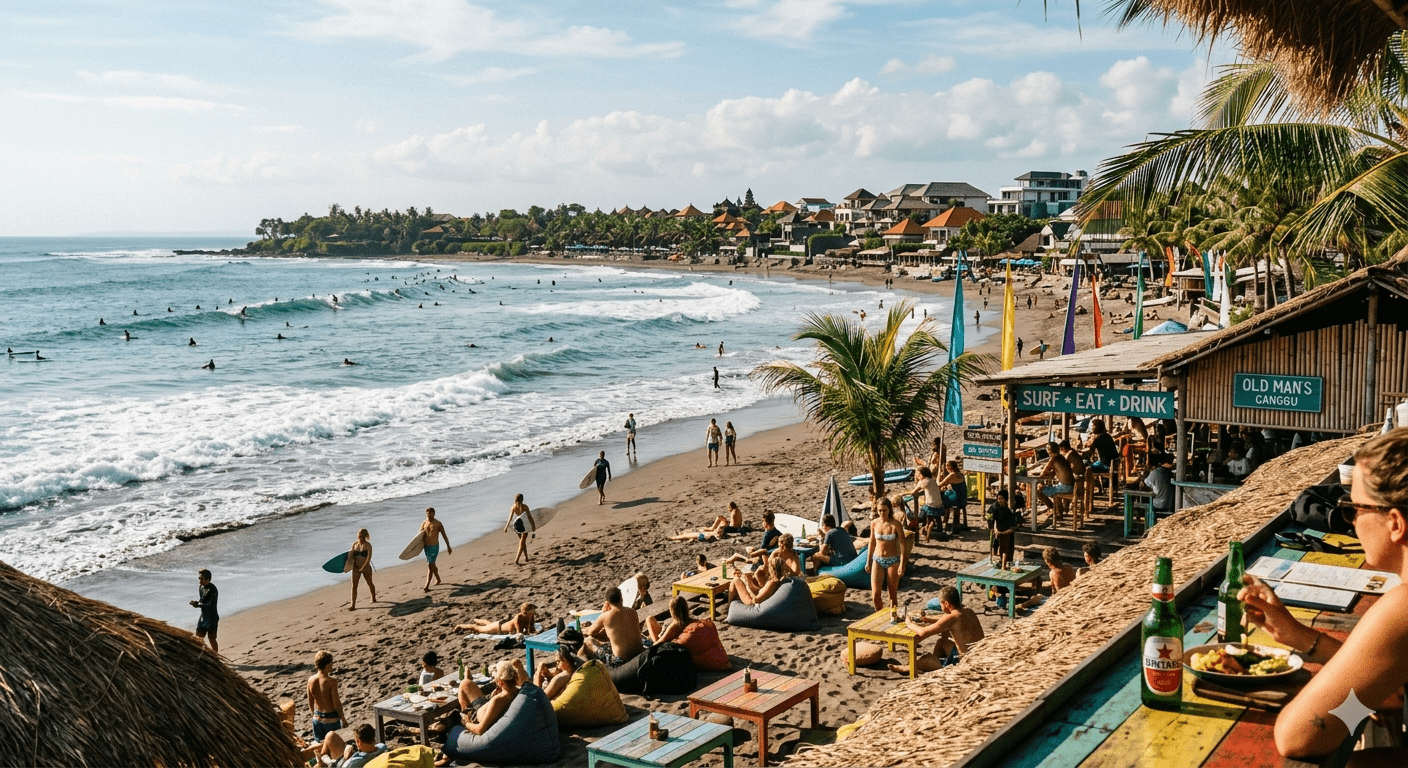
Batu Bolong is the original village — the most walkable area, home to Old Man’s bar, Batu Bolong Beach, and the highest density of cafés and surf schools. It gets crowded, but it retains genuine character. This is the right base for first-timers and surf beginners who want to be central to everything.
Echo Beach sits about five minutes northwest by scooter. It’s rawer, has fewer influencers, and offers arguably the better wave. The vibe leans more local. It’s getting developed fast, but it remains the pick for serious surfers and travellers on tighter budgets who don’t need to be surrounded by things.
Berawa is slightly inland and rapidly developing. Most co-working spaces are located here, along with Finn’s Beach Club. The roads are cleaner, the pace more residential, and it’s the strongest option for digital nomads on longer stays. The beach here is windier and less swimmable than Batu Bolong.
Pererenan sits north of Echo Beach and is increasingly popular with people fleeing the Batu Bolong crowds. Rice paddies still exist here. There are fewer tourists, an emerging restaurant scene, and the kind of quiet that used to define all of Canggu. If you’re visiting for two weeks or more and want to feel like a resident rather than a tourist, this is your area.
Or maybe I should say it this way: the word “Canggu” on a booking site is nearly meaningless without knowing the sub-area. A villa listed as Canggu could be five kilometres from the beach you’re planning to surf every morning.
How to choose your base — quick steps:
- Decide your priority: surf access, nightlife, remote work, or quiet.
- Match that priority to the neighbourhood: surf → Echo Beach, work → Berawa, first-timer → Batu Bolong, peace → Pererenan.
- Search Airbnb or Booking.com filtered to that specific village name — not just “Canggu.”
- Book at least three nights minimum. Moving accommodation in Canggu with luggage is a logistical headache.
Rent a scooter for a day (IDR 70,000–100,000) and ride through all four areas before committing. You’ll understand immediately why the geography matters so much.
Pros and Cons — The Part Most Guides Skip
I’ve seen conflicting data across travel communities — some describe Canggu as “ruined by overtourism,” while others still rate it the best base on the island. My read: both are partially right, and which version you encounter depends almost entirely on when you go and which neighbourhood you’re in.
What Canggu does well:
- World-class café and food scene at every budget level
- Consistent, accessible surf for all experience levels
- Strong digital nomad infrastructure with fast, reliable internet
- A more relaxed atmosphere than Kuta or Seminyak
- Excellent sunset spots along the full coastline
- A genuinely welcoming international community
- Co-working spaces that rival dedicated office setups
What nobody warns you about:
- Traffic on Jalan Batu Bolong between 4–7pm is genuinely brutal
- The area is not walkable — a scooter or Gojek is not optional
- Rice paddies are disappearing fast under new construction
- The beach has black sand and strong rip currents — not suitable for casual swimming
- Prices have risen 30–40% since 2020
- Tourist taxi scams at Ngurah Rai Airport are widespread and persistent
- Peak dry season (July–August) feels noticeably overcrowded
“The version of Canggu on TikTok exists. It’s one café, one hour, on a Tuesday in low season. The rest of the time it’s gridlock and IDR 120,000 smoothie bowls.”
What most guides skip entirely is the rip current situation. Canggu’s beaches — particularly Echo Beach — have strong, unpredictable rips. Travellers who swim here without surfing experience get into difficulty every single season. If you’re not surfing, treat the water as a visual backdrop, not a swimming pool.
Look — if you’re a solo traveller or couple who can ride a scooter, aren’t expecting white sand, and want a creative international atmosphere at reasonable cost, Canggu delivers. But it won’t deliver what it doesn’t have.
Canggu vs Seminyak — Which One Fits Your Trip?
Canggu vs Seminyak: Canggu is better suited for digital nomads, surfers, and longer stays because it’s less commercially dense and has a surf break on its doorstep. Seminyak works better when you want upscale restaurants, boutique shopping, and nightlife within walking distance. The key difference is pace — Canggu is sprawling and low-key; Seminyak is compact and polished.
| Factor | Canggu | Seminyak | Winner |
|---|---|---|---|
| Surf access | Multiple breaks, beginner-friendly schools | No surf break | Canggu |
| Walkability | Low — scooter essential | Higher — core area walkable | Seminyak |
| Nightlife | Chill sunset bars, low-key clubs | Rooftop bars, proper club scene | Seminyak |
| Remote work | Excellent co-working infrastructure | Limited options | Canggu |
| Price | Mid-range, gap narrowing | More expensive overall | Canggu (slightly) |
Some travel writers argue Seminyak is the superior pick for first-timers because of its walkability. That’s valid if you’re on a four-night trip and want everything compact. But if you’re staying seven or more days and want to understand Bali’s current creative culture, Canggu is the more interesting base.
For solo travellers, couples, and digital nomads on a 7–14 day Bali trip, Canggu is usually the best base — provided you’re comfortable on a scooter and not expecting a swimming beach. For families with young children or travellers wanting hotel-style luxury within a walkable area, Nusa Dua or Seminyak is a stronger fit. Ubud remains the pick for cultural immersion without beach access.
What to Actually Do in Canggu
The unmissable landmarks
Deus Ex Machina on Jalan Batu Mejan is Canggu’s most singular space — motorcycles, custom surfboards, espresso, vinyl, and live music under one roof. It’s a concept that genuinely shouldn’t work and yet is the most cohesive creative environment on the island. Go Sunday evening for the market and music sessions.
Batu Bolong Beach is the social anchor of the area. Watch the surfers, grab a Bintang at Old Man’s, and time your visit for 6pm to catch the sunset through the small temple — Pura Batu Bolong — that sits right on the sand. Bring a sarong. It’s an active worship site and a genuinely beautiful place as the light drops.
Finn’s Beach Club in Berawa is the slickest day-club experience in Canggu. Multiple pools, a 60-metre water slide, full cocktail menu. Day passes range from free-with-minimum-spend to IDR 350,000 or more on peak weekends. Not a budget move — but worth one afternoon.
Surf lessons and conditions
Echo Beach and Batu Bolong offer beach breaks that work year-round. Dry season (April–October) delivers cleaner, more consistent swell. Most schools charge IDR 250,000–400,000 for a two-hour beginner lesson including board rental. Rip Smart Surf School and Odysseys Surf School both carry solid reputations among the traveller community.
The food and café scene
This is where Canggu genuinely earns its reputation. Warung-style local food — nasi goreng, mie goreng, babi guling — runs IDR 25,000–60,000 per plate. Trendy cafés with cold brew and açaí bowls cost IDR 80,000–160,000 per item. You can eat extremely well on IDR 300,000 per day, or spend three times that without quite noticing how.
Two spots that appear reliably in serious local recommendations: Betelnut Café for all-day brunches and Shady Shack for vegan food that actually tastes like food. Neither needs a reservation on most days.

Getting Around Without Getting Scammed
Airport warning: Touts at Ngurah Rai arrivals — some wearing official-looking branded vests — will quote IDR 400,000–600,000 for a taxi to Canggu. The Grab or Gojek app price for the same journey is IDR 90,000–140,000 depending on traffic and time of day. Walk past all of them, exit the terminal completely, move to the car park area, and book via app. It’s worth the extra three minutes.
Scooter rental costs IDR 70,000–100,000 per day from any local rental shop, or ask your accommodation to arrange it. You technically need an International Driving Permit for a motorbike in Bali. Enforcement is inconsistent, but fines at police checkpoints for foreigners without documentation run IDR 200,000–500,000. Helmet on, always — both for safety and because checkpoints will fine you for that too.
Gojek and Grab both work well throughout Canggu. Local ojek drivers occasionally block pickups near Batu Bolong Beach. If your driver can’t reach the pin, have them meet you one junction away from wherever you’re standing. The apps give you transparent, pre-agreed pricing — use them for any journey you don’t want to negotiate manually.
Walking is only realistic within Batu Bolong village itself. Between neighbourhoods, the roads have no pavements, traffic moves fast, and the distances are further than they appear on Google Maps. Don’t plan on walking from Berawa to Echo Beach unless you enjoy scooter exhaust.
Traffic on Jalan Batu Bolong between 4–7pm is a genuine gridlock. If you’re based at the Echo Beach or Berawa end and planning to be near central Canggu during those hours, add 25–40 minutes to your estimate. Plan around it rather than through it.
Where to Stay in Canggu and What It Costs
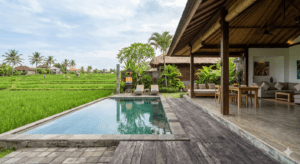
Canggu runs the full range from IDR 120,000 dormitory beds to IDR 5,000,000+ private pool villas. The sweet spot for most visitors is a private room in a small guesthouse at IDR 300,000–600,000 per night, or a two-bedroom villa on Airbnb at IDR 1,000,000–2,000,000 per night. Prices have risen noticeably since 2022 — budget slightly more than you think you need.
| Type | Price per night |
|---|---|
| Dorm bed (hostel) | IDR 100,000–200,000 |
| Private guesthouse room | IDR 300,000–700,000 |
| Boutique hotel | IDR 700,000–2,000,000 |
| Private villa (2 bedroom) | IDR 1,200,000–3,500,000 |
| Luxury villa (4 bedroom, pool) | IDR 4,000,000+ |
Book in Batu Bolong for maximum walkability and beach proximity. Choose Berawa for quieter roads, more space, and co-working access. Pick Pererenan if you’re staying two weeks or more and want local rhythms over tourist density. For peak July–August travel, book at least six to eight weeks in advance — the most popular accommodation sells out well before you’d expect.
Frequently Asked Questions
Q: What’s the best time of year to visit Canggu? A: May through September is the dry season — lower humidity, consistent surf, and cleaner skies. July and August are the peak crowd months. For fewer tourists with still-decent weather, aim for May–June or September.
Q: How do I get from Bali airport to Canggu without getting overcharged? A: Download Grab or Gojek before you land. Walk past all airport taxi touts, exit the terminal, and book a ride through the app. The fare should be IDR 90,000–140,000. Never accept a quote above IDR 200,000.
Q: Should I stay in Canggu or Seminyak as a first-time Bali visitor? A: Canggu if you surf, work remotely, or want a creative and relaxed atmosphere. Seminyak if you want walkability, upscale restaurants, and a compact itinerary. Both are good choices — they serve different travel styles.
Q: Is Canggu actually still worth visiting after all the hype? A: Yes, but it’s changed significantly since 2019. Prices are up, rice paddies are disappearing, and the busiest streets get crowded. The surf, food scene, and atmosphere remain genuinely excellent. Manage your expectations going in and it still delivers.
Q: When should I avoid visiting Canggu? A: Peak July–August if crowds bother you — the area is noticeably more congested and accommodation is pricier. Wet season (November–March) brings daily rain and choppier surf, though it’s quieter and cheaper by 20–30%.
The Bottom Line
The surf is real. The food scene is genuinely excellent. The energy — that specific mix of creative internationals, local Balinese culture, and black-sand coastline — doesn’t exist anywhere else in Asia quite like this.
Go. Enjoy it. Just leave the Instagram version of the place at home, and you’ll have a far better time than those who brought it with them.