
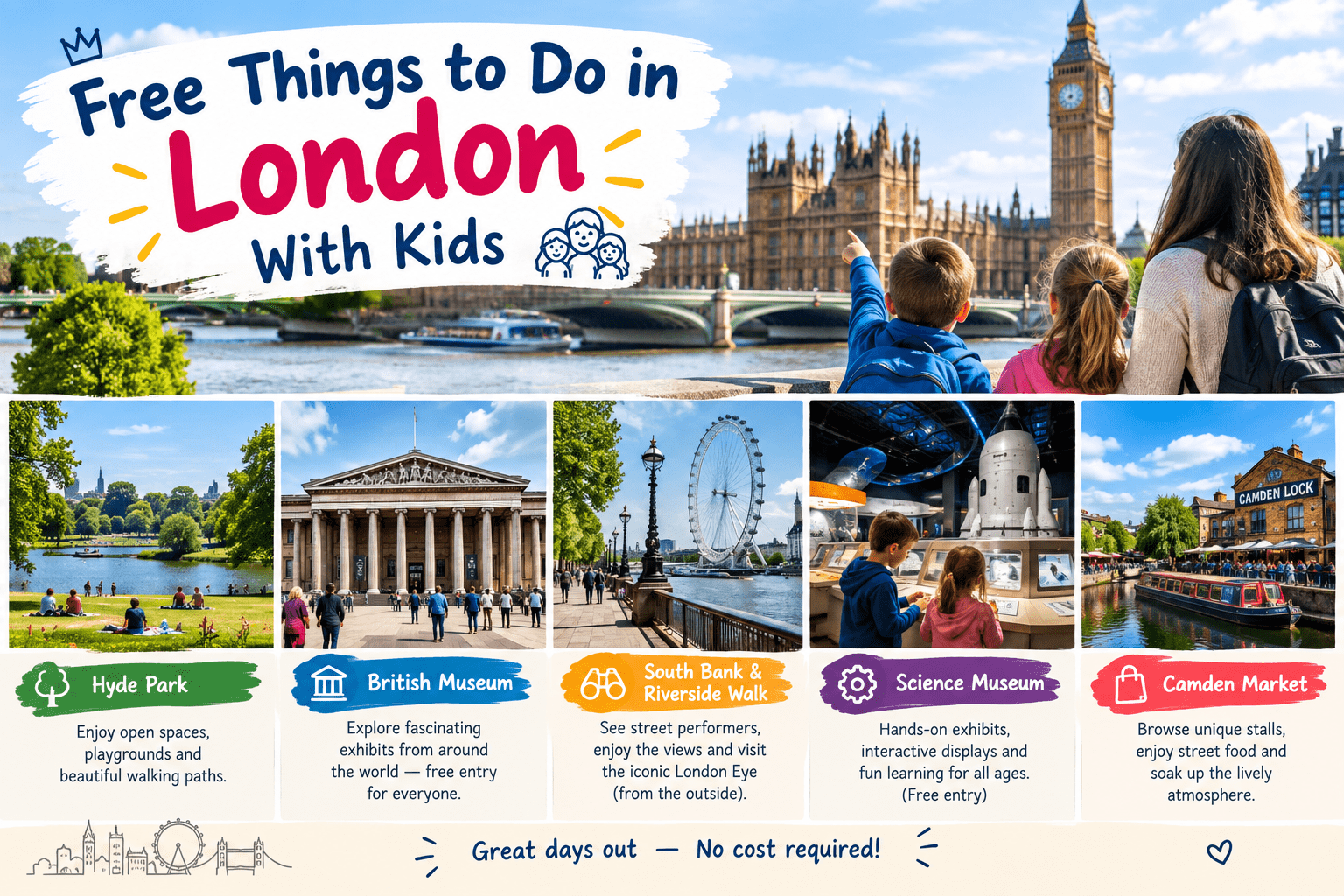
Free things to do in London means visiting attractions, museums, parks, markets and events that charge no entry fee — and in London, that list runs far deeper than most people realize. Unlike Paris or Florence, where free museum entry is often limited to the first Sunday of the month, London’s major national museums are free every day of the year, no membership card and no catch.
Here’s the thing: most guides stop at the same five museums and call it a list. That leaves out markets, free walks, street art, free live events, and the transport math that actually determines what your trip costs. This version covers all of it.
The Best Free Museums in London (And When to Actually Go)
The core group — British Museum, National Gallery, Tate Modern, V&A, Natural History Museum, Science Museum, Tate Britain, National Portrait Gallery — are all free, permanently, no exhibition membership required. Beyond that core group, there’s a longer tail most first-time visitors never hear about: the Wallace Collection (an entire townhouse of European art and armor), Sir John Soane’s Museum (a genuinely strange and wonderful architect’s home crammed with antiquities), the Horniman Museum in Forest Hill (natural history plus a free aquarium), the Museum of London Docklands, the National Army Museum, and the Museum of the Home in Hackney.
What most guides skip is timing. The British Museum gets crowded April through August, and a free timed ticket booked in advance saves real queue time in those months. The Natural History Museum works the same way — a pre-booked free slot skips a 30-45 minute walk-up line on weekends. Smaller museums like the Soane’s Museum and the Wallace Collection almost never need booking, which makes them good backup plans when the big-name museums are slammed.
Quick Comparison
| Option | Best For | Key Benefit | Limitation |
|---|---|---|---|
| British Museum | History, artifacts | 8 million objects, no booking most months | Very crowded peak season |
| Tate Modern | Contemporary art | Free viewing level, no timed entry | Turbine Hall installations rotate |
| Natural History Museum | Families, kids | Dinosaur hall, blue whale | Weekend queues without booking |
| Sir John Soane’s Museum | A quieter, offbeat afternoon | Genuinely unique interior, rarely crowded | Small — closes when full on busy days |
| V&A East (Stratford) | Avoiding South Kensington crowds | Opened April 2026, no ticket needed | Fewer headline pieces than the original V&A |
One thing worth knowing: several museums run free “late” evenings. The British Museum opens late on Fridays. Tate Modern and Tate Britain both run free lates on Friday and Saturday evenings, usually themed around a current exhibition. Quieter, better lit for photos, and honestly a better experience than fighting a Saturday afternoon crowd.
Free Markets and Street Life
Borough Market is the obvious one — free to wander, though you’ll pay for the food itself. Less obvious: Leadenhall Market, a covered Victorian arcade near the Bank of England that doubled as a filming location for the Harry Potter films, costs nothing to walk through and photograph. Camden Market is free to browse, and Old Spitalfields Market in the East End mixes vintage stalls with genuinely good street art nearby in Shoreditch.
Speaking of street art — Brick Lane and the surrounding Shoreditch streets have some of the best free open-air art in Europe, changing regularly as new pieces go up over old ones. It’s worth checking recent photos before you go, since specific murals don’t last forever.
Quick note: markets get busiest on weekends, especially Saturday afternoons. If you want photos without crowds, weekday mornings are the move.
Free Parks, Views and Walks

London’s Royal Parks — Hyde Park, Regent’s Park, St James’s Park, Richmond Park, Greenwich Park — cost nothing and stay open daily, typically dawn to dusk. Richmond Park stands out because it’s genuinely wild: several hundred deer roam freely across nearly 2,500 acres, which is a different experience than a manicured city park.
For views, Primrose Hill gives you a free skyline shot that rivals most paid viewpoints. The Sky Garden offers a similar deal at a different scale — free entry, but you need to book a slot in advance since walk-ups aren’t guaranteed. Greenwich Park adds the Royal Observatory’s outdoor grounds and a genuinely striking view back over Canary Wharf and the river.
The South Bank walk, from Westminster Bridge to Tower Bridge, is free and arguably the single best value activity in London: you pass the London Eye, the Globe Theatre, Tate Modern, Shakespeare’s Globe, and Borough Market without spending a penny, and it’s spectacular at sunset.
Free Things to Do With Kids
Families searching this keyword usually want a slightly different list than solo travelers. The Natural History Museum’s dinosaur hall and blue whale model are the reliable kid-pleasers. The Science Museum’s main galleries are free, though its interactive Wonderlab section is ticketed — worth knowing before you promise kids the whole museum is free. The Transport Museum in Covent Garden offers free tickets for children, and several city farms (Vauxhall City Farm, Hackney City Farm, Mudchute Park and Farm) let kids see real animals at zero cost.
Playgrounds inside the Royal Parks are free, and Coram’s Fields near King’s Cross is a park specifically designed for children and families, adults only admitted with a child.
Free Events, Ceremonies and Live Culture
The Changing of the Guard at Buckingham Palace is free to watch, though it doesn’t run every single day — check the published schedule before planning around it. Free comedy nights, open mic gigs, and even free TV recordings happen regularly across London; websites like the BBC’s ticket portal list free studio audience slots for shows recorded in London. Church concerts, particularly lunchtime recitals at St Martin-in-the-Fields and St Paul’s Cathedral, are frequently free or donation-based.
Seasonal free events add another layer — summer festivals in the Royal Parks, Christmas lights switch-ons on Oxford Street and Regent Street, and Bonfire Night displays in parks across the city. These shift year to year, so checking local listings closer to your travel dates matters more than for the permanent attractions.
Getting Around for Less (Since Travel Isn’t Free)
Attractions being free doesn’t mean the day is free — you’ll still pay for transport. A contactless card or Oyster card caps your daily spend on Tubes and buses automatically, so you’re never charged more than the daily cap regardless of how many journeys you take. For a genuinely free-only day, walking between nearby attractions (like the South Bank chain above) cuts transport costs close to zero.
A Real Free Weekend in London: What It Actually Looks Like
To plan a genuinely free weekend in London, follow this sequence:
Day 1: 1. Morning at the British Museum. 2. Walk to Leadenhall Market. 3. Afternoon on the South Bank, ending at Tate Modern. 4. Sunset at a pre-booked Sky Garden slot.
Day 2: 1. Morning in Richmond Park or Greenwich Park. 2. Borough Market for a wander. 3. Afternoon at the Natural History Museum or V&A. 4. Evening at a free museum “late” (check what’s running that Friday or Saturday).
Total entry cost across both days: £0. You’ll pay for food and transport caps, but nothing for a single attraction.
Short version, because it earns its own line: this genuinely stretches to a full week if you rotate museums with parks and markets.
What Most Guides Get Wrong About “Free” London
Some guides treat this topic as a static checklist. The more useful framing: pair the big museums with markets, parks, one paid viewpoint booking, and a free evening event, and you can fill 5+ days without touching an attraction budget. Most people assume the free version of London is a stripped-down version of the paid trip — the visitor numbers say otherwise. London’s free national museums pull some of the highest annual visitor totals of any museums worldwide, precisely because free-and-excellent isn’t a compromise here.
I’ve seen some guides argue the V&A East in Stratford is a better use of time than the original South Kensington site, since it’s quieter and just as free. That’s fair advice on a second trip. On a first visit, though, the original V&A’s scale and range is still worth the crowd.
This guide covers central London’s major free attractions, kids’ options, markets and a workable multi-day itinerary. It does not cover day trips outside London (Windsor, Bath, Oxford) or one-off seasonal events tied to specific dates, which shift too much year to year for a static list.
Frequently Asked Questions
Q: What’s the best free thing to do in London?
A: The British Museum, for scale and no booking requirement most of the year — pair it with the South Bank walk for a full free day.
Q: How do I visit London museums for free?
A: Just walk in. Major national museums charge nothing for entry; only special or temporary exhibitions charge separately.
Q: Should I book free museum tickets in advance?
A: Yes for the British Museum and Natural History Museum during April–August — it skips long walk-up queues on busy days.
Q: What free things can I do in London with kids?
A: The Natural History Museum, the Science Museum’s free galleries, city farms, and free children’s tickets at the Transport Museum.
Q: Is London expensive even if attractions are free?
A: Transport and food still cost money, though a daily contactless travel cap and market-stall food keep costs manageable.
Q: When should I visit museums to avoid crowds?
A: Weekday mornings, or free “late” evenings run by the British Museum (Fridays) and the Tate galleries (Friday/Saturday).
Q: Are there free things to do in London at night?
A: Yes — museum lates, free church concerts, and free comedy or open mic nights across venues in Shoreditch and Soho.
Q: How many days do I need to see London’s free attractions?
A: A realistic 3-5 days covers the major museums, parks, markets and one free evening event without repeating anything.
This guide focuses on genuinely free, no-ticket-cost attractions and activities in central and greater London. It won’t help if you’re planning day trips outside the city or chasing one-off seasonal freebies tied to specific dates — those change too often for a static guide to track reliably.