
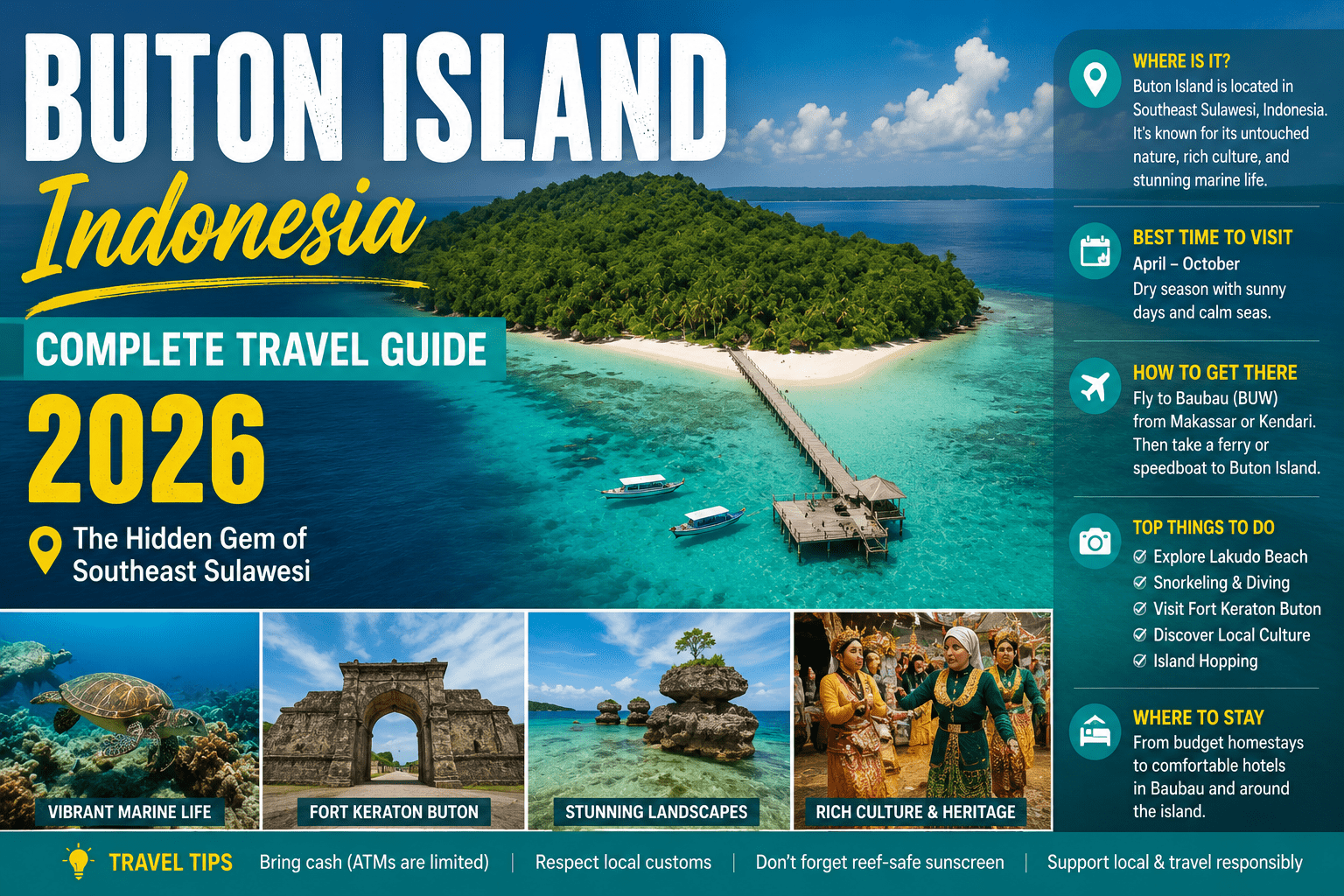
Buton Island Indonesia What Every Traveler Needs to Know Before Going
Buton Island is one of those places that keeps showing up in “Indonesia’s hidden gems” lists, then disappears before anyone explains how to actually get there.
Here’s what it is in plain terms: Buton Island (also spelled Butung) is a large island in Southeast Sulawesi province, Indonesia, sitting in the Banda Sea between Sulawesi and Maluku. It’s home to the historic Buton Sultanate, one of the longest-running sultanates in Indonesian history, and the city of Baubau serves as its main urban hub and arrival point.
It’s not Bali. It’s not Raja Ampat. And that’s exactly the point.
DEFINITION SNIPPET BLOCK (Block A — Featured Snippet Target)
Buton Island Indonesia is a large island in Southeast Sulawesi province, located in the Banda Sea. It is historically significant as the seat of the Buton Sultanate and is known for its massive hilltop fortress, coral reef diving, and near-complete absence of international tourist infrastructure. The main gateway city is Baubau, served by Baubau Airport (BUW).
Why Visit Buton Island — and Who It’s Actually Right For
Most people who search for Buton Island have already done Bali, maybe Lombok, possibly Komodo. They’re hunting for something different — fewer tourists, more texture, the sense that a place hasn’t been packaged yet.
Buton delivers that. But it comes with trade-offs you should understand upfront.
The island has no developed tourist strip. English signage is scarce. Accommodation options are basic outside of Baubau city. If you’re expecting the ease of Ubud or the comfort of a Labuan Bajo resort — you won’t find it here. What you will find is a place that feels genuinely unfiltered, where local life isn’t arranged around foreign visitors.
Some experts argue that undeveloped destinations are automatically more “authentic.” That’s valid to a point. But authenticity without infrastructure can also mean real frustration — missed connections, language barriers, and no fallback plan. Know which traveler you are before booking.
Look — if you’re someone who researches ferry timetables the night before and considers that fun, Buton is made for you. If that sentence made you anxious, plan a different first Sulawesi stop like Makassar or Wakatobi with a dive operator.
How to Get to Buton Island
Getting here takes planning. There’s no direct flight from Bali or Jakarta to Baubau — you connect.
The main air route goes through Makassar (UPG), which has daily connections from Jakarta and Bali. Wings Air (a Lion Air subsidiary) operates the Makassar–Baubau route on most days, with flight time around 1.5 hours. Garuda Indonesia has operated the route seasonally, though availability fluctuates — check directly before assuming.
Flying is the fastest option. But it’s not the only one.
Pelni, Indonesia’s national ferry company, runs inter-island ships that stop at Baubau as part of longer eastern Indonesia routes. Travel times are long — Makassar to Baubau by Pelni ferry takes roughly 12–16 hours depending on the vessel and schedule. It’s worth doing once if you have the time. The experience of crossing those waters overnight is something no airport lounge replicates.
Quick note: Pelni schedules change seasonally and aren’t always updated reliably on third-party sites. Check pelni.co.id directly before planning your ferry leg.
HOW-TO SNIPPET BLOCK (Block B — Featured Snippet Target): To get to Buton Island Indonesia, follow these steps:
- Fly to Makassar (Sultan Hasanuddin Airport, UPG) from Jakarta or Bali.
- Book a connecting Wings Air flight from Makassar to Baubau (BUW).
- Arrange airport transfer or taxi to your accommodation in Baubau city.
- Use local angkot (minibuses) or ojek (motorbike taxis) to explore the island.
Top Things to Do on Buton Island
Buton Fortress (Benteng Keraton Buton)
This is the main reason most travelers make the trip.
Buton Fortress is considered one of the largest traditional fortresses in the world by perimeter length — UNESCO has previously nominated it for heritage consideration, and Indonesia’s own cultural registry lists it as a protected national site. The walls stretch over 2 kilometers, enclosing what was once the heart of the Buton Sultanate. Inside, you’ll find old royal residences, mosques, graves of former sultans, and views over Baubau city that are genuinely hard to describe without sounding like a brochure.
Most people assume the fortress is a ruin you walk around the outside of. The data says otherwise — much of the inner complex is walkable and inhabited, with families still living within the original walls. That detail changes the experience entirely.
Entrance is free or nominally priced (under IDR 20,000 as of 2025). Go early morning. The afternoon heat at the hilltop is serious.
Katembe Beach
Katembe is the island’s most photographed beach and the one you’ll see on every TripAdvisor listing. White sand, clear water, calm enough for swimming. It’s beautiful, genuinely, and not yet crowded in the way that beaches in southern Bali are.
Reach it by local speedboat from Baubau harbor — roughly 20–30 minutes. There’s basic food available on the beach, though don’t expect much beyond fried snacks and coconut water.
Malige Palace and Sultanate History
Or maybe I should say it this way — the Buton Sultanate history is the island’s single most underexplored angle in existing travel content.
The sultanate ran continuously for nearly 600 years, from around the 14th century until Indonesian unification. The Malige Palace, a traditional wooden structure built without nails using interlocking timber joints, still stands in Baubau and is open to visitors. The local guide who walks you through it will almost certainly speak limited English, but the building itself speaks clearly. Forty-five sultans. Six centuries. One island.
Diving and Snorkeling
Buton sits at the edge of the Coral Triangle, one of the most biodiverse marine regions on the planet. The reefs around the island — particularly near the smaller surrounding islands — are reported to be in strong condition compared to more-visited Indonesian dive sites.
I’ve seen conflicting data on this — some dive operators claim visibility regularly exceeds 20 meters, while independent diver accounts from 2024 note that specific sites vary considerably with season and rainfall runoff. My read is that dry season (April–October) is when you want to be here if diving is the priority.
There is no established dive center in Baubau as of mid-2026 in the way Wakatobi or Komodo has infrastructure. Arrange diving through your accommodation or contact operators in Makassar who run liveaboard routes past Buton.
COMPARISON BLOCK (Block C — Featured Snippet Target)
Buton Island vs Wakatobi for diving in Southeast Sulawesi: Buton is better suited for travelers combining cultural exploration with casual snorkeling because infrastructure is lower-cost and the fortress is unmatched. Wakatobi works better when diving quality and resort comfort are the primary goals — it has dedicated dive centers and established liveaboard routes. The key difference is specialization: Wakatobi is dive-first, Buton is everything-else-first with diving as a bonus.
QUICK COMPARISON TABLE
| Option | Best For | Key Benefit | Limitation |
|---|---|---|---|
| Buton Island | Cultural + budget | Unique history, uncrowded beaches | Limited English, few hotels |
| Wakatobi | Serious divers | World-class reef systems | Expensive, limited overland |
| Makassar | Urban base + transit | Full city infrastructure | No beaches, no fortress |
| Baubau City | First-night stay | Most hotels, restaurants, ATMs | Industrial feel |
Where to Stay on Buton Island
Budget accommodation in Baubau city is serviceable. RedDoorz has properties in Baubau — they’re basic, clean, reliable for the price point, and bookable online in advance, which matters when you’re landing in a city with limited English signage.
Beyond Baubau, accommodation is guesthouses (losmen) only. Katembe Beach has a small number of basic beach bungalows — expect cold water, intermittent WiFi, and mosquito nets. That’s the deal. Book through local contacts or ask your Baubau hotel to arrange it.
There’s no international hotel chain on the island. None. That’s either a problem or a feature, depending on who you are.
Best Time to Visit Buton Island Indonesia
The dry season runs roughly April through October. This is when you want to be here — lower humidity, less rain, better sea conditions for ferry crossings and snorkeling.
November through March is wet season. That said, Buton’s rainfall pattern isn’t as extreme as Java or Sumatra — you’ll get afternoon showers, not week-long monsoon downpours. Travelers who’ve visited in December report it’s manageable if you time outdoor activities to the morning.
Avoid national holiday periods (Lebaran/Eid al-Fitr and school holidays in June–July) if you’re particular about domestic crowds — Buton sees a spike in Indonesian domestic tourists during these windows.
Anyway, the sweet spot most independent travelers target is May–September. Good weather, manageable temperatures, and the fortress looks spectacular in clear light.
Practical Information — Visas, Money, Language, and Getting Around
Visas
Indonesian e-visa on arrival is available to most nationalities — check the latest requirements at imigrasi.go.id (Indonesia’s official immigration authority). As of 2025, the standard tourist visa on arrival covers 30 days, extendable once for another 30.
Money
ATMs exist in Baubau city — BRI and BNI branches are the most common. Bring enough cash before leaving the city. Card acceptance outside Baubau is essentially zero. Budget roughly IDR 200,000–400,000 per day for food and transport if you’re traveling independently on a tight budget.
Getting Around
Within Baubau, angkot (shared minibuses) cover main routes cheaply. Ojek (motorbike taxis) are faster and more flexible — agree on the price before getting on. Gojek doesn’t reliably operate in Baubau, though this may change. For reaching outer parts of the island, chartered transport (sewa mobil — rented car with driver) is the practical option and costs IDR 300,000–600,000 per day.
What most guides skip is this: travel times between points on Buton are longer than the map suggests. Roads outside the city center are often narrow, partially unpaved, and heavily used by trucks. Budget 30–40% extra time on any overland journey.
VOICE SEARCH / AEO Q&A SECTION
Q: What’s the best time to visit Buton Island Indonesia? A: April through October is the dry season and the most comfortable travel window. May to September is the sweet spot — good weather, clear skies, and better sea conditions for getting around by boat.
Q: How do I get to Buton Island from Bali? A: Fly from Bali (DPS) to Makassar (UPG), then take a connecting Wings Air flight to Baubau Airport (BUW). Total travel time is around 4–6 hours depending on the layover length.
Q: Should I visit Buton Island or Wakatobi for diving? A: If diving is your main goal, choose Wakatobi — it has established dive centers and better reef infrastructure. Buton is the better pick if you want cultural history combined with casual snorkeling.
Q: Why does Buton Island have a giant fortress? A: Buton Fortress was built by the Buton Sultanate, which ruled the island for roughly 600 years. The walls protected the royal seat of power and the community living within — it’s one of the largest traditional fortresses in the world by total perimeter.
Q: When should I book accommodation on Buton Island? A: Book Baubau city hotels at least one week in advance, especially during dry season (May–September) and Indonesian national holidays. Outside the city, contact guesthouses directly — most don’t appear on major booking platforms.