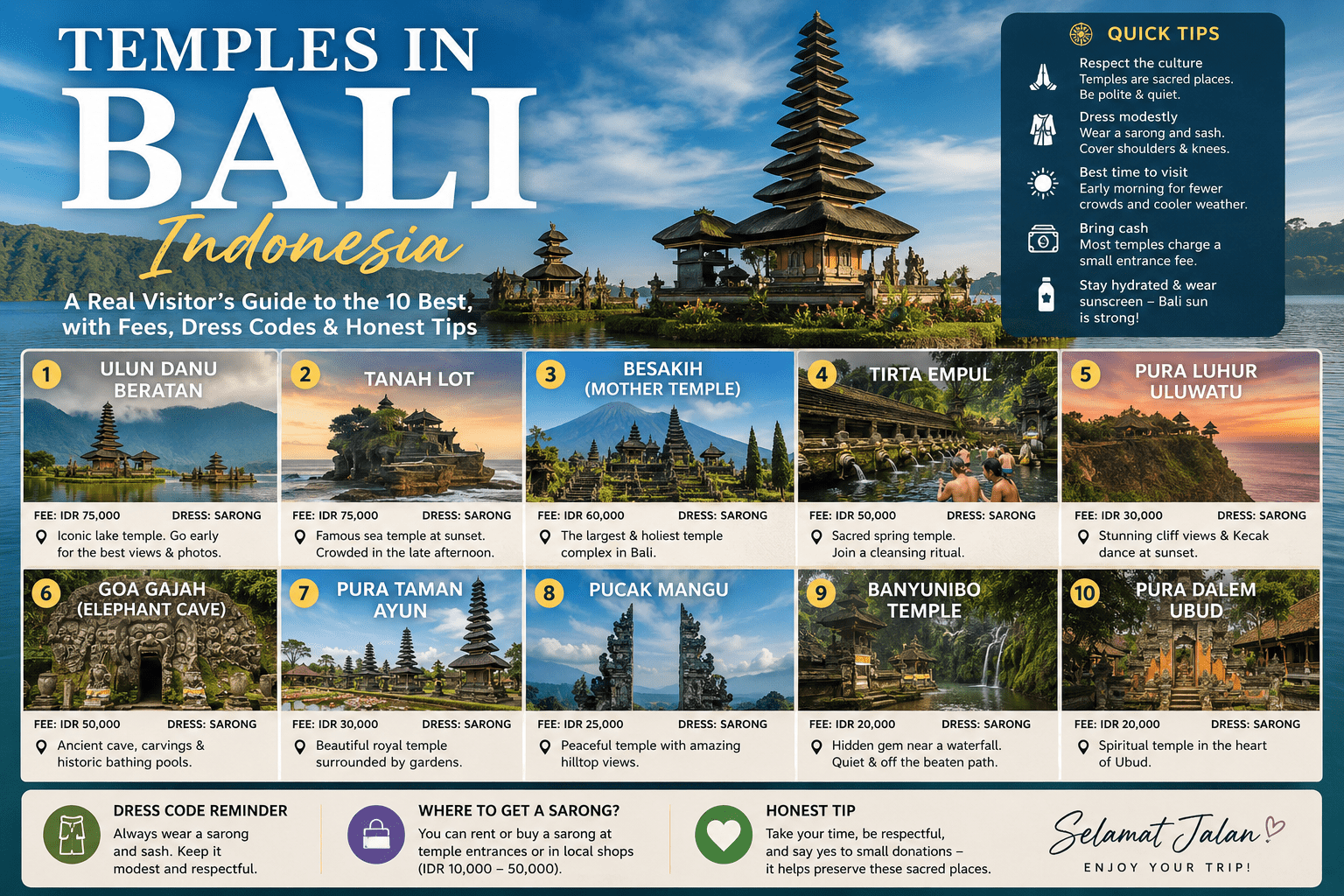
Temples in Bali Indonesia A Real Visitor’s Guide to the 10 Best, with Fees, Dress Codes & Honest Tips
Bali has over 20,000 temples. That number sounds exciting until you’re standing in Seminyak at 9 AM wondering which three are actually worth your limited time — and which ones are going to hit you with questionable “donation” fees the moment you walk in.
This guide skips the fluff. You’ll get the temples worth the trip, what each one actually costs in 2026, exactly what to wear, and the things most travel articles quietly skip over.
Temples in Bali Indonesia, known locally as Pura, are Hindu places of worship built according to Balinese architectural rules rooted in the island’s unique form of Hinduism. Most are open to non-Hindu visitors as tourists, with some inner sanctuaries restricted to worshippers only. Wearing a sarong and sash around the waist is required at every single one.
This guide covers the 10 best temples for tourists. It does NOT address the hundreds of smaller village temples that are typically closed to outsiders, or temples currently under restoration.
Why Bali’s Temples Are Different From Every Other Temple in Southeast Asia
Most people assume Balinese temples are like the grand Buddhist wats of Thailand or the towering Hindu temples of South India. They’re not.
Bali’s temples are living, breathing spiritual centers, not monuments. Ceremonies happen constantly — roughly every 210 days at each temple, following the Balinese Pawukon calendar cycle. Stumble into one of those festivals and you’re witnessing something most tourists never see.
According to UNESCO, the subak irrigation system tied to Bali’s water temples — including Pura Ulun Danu Bratan — was inscribed as a World Cultural Heritage site in 2012, recognizing the system’s role in managing rice agriculture across the island for over a thousand years. That’s not just a pretty backdrop. It’s a functioning, spiritually governed water management network that has operated for centuries.
Most guides skip this: the six holiest temples in Bali, called Sad Kahyangan, are believed to form a spiritual axis protecting the island. Tanah Lot and Uluwatu are two of them. Knowing that before you visit changes how you experience them — it’s not just a sunset photo spot, it’s a site Balinese people consider one of the island’s cosmic anchors.
The 10 Best Temples in Bali Indonesia
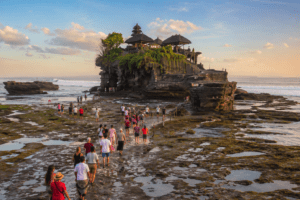
1. Pura Tanah Lot — Best for Sunset Views
Entrance fee: IDR 75,000 (~USD 4.50) as of 2025–2026 Opening hours: 7:00 AM – 7:00 PM Location: Beraban, Tabanan Regency
Tanah Lot sits on a rock formation roughly 20 meters from shore, accessible on foot only during low tide. It’s one of the Sad Kahyangan — the six supremely sacred temples — and it’s also the most photographed spot in Bali. That’s the trade-off: extraordinary setting, serious crowds.
Here’s the thing: arrive before 8 AM and you’ll have near-empty pathways. Arrive at 5 PM and you’ll be shoulder-to-shoulder with tour buses.
The entrance fee is higher than most temples and has increased significantly over the past few years. A sarong is included at the gate. You cannot enter the temple itself — it’s restricted to Hindu worshippers — but the surrounding cliff complex, viewpoints, and shore path are open to all.
Quick note: the “holy snake” caves beneath the rock are real. Banded sea kraits live there, considered sacred guardians of the temple. Rangers let visitors get a close look, though handling them is not allowed.
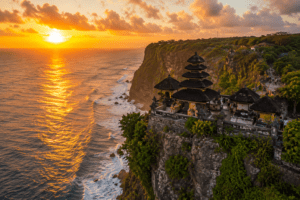
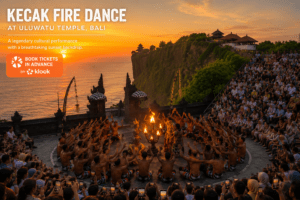
2. Pura Uluwatu — Best for Drama and Kecak Dance
Entrance fee: IDR 50,000 (~USD 3) daytime; Kecak fire dance performance (evening) is separate at IDR 150,000+ Opening hours: 9:00 AM – 6:00 PM Location: Pecatu, Badung Regency
Perched on a 70-meter cliff over the Indian Ocean, Uluwatu is relentless. The views hit you before you’ve even reached the gate. It’s also one of the Sad Kahyangan, and it stays genuinely atmospheric even with crowds because the scale of the cliff just swallows everything.
Monkeys. Let’s address it directly. They will take your sunglasses, phone, food, and occasionally your dignity. Hold your belongings tightly, don’t make eye contact, and don’t wave anything shiny. Rangers are stationed throughout and will help recover stolen items — typically in exchange for food the monkey receives. It’s a known system.
The Kecak fire dance at sunset is performed here nightly starting around 6 PM. Book through Klook in advance; tickets sell out.
3. Pura Besakih — The Mother Temple
Entrance fee: IDR 60,000 + compulsory sarong rental if you don’t bring your own Opening hours: 8:00 AM – 5:00 PM Location: Karangasem, at the slopes of Mount Agung
Besakih is Bali’s largest and most sacred temple complex — 86 temples spread across the slopes of the island’s highest and holiest volcano. The Balinese call it Pura Agung Besakih, the “mother temple,” and they mean it.
This is also the temple most likely to frustrate first-time visitors. The “compulsory guide” system at the main entrance has been documented extensively by travelers. You’ll be approached by a man near the entrance offering guide services at a “donation” rate that isn’t negotiable in practice. Some travelers report walking the complex independently without issue; others report being followed and pressured. I’ve seen conflicting accounts across hundreds of trip reports — some say it’s improved since 2023, others say it hasn’t. My read is: go early (before 9 AM), bring your own sarong, and be politely but firmly direct if you prefer to explore without a guide.
The temple is worth it regardless. When festivals are active, it’s genuinely moving.
4. Pura Tirta Empul — The Holy Spring Temple
Entrance fee: IDR 50,000 (~USD 3) Opening hours: 9:00 AM – 5:00 PM Location: Tampaksiring, Gianyar
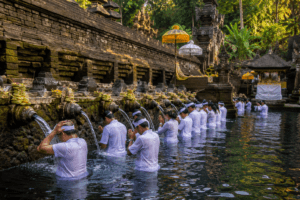
This one is different. Pura Tirta Empul is a water purification temple where Balinese Hindus — and increasingly, curious tourists — wade into sacred spring-fed pools and move between a series of stone spouts for ritual cleansing. The spring is believed to have been created by the god Indra, and the water has flowed continuously for over a thousand years.
Tourists are welcome to participate in the melukat purification ritual — not just observe. If you want to do it, wear something you don’t mind getting completely soaked, and follow instructions from the temple priest or a local guide. Do not use the two spouts at the far end of the pool; those are for purification of the deceased and are off-limits to visitors.
Or maybe I should say it this way: this isn’t a pool you swim in for fun. It’s a ceremony. Entering with that understanding makes a real difference in how you’re received.
5. Pura Ulun Danu Bratan — The Lake Temple
Entrance fee: IDR 75,000 (~USD 4.50) Opening hours: 8:00 AM – 6:00 PM Location: Bedugul, Tabanan
Floating on the edge of volcanic Lake Bratan at 1,200 meters above sea level, Pura Ulun Danu Bratan appears to emerge from the water on misty mornings. It’s one of Bali’s most photographed temples for a reason that photographs don’t quite capture — the altitude means cool air, mountain-range backdrop, and light that shifts dramatically through morning cloud cover.
Dedicated to Dewi Danu, the goddess of lakes and rivers, it’s one of the most important water temples in Bali. The UNESCO-recognized subak irrigation network depends on this temple’s ritual system. Entrance includes access to the surrounding gardens.
Bring a light jacket. Bedugul is noticeably cooler than the south of Bali.
6. Goa Gajah — The Elephant Cave Temple
Entrance fee: IDR 50,000 (~USD 3) Opening hours: 8:00 AM – 5:00 PM Location: Bedulu, Gianyar, near Ubud
Built in the 9th century, Goa Gajah predates most of Bali’s well-known temple complexes. The entrance to the cave is carved directly into a rock face — a dramatic, gaping mouth surrounded by demon figures and foliage in high relief. Inside, a T-shaped cave holds a Ganesh statue and several Shiva lingams.
The name “Elephant Cave” likely comes from the nearby Petanu River, formerly known as “Lwa Gajah.” No elephants were involved. This minor clarification might save you from asking a ranger awkward questions.
It’s smaller than the big-name temples. But for anyone interested in Hindu-Buddhist syncretism in early Balinese history, it’s one of the most historically rich sites on the island.
7. Pura Luhur Batukaru — Most Underrated Temple in Bali
Entrance fee: IDR 30,000 (~USD 2) Opening hours: 8:00 AM – 5:00 PM Location: Wongaya Gede, Tabanan, on the slopes of Mount Batukaru
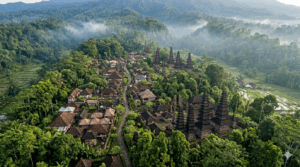
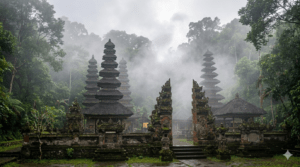
This one most guides skip. Pura Luhur Batukaru sits on the slopes of Bali’s second-highest volcano, surrounded by primary jungle, with almost none of the crowds that overwhelm the south-coast temples. It’s one of the Sad Kahyangan. Misty, quiet, and genuinely atmospheric.
It’s harder to reach — about 1.5 to 2 hours from Seminyak — and there’s no organized tourist infrastructure around it. That’s exactly why it’s worth the effort.
Some experts argue that the most spiritually significant temples are necessarily the most crowded ones. That’s valid if you’re measuring by foot traffic. But if you want to understand why the Balinese consider their temples sacred rather than scenic, Batukaru is a better answer than Tanah Lot at 5 PM.
8. Pura Gunung Kawi — The Royal Tomb Temple
Entrance fee: IDR 50,000 (~USD 3) Opening hours: 8:00 AM – 5:00 PM Location: Tampaksiring, Gianyar
320 steep steps down through rice terraces lead to a 11th-century complex of royal tombs carved directly into cliff faces along the Pakerisan River. These aren’t small carvings — each shrine stands roughly 7 meters tall, chiseled into the volcanic rock.
It’s one of the most dramatic archaeological sites in Bali. It’s also genuinely exhausting to visit because of those stairs — both ways. Wear shoes you trust.
9. Pura Saraswati — Ubud’s Water Lily Temple
Entrance fee: Free (donation encouraged) Opening hours: Daylight hours Location: Central Ubud, Jalan Kajeng
Right in the center of Ubud, a few steps from the main road and the Starbucks across from the palace. The temple’s lotus pond is one of the genuinely beautiful small spaces in Bali — calm, manageable, and mostly overlooked by travelers rushing to the Monkey Forest.
Dedicated to the Hindu goddess of knowledge, arts, and learning, it’s a legitimate place of active worship. Evening Kecak and legong dances are performed here regularly.
10. Pura Taman Ayun — The Royal Garden Temple
Entrance fee: IDR 20,000 (~USD 1.20) Opening hours: 8:00 AM – 6:00 PM Location: Mengwi, Badung
Part of the UNESCO World Heritage subak system, Taman Ayun was the state temple of the Mengwi Kingdom in the 17th century. It sits on an artificial island surrounded by a wide moat, with multi-tiered thatched meru shrines (some reaching 11 tiers) rising from manicured grounds.
Crowds here are lighter than at the major south-coast temples. It’s a frequent stop on Bedugul day trips and pairs well with a morning visit to Tanah Lot.
Bali Temple Dress Code — What You Actually Need to Know
This is where a lot of first-timers get confused. The rule is simple in theory and slightly more specific in practice.
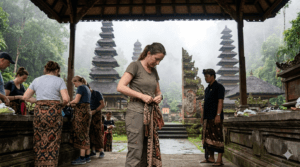
Every temple requires a sarong — a wraparound fabric worn from the waist down — and a sash tied around it. Both are available to rent at temple entrances for IDR 5,000–10,000 (under USD 1), or borrow for free at several temples. Bringing your own is never a bad idea; it speeds up entry and you’re not wearing something that’s been on 200 people before you.
To dress properly for a Bali temple visit, follow these steps:
- Cover your shoulders — tank tops and sleeveless shirts are not appropriate
- Tie a sarong from your waist to below the knee
- Secure a sash (selendang) tied at the waist over the sarong
- Remove your shoes before entering inner temple courtyards
- Avoid wearing black if possible — it’s the color of mourning in Balinese culture
Women who are menstruating are traditionally asked not to enter the inner sanctuaries at most temples. This rule is still observed at actively sacred temples like Besakih and Uluwatu. It’s posted at most entrances, usually quietly. Respecting it is expected.
Quick Comparison — Best Temples in Bali by Type
Temple | Best For | Key Benefit | Limitation Tanah Lot | Sunset views | Iconic ocean setting | Very crowded after 3 PM Uluwatu | Drama + evening performance | Cliffside views + Kecak dance | Persistent monkeys Besakih | Scale + culture | Largest complex in Bali | Pushy guide system Tirta Empul | Unique experience | Participate in purification ritual | Can be crowded midday Ulun Danu Bratan | Photography | Misty lake backdrop | Long drive from the south Batukaru | Quiet authenticity | Almost no tourists | Hard to reach independently
Best Time to Visit Bali Temples — and What Most Guides Get Wrong
Most articles say “go early morning” and stop there. That’s true but incomplete.
The dry season in Bali runs roughly from May to September. Skies are clearer, which matters enormously at highland temples like Bratan and Batukaru where clouds can completely obscure the setting. The wet season (October to April) brings fewer tourists and dramatically more green, lush surroundings — which actually benefits jungle temples like Gunung Kawi and Batukaru aesthetically.
For popular coastal temples (Tanah Lot, Uluwatu), arrive before 9 AM or after 4 PM. The 10 AM–3 PM window is peak tour-bus time and the light is harsh anyway.
Bali’s major temple festivals, Galungan and Kuningan, occur roughly every 210 days. During these periods, every pura in Bali is decorated with penjor (ornate bamboo poles), offerings are placed everywhere, and the island is genuinely transformed. Visiting during Galungan isn’t just allowed for tourists — it’s one of the best things you can experience in Bali. The next Galungan falls in late 2026; check the Balinese calendar before you book.
https://bali.com/bali/travel-guide/culture/festivals-in-bali/
Honest Answers to the Questions Travelers Actually Ask
Q: What’s the best temple in Bali for first-time visitors?
A: Tanah Lot for views, Tirta Empul for a genuinely different cultural experience. Most itineraries should include both. They’re on opposite sides of the island, so plan accordingly.
Q: How do I avoid tourist traps at Bali temples?
A: At Besakih, you don’t need to hire a guide to enter. At Tanah Lot, the sarong rental at the gate is legitimate. At any temple, if someone approaches you outside the official ticket booth offering to “help,” you can politely decline.
Q: Should I visit temples during a Bali ceremony?
A: Yes, as long as you stay in the outer courtyard (jaba) and don’t enter the inner areas where rituals are actively happening. Dress respectfully, don’t photograph worshippers without silent permission, and move quietly.
Q: Why does Bali have so many temples?
A: According to Balinese Hindu tradition, every village, rice field, home, and even large tree can have its own shrine or temple. The Balinese believe that deities inhabit the natural world, so the landscape itself is essentially sacred.
Q: When should I go to Uluwatu Temple to avoid crowds?
A: Before 10 AM for a quieter visit, or specifically for the Kecak dance at sunset — which is crowded but intentionally so. The performance itself is worth it.
This guide works best for independent travelers and small groups visiting Bali for the first time or the second time with more intention. It won’t help if you’re planning a pilgrimage or seeking access to restricted inner sanctuaries — those require local guides with proper ceremonial knowledge and, in many cases, prior arrangement with temple priests.