
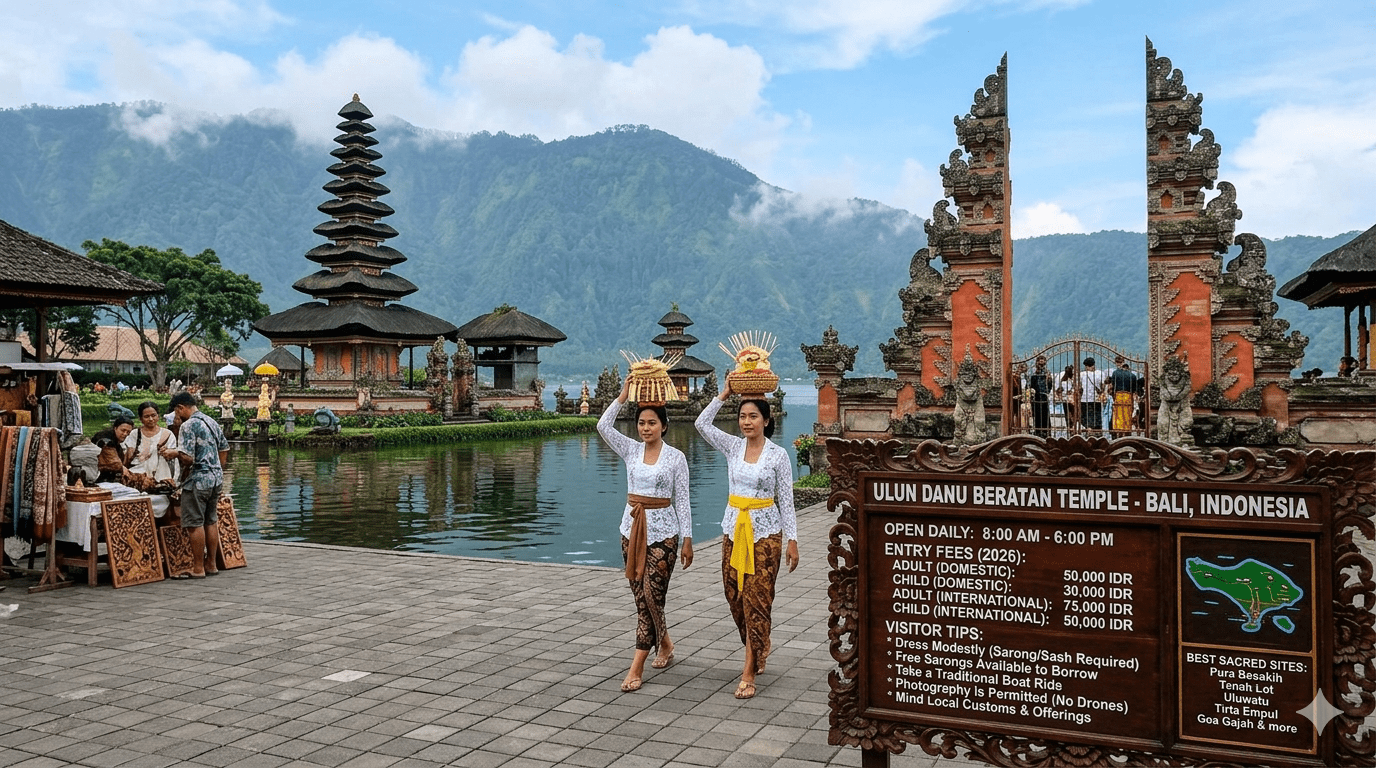
Temples in Bali Indonesia: 30 Sacred Sites You Need to Know Before You Go (2026)
This guide covers the 30 most important and rewarding temples across Bali, with 2026 entry fees, dress code rules, and practical visit tips. It does NOT cover private family temples or village shrines closed to tourists.
Temples in Bali, Indonesia are Hindu sacred sites used for active daily worship, ceremony, and spiritual life. Bali is home to an estimated 20,000 temples — from cliffside shrines overlooking the Indian Ocean to ancient stone complexes carved into jungle riverbeds. Most are open to respectful visitors with modest dress and a small entry fee.
That number — 20,000 — tends to stop people cold. Where do you even start?
This guide cuts through it. Below you’ll find 30 temples across every region of Bali, organized by type, with 2026 entry fees in IDR and USD, honest crowd assessments, best visiting times, and a full dress code section that covers the rules most other guides quietly skip.
What You Need to Know Before Visiting Any Temple in Bali
The Dress Code — And the Rules Nobody Tells You
Every temple in Bali requires the same two items: a sarong (kain) and a sash (selendang). The sarong wraps around your waist and covers your legs to at least mid-calf. The sash ties over it. Long pants alone are not enough — you still need the sarong wrapped over them.
Most major temples rent sarongs at the entrance for around IDR 10,000–20,000. Bring your own if you’re visiting multiple temples in one day. It’s just easier.
For your upper body: cover your shoulders. Tank tops, crop tops, and bikini tops are not acceptable — not even with a sarong below. A simple t-shirt works fine.
What most guides skip: Balinese Hindu custom asks women who are menstruating not to enter temple grounds. This isn’t enforced by a metal detector — it operates on trust and religious belief, upheld for centuries. Anyone with an open wound or recent bereavement is also asked to stay outside. Women more than seven months pregnant, or who have given birth in the last six weeks, follow the same guideline. These individuals can walk the outer grounds and courtyards — they’re just not expected to enter the inner sanctum.
It’s a cultural tradition, not a tourist restriction. Respecting it matters.
Look — if you’re a first-time visitor feeling uncertain about the rules, here’s what actually works: dress modestly from the start, carry your own sarong, and when in doubt, ask the staff at the entrance. They’re genuinely helpful.
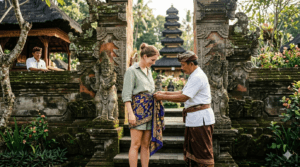
2025 Governor’s Circular — New Rules in Effect
As of 2025, Bali’s provincial government tightened temple visitor conduct rules under Bali Governor’s Circular Letter SE No. 7/2025. Key points:
No selfies or videos inside the inner sanctum (jeroan). No climbing, sitting, or leaning on temple walls, statues, or altars. No stepping on canang sari — those flower offerings on the ground are prayers, not decorations. Do not raise yourself physically higher than a priest during ceremony. Speak quietly; silence is preferred in inner courtyards.
Photography is allowed in outer areas. Capturing the architecture, the gardens, the light — all fine. Stay aware of whether a ceremony is in progress.
Entry Fees: What to Expect
Most Bali temples charge between IDR 30,000–150,000 (approximately USD $2–$9) for foreign visitors. Some temples include a sarong rental in the fee; others charge separately. Always bring cash — QRIS (Indonesian digital payment) is accepted at some larger sites like Uluwatu, but small temples are cash only.
Quick note: Tanah Lot raised its foreign visitor entry fee to IDR 100,000 for adults, effective April 2026 (up from IDR 75,000). Ulun Danu Beratan is also revising its pricing, effective July 1, 2026. Always confirm at the gate.
The 9 Directional Temples (Kahyangan Jagad) — Bali’s Holiest Sites
Bali has nine directional temples, known as Kahyangan Jagad, believed to spiritually protect the entire island. These are the most sacred. Visiting even two or three is considered significant by Balinese standards.
1. Pura Besakih — The Mother Temple
Location: Mount Agung slopes, Karangasem Regency, East Bali Entry Fee (2026): IDR 150,000 per person — includes sarong, on-site guide, and one-way shuttle bus Best Time to Visit: 7–9am before tour groups arrive Opening Hours: Daily, 8am–5pm Crowd Level: High
Pura Besakih is the largest and most sacred temple complex in Bali, sitting at roughly 1,000 meters elevation on the slopes of Mount Agung, Bali’s holiest volcano. The complex contains more than 80 individual shrines across terraced hillside ground. It’s not a single temple — it’s a city of temples.
The entry fee here is the steepest of any Bali temple, but the package is unusually complete. Your ticket includes an assigned local guide, sarong rental, and a shuttle ride up to the main gate. The guide is genuinely useful — Besakih’s layout is disorienting without one. You can walk the 10–15 minutes back down afterward, or pay an extra IDR 20,000 for the return shuttle.
Most people assume the past controversies around Besakih — reports of aggressive unofficial guides demanding extra payment — are still ongoing. The fixed-fee system introduced in recent years has largely resolved this. It’s not a perfect experience, but it’s significantly cleaner than it was.
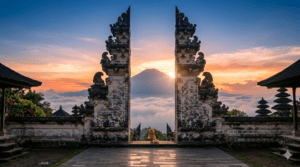
2. Pura Luhur Lempuyang — Gates of Heaven
Location: Mount Lempuyang, Karangasem Regency, East Bali Entry Fee (2026): IDR 100,000 per person — includes sarong; shuttle bus IDR 50,000 extra Best Time to Visit: 6–8am for clear Mount Agung views through the gate Opening Hours: Daily, 6am–6pm Crowd Level: Extreme at the lower gate; quiet above
You’ve seen the photo. Two stone split gates (candi bentar) perfectly framing Mount Agung on a clear morning. It’s one of the most shared images of Bali anywhere — and yes, the real thing is better.
Here’s the thing: the “Gates of Heaven” at the lowest level are only a small part of what Lempuyang actually is. The full complex climbs 1,700 steps up the hillside through seven separate temples. Most tourists queue 45–90 minutes at the bottom gate, take the photo, and leave. Walk up instead. The higher temples are almost deserted — ancient, atmospheric, and genuinely spiritual in a way the crowded entrance never could be.
The mirrored water reflection in the famous photo is created by a pool of water held by a staff member between you and the gate. It’s a posed shot. That said, even without the reflection, the framing of Agung through the stone gate is extraordinary on a clear day.
3. Pura Luhur Uluwatu — Clifftop Drama
Location: Bukit Peninsula, Badung, South Bali Entry Fee (2026): IDR 50,000 adults (foreign) — Kecak Dance is a separate ticket, approximately IDR 135,000–150,000 Best Time to Visit: 5–6pm for sunset; Kecak Dance begins around 6pm daily Opening Hours: Daily, 7am–7pm Crowd Level: High at sunset; moderate during the day
Uluwatu perches 70 meters above the Indian Ocean at the southwestern tip of Bali’s Bukit Peninsula. The temple structure itself is relatively small — what makes it extraordinary is the setting. Stone paths carved into clifftops, the ocean in every direction, and wild macaque monkeys who will absolutely steal your sunglasses if you’re not paying attention.
The Kecak Fire Dance at sunset is worth doing at least once. Around a hundred performers chant in hypnotic unison around a fire torch as the sun drops into the ocean behind them. Book tickets online in advance through GetYourGuide or Klook to avoid queuing on the day.
Monkey warning — this is serious. Do not carry food, do not make eye contact with the monkeys, and secure your belongings before entering. Staff at the entrance will loan you a stick to deter them. Take it.
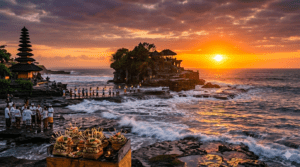
4. Pura Tanah Lot — Icon of Bali
Location: Beraban, Kediri, Tabanan Regency, South Bali Entry Fee (2026): IDR 100,000 adults (foreign), IDR 60,000 children — increased April 2026 Best Time to Visit: Late afternoon, 4–6pm Opening Hours: Daily, 7am–7pm Crowd Level: Very high
Tanah Lot sits on a rocky outcrop surrounded by ocean, walkable on foot only at low tide. At high tide, the temple appears to float. It’s a 16th-century sea temple dedicated to the sea gods — local legend credits the Hindu priest Nirartha with its founding.
Or maybe I should say it this way: Tanah Lot is Bali’s most visited temple for a reason, but it’s not its most spiritual. Non-Hindus cannot enter the temple structure itself. The real reward here is the dramatic photography, the sunset light on the rock, and the coastal walk to nearby Pura Batu Bolong — a free add-on most people miss.
The fee increase in April 2026 reflects a broader Bali push to align major site pricing with infrastructure improvements. Always confirm current pricing at the gate.
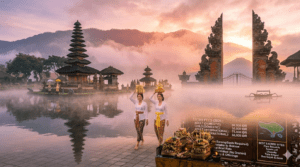
5. Pura Ulun Danu Beratan — The Floating Temple
Location: Lake Beratan, Bedugul, Tabanan Regency, Central Bali Entry Fee (2026): Under revision — new pricing takes effect July 1, 2026; confirm on arrival Best Time to Visit: Early morning for mist over the lake Opening Hours: Daily, 7am–5pm Crowd Level: Moderate to high
This is the temple on Indonesia’s 50,000 rupiah banknote — a multi-tiered pagoda rising from the misty surface of Lake Beratan at 1,200 meters elevation. The cool mountain air and lake reflections make it visually distinct from every other temple on this list.
Ulun Danu Beratan is dedicated to Dewi Danu, goddess of water — appropriate for a temple built on the edge of a lake that supplies much of Bali’s irrigation network. Standard sarong requirements apply, though no strict formal dress code beyond that.
6. Pura Luhur Batukaru — The Forest Mountain Temple
Location: Mount Batukaru, Tabanan Regency, Central Bali Entry Fee (2026): IDR 30,000 per person Best Time to Visit: Morning — mist clears by 10am most days Opening Hours: Daily, 8am–5pm Crowd Level: Low
Batukaru sits in dense rainforest on the slopes of Bali’s second-highest peak. It’s one of the least visited of the nine directional temples, which is precisely why it’s worth the drive. The complex is mossy, old, quiet, and authentically spiritual in a way that heavily trafficked temples sometimes struggle to be.
The road up involves twisting mountain lanes through rice terraces. Hire a driver.
7. Pura Ulun Danu Batur — Volcano Lake Temple
Location: Kintamani, Bangli Regency, Northeast Bali Entry Fee (2026): IDR 30,000 per person Best Time to Visit: Morning, before clouds descend over the caldera Opening Hours: Daily Crowd Level: Moderate
Perched on the rim of the Batur caldera with views of the volcanic lake below, this directional temple offers scenery completely unlike anything else in Bali. Combine with a Kintamani volcano viewpoint for one of the island’s best day excursions.
8. Pura Luhur Pucak Mangu — Crater Lake Temple
Location: Mount Catur, above Lake Buyan, Tabanan Entry Fee (2026): Small donation Access Note: Requires a moderate hike — not suitable for mobility limitations Crowd Level: Extremely low
One of the nine directional temples and almost unknown to foreign visitors. The hike passes through thick forest above Bali’s twin crater lakes. The reward is a remote hilltop temple with sweeping views and genuine solitude.
It belongs on every serious Bali itinerary. Almost nobody goes.
9. Pura Masceti — Southern Coast Temple
Location: Ketewel, Gianyar Regency, South Bali Entry Fee (2026): Small donation Crowd Level: Very low
One of the nine directional temples, facing the open Indian Ocean on Bali’s south coast. Used for ceremonies connected to the ocean and agricultural fertility. Rarely visited. Genuinely atmospheric.
Famous Temples Every Visitor Should See
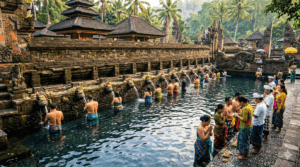
10. Pura Tirta Empul — Sacred Purification Pools
Location: Tampaksiring, Gianyar Regency, Central Bali Entry Fee (2026): IDR 50,000 per person — sarong included Best Time to Visit: Before 9am — arrive early to experience the ritual before tour groups Opening Hours: Daily, 7am–5pm Crowd Level: High mid-morning; manageable at opening
Tirta Empul centers on sacred spring pools where Balinese Hindus perform the melukat purification ritual — bathing under 13 fountain spouts, each believed to cleanse a different kind of negative energy. Tourists are permitted to participate respectfully. Inquire at the entrance about proper procedure before entering the water.
The entry fee covers temple grounds access. Sarong is included. Bring a spare change of dry clothes if you plan to bathe.
I’ve seen conflicting information on whether melukat is appropriate for all tourists to join — some sources say yes with respectful intent, others say observe only. My read: if you approach it with genuine respect and follow the guidance of on-site priests, participation is welcomed.
11. Pura Goa Gajah — Elephant Cave Temple
Location: Bedulu Village, Gianyar Regency, near Ubud Entry Fee (2026): IDR 50,000 per person Best Time to Visit: Morning Opening Hours: Daily, 8am–5pm Crowd Level: Moderate
Goa Gajah gets its name from the mythical demonic face carved into the cave entrance — likely a representation of Ganesh, though scholars debate this. The cave interior contains ancient statues and meditation niches. Outside, explore bathing pools, mossy stone carvings, and quiet jungle paths that most visitors never find.
Wear sturdy shoes if you want to explore the back trails. There are hidden corners most tourists miss entirely.
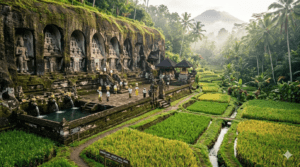
12. Pura Gunung Kawi — 11th-Century Rock Shrines
Location: Tampaksiring, Gianyar Regency, Central Bali Entry Fee (2026): IDR 50,000 per person Best Time to Visit: Morning Opening Hours: Daily, 7am–5pm Crowd Level: Moderate
Ten massive royal shrines carved directly into sheer rock cliffs above the Pakerisan River — this is one of Bali’s most extraordinary archaeological sites. Dedicated to King Anak Wungsu and his queens, the complex dates to the 11th century. You reach it by descending roughly 300 steps through rice terraces. The descent itself is part of the experience.
Rice paddies, jungle, the sound of flowing water, moss-covered stone everywhere. It doesn’t get crowded the way central Ubud does.
13. Pura Taman Ayun — Royal Garden Temple
Location: Mengwi, Badung Regency, South Bali Entry Fee (2026): IDR 30,000 per person Best Time to Visit: Morning to midday Opening Hours: Daily, 8am–6pm Crowd Level: Low to moderate
Built in 1634 by the King of Mengwi, Taman Ayun served as the royal family’s main temple. The complex is surrounded by a wide moat, giving the tiered pagoda towers a floating, reflected appearance. It’s part of the UNESCO World Heritage Bali Cultural Landscape designation (2012) and remarkably uncrowded given how visually impressive it is.
https://whc.unesco.org/en/list/1194/
14. Pura Saraswati — Ubud’s Lotus Temple
Location: Ubud Center, Gianyar Regency Entry Fee (2026): Free — donations welcome Best Time to Visit: Evening, for traditional dance performances Opening Hours: Daily Crowd Level: Moderate
Dedicated to the goddess of wisdom and arts, Saraswati sits behind a lotus pond in the heart of Ubud. Evening dance performances make it one of the few temples where cultural performance and sacred architecture combine in the same visit. Check schedules locally — performances are not every night.
15. Pura Tirta Gangga — Water Palace
Location: Karangasem Regency, East Bali Entry Fee (2026): IDR 50,000 per person Best Time to Visit: Early morning Opening Hours: Daily, 7am–6pm Crowd Level: Low to moderate
Tirta Gangga is technically a royal water palace, but its sacred pools, stepping-stone paths, and tiered fountains make it one of Bali’s most beautiful spiritual sites. You can swim in the pools for a small additional fee. Mount Agung fills the background on clear days — the combination of water and volcano is spectacular.
Hidden Gems and Off-the-Beaten-Path Temples
16. Pura Gunung Kawi Sebatu — The Secret Purification Temple
Location: Tegallalang, Gianyar Regency, near Ubud Entry Fee (2026): IDR 20,000 per person Best Time to Visit: Morning Crowd Level: Very low
Unlike its famous namesake in Tampaksiring, Gunung Kawi Sebatu is a forest purification temple rarely included on tours. Local priests conduct regular melukat ceremonies here. It’s peaceful in a way that Tirta Empul — genuinely beautiful but increasingly tourist-managed — no longer quite is.
This is the one to visit if you want the purification experience without the crowds.
17. Pura Gunung Lebah — Campuhan Ridge Temple
Location: Campuhan Ridge, Ubud Entry Fee (2026): Free Crowd Level: Very low
Nestled at the start of the Campuhan Ridge Walk, where two rivers meet below a jungle-covered valley, Gunung Lebah is an ancient Ubud temple hidden in plain sight. Most tourists walk right past it on their way to the ridge. Stop. It’s tranquil, architecturally beautiful, and completely free.
18. Pura Kehen — Bangli’s Underrated Gem
Location: Bangli, Central Bali Entry Fee (2026): IDR 15,000 per person Best Time to Visit: Anytime — it’s rarely crowded Crowd Level: Low
Often called “mini Besakih,” Pura Kehen features beautiful stone carvings, a 700-year-old sacred banyan tree at its entrance, and terraced architecture climbing up a hillside. For IDR 15,000, it offers more visual reward per rupiah than almost any other temple on this list.
Hardly anyone goes. That’s genuinely puzzling.
19. Pura Petitenget — Seminyak’s Sacred Site
Location: Seminyak, Badung Regency, South Bali Entry Fee (2026): Donation-based Crowd Level: Low despite central location
Petitenget is a seaside temple sitting in the middle of Seminyak’s restaurant and beach club strip — a jarring juxtaposition that somehow works. Active local ceremonies happen here regularly. Sunset views are excellent, and because it doesn’t appear in most tourist itineraries, you can often visit in peace despite being in Bali’s busiest neighborhood.
20. Pura Luhur Pulaki — Coastal Monkey Temple, North Bali
Location: North Bali coast, Buleleng Regency Entry Fee (2026): IDR 15,000 per person Crowd Level: Very low
Pulaki sits on a cliff above the north Bali coast, surrounded by wild monkeys and local legend. Built by the same Hindu priest credited with founding Tanah Lot, it sees almost no foreign visitors. Combine with a north Bali road trip along the coast.
21. Pura Taman Beji Griya — Forest Purification Temple
Location: Abiansemal, Badung Regency Entry Fee (2026): Best visited as part of a guided experience — IDR 350,000–600,000 including guide, ceremony, and flowers Crowd Level: Low
Taman Beji Griya has emerged in recent years as one of Bali’s most sought-after melukat experiences for thoughtful visitors. The ceremony takes place in a jungle stream, conducted by a local priest. Book in advance through GetYourGuide or Klook. This is not a drop-in temple — it works best with a proper guide and prior arrangement.
22. Goa Giri Putri — Underground Cave Temple (Nusa Penida)
Location: Nusa Penida island — requires a fast boat from Sanur, approximately 40 minutes Entry Fee (2026): IDR 30,000 per person Crowd Level: Low
Entry requires crawling through a narrow rock opening on hands and knees — symbolizing rebirth. Inside, a vast limestone cavern opens into a full temple complex. Local families come to pray here. The atmosphere is nothing like a mainland tourist temple. The journey to Nusa Penida itself makes the trip worthwhile.
23. Pura Tanah Kilap — Clifftop Ocean Temple
Location: Ungasan, Bukit Peninsula, South Bali Entry Fee (2026): Small donation Crowd Level: Very low
A small coastal temple perched on dramatic white limestone cliffs at the southern end of the Bukit Peninsula. Far fewer visitors than Uluwatu, with equally striking ocean views. Worth combining with a south Bukit beach day.
24. Pura Batu Bolong — Tanah Lot’s Quiet Neighbor
Location: Adjacent to Tanah Lot complex, Tabanan Entry Fee (2026): Included in Tanah Lot ticket Crowd Level: Low
Most visitors who pay to enter Tanah Lot never walk to Batu Bolong — a natural rock arch temple 10 minutes along the coastal path. Through the arch, at the right moment, you can see the sunset framed perfectly. It’s free with your Tanah Lot entry.
Just walk.
Ancient and Archaeological Temples
25. Pura Yeh Pulu — Mysterious Rock Reliefs
Location: Bedulu, near Ubud, Gianyar Regency Entry Fee (2026): IDR 15,000 per person Crowd Level: Very low
Yeh Pulu is a 14th-century relief carved into a 25-meter stretch of rock face, depicting scenes of ancient Balinese life with remarkable detail. The setting — a narrow jungle path alongside the carved wall — feels genuinely archaeological. Almost no one visits. It should be on every history-focused Bali itinerary.
26. Pura Pejeng — The Moon Temple
Location: Pejeng, Gianyar Regency, near Ubud Entry Fee (2026): IDR 15,000 per person Crowd Level: Very low
Pejeng is home to the Moon of Pejeng — a bronze kettledrum over 2,000 years old, believed to be the largest bronze drum cast in a single piece anywhere in the world. It sits on display in the temple’s inner courtyard. The temple itself dates to the 9th century CE.
Most people assume Bali’s significant ancient artifacts are in museums. Several are still sitting exactly where they were placed, in active temples like this one.
27. Pura Kebo Edan — Temple of the Mad Buffalo
Location: Pejeng area, Gianyar Regency Entry Fee (2026): IDR 10,000 per person Crowd Level: Extremely low
Kebo Edan contains one of Bali’s strangest ancient sculptures — a massive stone figure in an unusual ritual posture, believed to represent Bhairawa, a fierce deity form of Shiva. Dating to the 13th–14th century, the sculpture is confronting and raw in a way that polished tourist temples never are.
28. Pura Gunung Kawi Sebatu (Archaeological Pools Section)
Already covered above under Hidden Gems — worth noting separately that the archaeological bathing pool area here predates the main temple and is distinct from the melukat area.
29. Pura Mengening — Sacred Spring Temple
Location: Tampaksiring, Gianyar Regency Entry Fee (2026): Small donation Crowd Level: Very low
A quiet water temple near Tirta Empul, regularly skipped by visitors who only know the famous purification complex. The spring here is considered equally sacred by local Balinese. Small, serene, and easy to combine with a Tirta Empul visit.
30. Pura Dalem Puri — Denpasar’s Urban Temple
Location: Pemecutan, Denpasar Entry Fee (2026): Donation-based Crowd Level: Low
An active and ceremonially significant temple in Bali’s capital city. Worth visiting for travelers staying in Denpasar rather than the resort areas — and it offers a genuine insight into how Balinese temples function in a modern urban setting, which is different from anything you’ll see on the tourist trail.
Quick Comparison Table
| Option | Best For | Entry Fee (Foreign) | Crowd Level | Key Limitation |
|---|---|---|---|---|
| Tanah Lot | Sunset photography | IDR 100,000 | Very High | Cannot enter inner shrine |
| Uluwatu | Sunset + Kecak Dance | IDR 50,000 + dance | High | Monkey theft risk |
| Besakih | Scale + spirituality | IDR 150,000 | High | Remote; full day needed |
| Lempuyang | Gates of Heaven photo | IDR 100,000 | Extreme at gate | 45–90 min queue |
| Tirta Empul | Purification ritual | IDR 50,000 | High | Crowded 10am–2pm |
| Gunung Kawi Sebatu | Quiet melukat | IDR 20,000 | Very Low | Not on standard tours |
| Goa Gajah | Archaeology near Ubud | IDR 50,000 | Moderate | Small complex |
| Pura Kehen | Architecture, no crowds | IDR 15,000 | Very Low | Requires own transport |
How to Plan Your Bali Temple Itinerary
To plan a Bali temple day trip effectively, follow these steps:
- Choose a region first — South Bali (Uluwatu, Tanah Lot), Ubud area (Tirta Empul, Gunung Kawi, Goa Gajah), or East Bali (Besakih, Lempuyang, Tirta Gangga). Do not try to mix all three in one day.
- Book a private driver — costs IDR 500,000–700,000 for a full day and removes every logistical headache. Use Grab for point-to-point trips within the Ubud area.
- Start before 9am — most temples are peaceful before the tour buses arrive.
- Carry cash — bring IDR 500,000–1,000,000 for a full day in various denominations. Smaller temples are cash only.
- Pack your own sarong — brings it saves time and money at multiple entrances.
Voice Search Q&A
Q: What’s the best temple to visit in Bali for first-timers? A: Tirta Empul for a spiritual experience, Tanah Lot or Uluwatu for dramatic scenery. Start with one of these three — all are accessible, well-managed, and genuinely impressive.
Q: How do I get to temples in Bali without a tour? A: Hire a private driver for IDR 500,000–700,000 per day. For Ubud-area temples, use Grab. Avoid renting a scooter unless you’re experienced with Indonesian mountain roads.
Q: Should I book Bali temple tours in advance? A: For Uluwatu’s Kecak Dance and guided purification experiences at Taman Beji Griya, yes — book through GetYourGuide or Klook. For standard temple entry, no advance booking is needed.
Q: Why does Bali have so many temples? A: Balinese Hinduism assigns a temple to every function of community life — village governance, agriculture, family ancestors, and directional spiritual protection. The island has an estimated 20,000 temples in active use, according to the Bali Tourism Board.
Q: When should I visit Bali temples to avoid crowds? A: Arrive at major temples before 9am. Tuesday and Wednesday mornings are typically less busy than weekends. Avoid visiting during Galungan and Kuningan holidays if you want quieter grounds — though those are also the most ceremonially beautiful times to witness Balinese Hindu culture firsthand.
Practical Tips
Getting There: Grab works well for most Ubud-area temples. For South Bali (Uluwatu, Tanah Lot) and East Bali (Besakih, Lempuyang), hiring a private driver for the day is significantly more practical. Remote temples like Batukaru and Pucak Mangu require a local driver who knows the roads.
Booking Tours: GetYourGuide and Klook both offer well-reviewed temple combination tours and purification ceremony experiences. Useful for first-timers who want context, transport, and local guidance in one package.
Best Months to Visit: April–October (dry season) gives clearer skies and better conditions for open-air temples. Bali’s wet season (November–March) is when the island is greenest — and temple ceremony activity is particularly intense.
What to Bring Every Day: Your own sarong, IDR cash in various denominations, a reusable water bottle, and covered shoes if you plan to visit jungle or mountain temples.
This guide covers 30 publicly accessible temples across Bali. It does not address private family temples, restricted ceremony periods, or temples temporarily closed for renovation — always confirm locally before a long journey to a remote site.