
Pulau Misool: The Raja Ampat Island Most Travelers Never Reach (And Why That’s Changing)
This guide covers independent travel, liveaboard, and resort access to Misool. It does NOT address the northern Raja Ampat islands of Waigeo or Wayag — those require a separate itinerary.
Pulau Misool is a remote island group in southern Raja Ampat, West Papua, Indonesia, reachable only by ferry, private speedboat, or liveaboard boat from the port city of Sorong. It covers roughly 2,034 square kilometres of land and is surrounded by one of the most biodiverse marine environments on the planet.
That’s the definition. Here’s why it matters.
Raja Ampat’s waters sit at the heart of the Coral Triangle, home to more than 1,500 species of fish and 550 species of coral — and Misool sits at the quieter, less-visited southern edge of that ecosystem. While Wayag and the northern islands now draw consistent crowds, Misool hasn’t fully crossed into the tourist mainstream yet. That gap is closing. Fast.
Is Misool Worth the Effort to Get To?
Honestly? It depends entirely on what you want from a trip to Indonesia.
Unlike the broader Raja Ampat region, which has become increasingly busy, Misool is still relatively untouched. The tradeoff is real: getting there takes time, connectivity is near-zero, and most accommodation is basic. But that’s also the point. If you’re chasing an Instagram-ready beach resort with reliable WiFi, this isn’t it.
Travelers who’ve made the journey consistently describe the same reaction — the karst limestone formations rising from flat turquoise water look less like Southeast Asia and more like a planet that hasn’t been named yet.
Most people assume Misool is only accessible via expensive eco-resorts. The data says otherwise — budget homestays operated by local families have been quietly running for years, and the ferry costs a fraction of what the private speedboat operators quote.
Or maybe I should say it this way: Misool has two completely different travel experiences depending on your budget, and most guides only write about one of them.
How to Get to Pulau Misool
This is where most guides go vague. Let’s be specific.
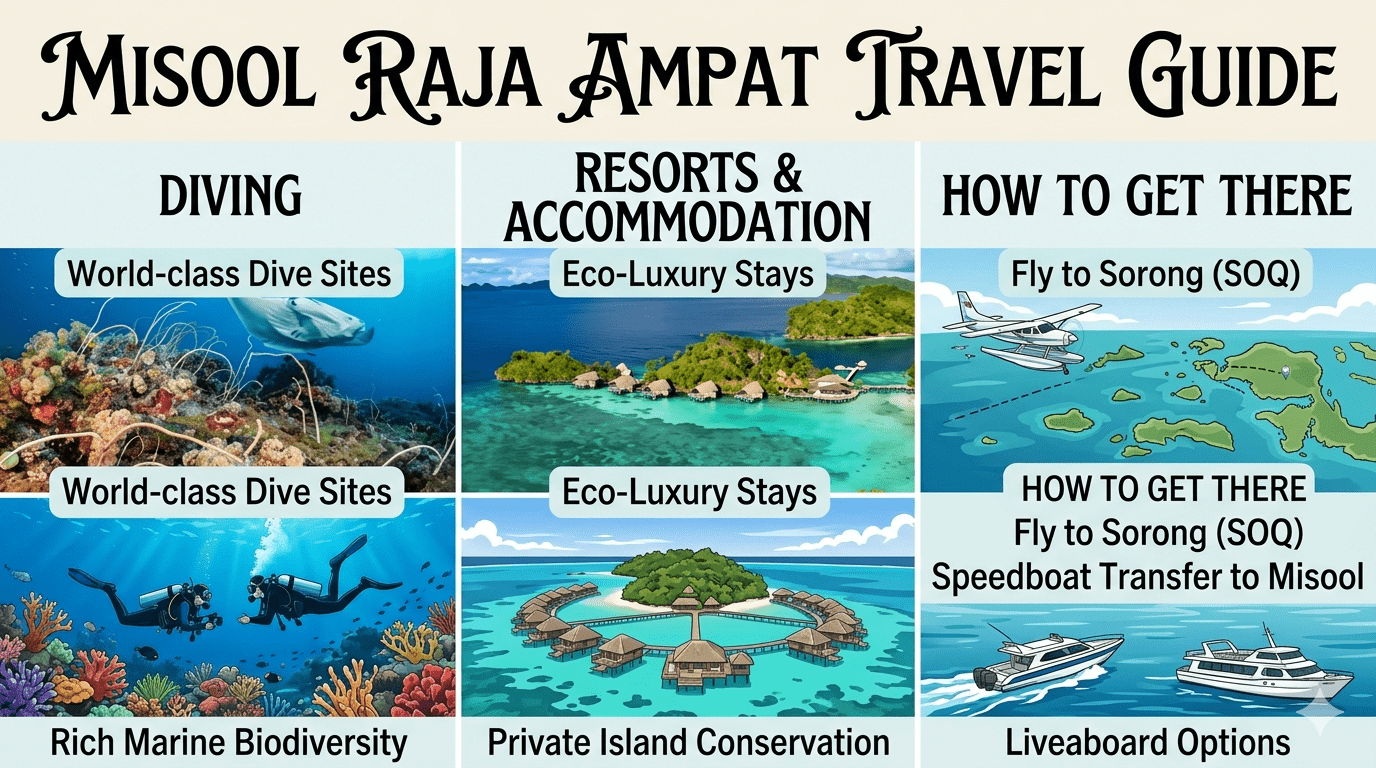
Step 1: Fly to Sorong Your entry point is Domine Eduard Osok Airport (SOQ) in Sorong, West Papua. Garuda Indonesia and Wings Air both serve Sorong, with connections from Jakarta, Makassar, and Manado. Budget roughly IDR 1.5–3.5 million (USD 90–220) for a domestic one-way ticket depending on the route and booking window.
Step 2: Get from the Airport to the Harbour Sorong has two relevant departure points. The public ferry (KM Terubuk) leaves from Usahamina Harbour. Private speedboats depart from the main Sorong port area. A taxi between the airport and either harbour runs about IDR 80,000–120,000. Don’t let anyone at the airport convince you a private transfer is mandatory.
Step 3: Choose Your Route to Misool
Quick Comparison
| Option | Best For | Key Benefit | Limitation |
|---|---|---|---|
| Public Ferry (KM Terubuk) | Budget travelers | Cheapest option (~IDR 100–200k) | Slow (12–18 hrs), infrequent schedule |
| Private Speedboat | Groups splitting costs | Flexible timing, 4–5 hrs | Expensive solo (IDR 2–4 million) |
| Liveaboard | Divers | All-inclusive, route flexibility | Premium price (USD 150–400/night) |
| Misool Resort Transfer | Resort guests | Direct, comfortable | Resort booking required |
Most independent travelers use the public ferry. Check the KM Terubuk’s current sailing schedule on the ferry company’s Instagram page before you finalize dates — the timetable shifts seasonally and the website isn’t always current.
To get to Misool independently, follow these steps:
- Book a flight into Sorong (SOQ) at least 6 weeks ahead for peak season.
- Purchase your Raja Ampat Marine Park Permit online before departure.
- Take a taxi to Usahamina Harbour for the public ferry, or negotiate speedboat rates at the main port.
- Confirm your homestay or resort can arrange local pickup from the Misool jetty.
Entry Fees: What You’ll Actually Pay
This section trips up nearly every first-time visitor to Raja Ampat.
In 2026, all visitors must pay two separate official fees: the Marine Park Entry Permit (IDR 700,000 for international visitors) and the Visitor Entry Ticket (IDR 300,000), managed by different government departments. Together that’s roughly IDR 1,000,000 — around USD 62–67 at current rates.
Both permits are valid for 12 months from the date of purchase, so if you’re planning a return visit within a year, you won’t pay again. The Marine Park Permit can be bought online ahead of your trip — do this before you arrive, because some operators at the harbour have been known to issue unofficial versions.
Quick note: individual attractions within Misool — like the jellyfish lake — charge an additional entrance fee on the spot, currently around IDR 75,000 per person. Bring cash. There are no ATMs in Misool.
Where to Stay in Misool
Here’s the thing most resort-focused guides won’t tell you: you don’t need to spend USD 500 a night to sleep in Misool.
Budget — Local Homestays (Penginapan) Misool has a growing number of family-run overwater homestays, particularly in and around the main settlement areas. Expect basic fan rooms, shared bathrooms, and meals cooked by the family. Rates typically run IDR 200,000–450,000 per night (USD 12–28), usually including meals. Local guides based in Sorong — including those from the island itself — can arrange homestay bookings and local pickups that the major booking platforms don’t list.
The tradeoff is real. You’ll sleep on thin mattresses, the mosquitoes appear at dusk, and the water pressure is variable. The reef twenty metres from your porch is spectacular.
Mid-Range — Small Dive Resorts Several smaller dive operations have set up in the Misool area over the past decade, offering modest bungalows with meals and guided snorkelling for USD 80–180 per person per night. These sit between the homestay experience and the full luxury tier.
Luxury — Misool Resort Misool Resort is the benchmark. It operates as a private eco-resort on its own island within the archipelago, running a strict no-take marine sanctuary across 300,000 acres of surrounding sea. Rates are USD 550–900+ per person per night all-inclusive, and the marine life inside the sanctuary is noticeably different from unprotected areas — more sharks, more manta rays, more of everything. Some experts argue the premium isn’t justified for non-divers. That’s valid for travelers on a wildlife photography itinerary with a shorter budget. But if underwater biodiversity is the primary reason you’re going, the sanctuary access alone changes the calculation.
Liveaboard — Dewi Sri and Others For serious divers, a liveaboard removes the logistical puzzle entirely. Vessels like Dewi Sri Liveaboard cover multiple dive sites across southern Raja Ampat on a single itinerary. You sleep onboard, eat onboard, and wake up at a different dive site each morning. Rates range from USD 150–400 per person per night depending on the vessel standard.
Best Time to Visit Misool
I’ve seen conflicting data on this — some sources recommend October–April as peak season, others flag December–January as inconsistently rough. My read: October through March is the most reliable window for calm seas and excellent visibility in Misool specifically, with October and November being the sweet spot before the Christmas travel surge.
April–May transitions into a period that’s still workable but wetter. June–September brings stronger swell from the south that makes speedboat transfers uncomfortable and can close access to certain dive sites entirely.
Look — if you’re planning around manta ray sightings specifically, here’s what actually works: target November through March. Manta aggregations around Misool’s cleaning stations are most predictable in this window, and the hammerhead sightings in December–February are consistent enough that divers time entire trips around them.
What to Do in Misool
Diving and Snorkelling This is the primary reason to come. Raja Ampat’s waters are home to more than 1,500 fish species and over 550 coral species, and Misool’s southern position means slightly less boat traffic and less diver pressure on key sites than the north. Highlights include Boo Windows (a famous swim-through archway), Nudi Rock (nudibranchs, pygmy seahorses), and the southern pinnacles that concentrate large pelagics.
Jellyfish Lake (Danau Ubur-Ubur) A landlocked lake separated from the sea where stingless jellyfish drift in enormous numbers. It’s one of only a handful of such lakes in the world accessible to travellers. The IDR 75,000 entry fee applies here.
Love Lagoon and Balbulol The Love Lagoon and Balbulol laguna are among the most photographed spots in Misool — heart-shaped karst formations surrounded by water, reached by trekking or paddling through narrow channels. Most homestay and resort operators include these in their island-hopping day tours.
Harfat Viewpoint Harfat is the highest accessible point in Misool, offering a 360-degree panorama of the island clusters and open sea. It requires a hike but no technical climbing ability.
Sea Kayaking Millekul Adventures operates sea kayaks based at Pulau Panun in the eastern Misool archipelago, running programmes from short four-day beginner trips to two- and three-week expeditions for experienced paddlers. All packages depart from and return to Sorong.
Practical Tips Most Guides Skip
Visa. Indonesia offers visa-on-arrival for most nationalities at IDR 500,000 (USD 31), valid 30 days and extendable once for another 30 days. Sorong Airport processes these. Check your specific passport’s eligibility at the official Indonesian immigration website before you travel — the list changes occasionally.
Cash. There are no ATMs in Misool. Withdraw everything you need in Sorong. IDR 2–3 million for a week of budget travel is a reasonable buffer on top of accommodation costs.
Connectivity. Free WiFi is extremely rare in Raja Ampat and essentially non-existent in Misool. A local SIM with a Telkomsel data plan has patchy but usable 4G signal in a few spots near the main settlements. Accept the disconnect.
Malaria. According to a BMC Medicine study published in 2025, malaria remains present in Misool and surrounding areas. Consult a travel health clinic about prophylaxis at least 4–6 weeks before departure. Use repellent after dark — the mosquitoes are concentrated near jungle cover on the larger islands, not over open water.
What to book in advance vs what to sort on arrival. Book flights and resort/liveaboard accommodation as far ahead as possible — Misool Resort frequently sells out 6–12 months ahead in peak season. Homestay bookings, local guides, and island-hopping day tours can often be arranged 2–4 weeks out via WhatsApp with local operators or Sorong-based guides.
Frequently Asked Questions
Q: What’s the best way to get to Misool from Sorong? A: The public ferry KM Terubuk is the cheapest option, taking 12–18 hours. Private speedboats take 4–5 hours and suit groups splitting the cost. Check the ferry’s current schedule on their Instagram before finalising dates.
Q: How much does it cost to visit Misool on a budget? A: Realistically, budget USD 35–60 per day covering a local homestay with meals, basic island tours, and snorkelling. Entry fees add a one-time IDR 1,000,000 (~USD 62) on top of this.
Q: Should I book a liveaboard or a land-based resort in Misool? A: Liveaboards suit serious divers wanting maximum site variety with minimum logistics. Land-based resorts and homestays suit those who want slower immersion, kayaking, trekking, and cultural contact. They’re genuinely different experiences, not just different price points.
Q: Why does Misool have stingless jellyfish? A: The lake evolved in isolation from the open sea, and the jellyfish inside lost their stinging cells over generations because they no longer needed to defend against predators. It’s a classic example of island endemism.
Q: When should I go to Misool to see manta rays? A: November through March offers the most consistent manta activity around Misool’s cleaning stations. December and January add hammerhead shark aggregations at deeper sites for technical and advanced divers.