
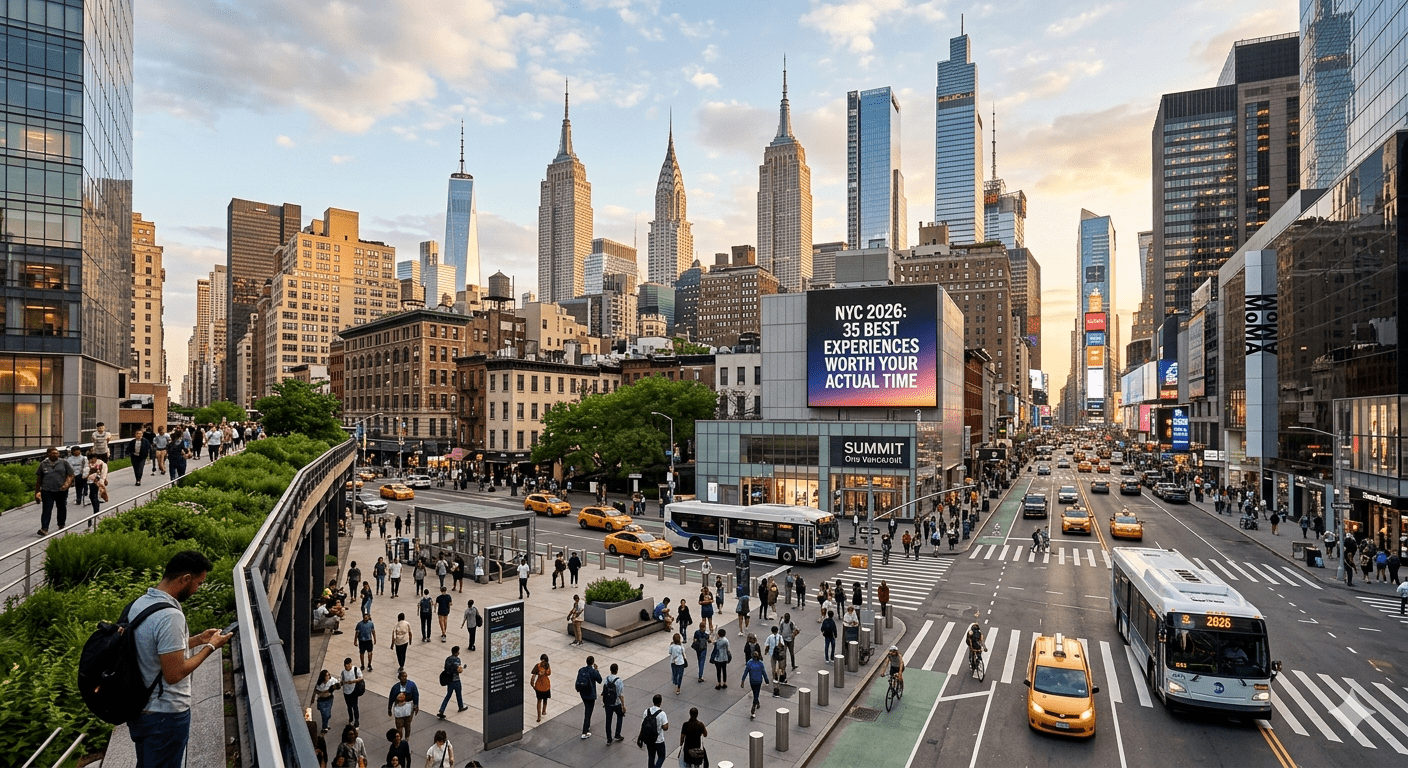
New York City in 2026: 35 Best Experiences Worth Your Actual Time
This guide covers first-time and returning visitors exploring NYC across 3–7 days. It does NOT address day trips outside the five boroughs or multi-week itineraries.
The best experiences in NYC are the ones you actually remember — not the ones you felt obligated to do. New York City isn’t a checklist. It’s a city with 8.3 million people, 5 boroughs, and roughly 26,000 restaurants. The options don’t overwhelm you. They paralyze you.
This guide cuts through that.
According to NYC Tourism + Conventions (2025), the city welcomed 64.3 million visitors in 2024 — surpassing pre-pandemic numbers for the first time. More people are coming. But most are still doing the same 10 things.
You won’t find a single “just walk around and soak it in” tip here.
What “Best Experiences in NYC” Actually Means in 2026
The best experiences in NYC are defined as moments that combine access, atmosphere, and timing in a way that makes the city feel genuinely alive to you — not staged for tourists. That sounds vague. It isn’t.
It means: knowing that the Top of the Rock gives you a better skyline view than the Empire State Building (because you can see the Empire State Building from it). It means knowing the High Line is best before 9 AM or after 7 PM. It means understanding that Chelsea, the East Village, and Astoria are completely different cities wearing the same zip code.
Most guides skip the timing. Almost all skip the pricing. None of them tell you when to book ahead versus when to just show up.
This one does.
The 35 Best NYC Experiences, Organized by Neighborhood
Rather than one undifferentiated mega-list, these are grouped geographically. Real travelers move through neighborhoods — not alphabetical indexes. Use this to build an actual day, not just a wish list.
Manhattan — Midtown and the Classics (Done Right)
1. Top of the Rock Observation Deck
Cost: $40–$50 | Booking: Required | Best time: Sunset or just after
Skip the Empire State Building if you can only do one. Top of the Rock gives you the full Manhattan skyline including the Empire State Building itself — which is the shot everyone wants. The 70th floor open-air platform is genuinely breathtaking, and it’s rarely as crowded as the alternative.
Quick note: Book the “sunset + twilight” ticket online. It lets you go up before sunset and stay through the city lighting up. Worth the extra $10.
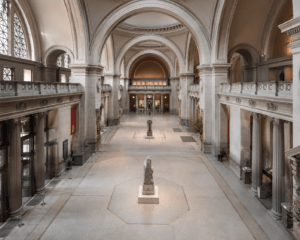
2. The Metropolitan Museum of Art
Cost: $30 suggested (pay what you wish for NY state residents) | Booking: Walk-in fine | Best time: Tuesday or Wednesday morning
The Met is not a morning-killing obligation. It’s 5,000 years of human creativity across 17 acres of floor space. You will not see it all. You shouldn’t try. Pick two wings — Egyptian Art and European Paintings, or Arms & Armor and the American Wing — and go deep.
3. One World Trade Center Observatory
Cost: $44 | Booking: Online in advance | Best time: Clear day, late morning
The views here are factually the highest in the Western Hemisphere. What most people don’t know: the “See Forever” theater experience at the beginning is actually worth sitting through. It contextualizes the building’s history in a way that hits harder than expected.
4. Chelsea Market
Cost: Free to enter | Booking: None | Best time: Late morning before lunch rush
Not a mall. Chelsea Market is a repurposed Nabisco factory with 35+ food vendors, independent shops, and one of the best lobster rolls in the city at The Lobster Place. Come hungry. Leave without plans.
5. The High Line
Cost: Free | Booking: None | Best time: Before 9 AM or after 7 PM
Here’s the thing: the High Line at noon in summer is a hot, crowded, sweaty experience that looks nothing like the photos. The same walk at 8 AM in May is genuinely magical — empty, cool, with the city waking up below you.
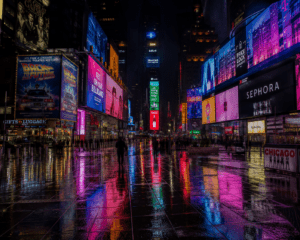
6. Times Square — Once, Briefly
Cost: Free | Best time: Actually, night
Controversial opinion: Times Square at night is worth 30 minutes. Not for what it is, but for the sheer sensory overload of it. The problem is people spend two hours there. Treat it as a 30-minute experience you pass through en route to a better dinner in Hell’s Kitchen.
7. Lincoln Center
Cost: Free to explore; ticketed shows from $30 | Booking: Required for shows | Best time: Evening
People treat Lincoln Center as ticketed-event-only territory. It isn’t. The outdoor plaza, especially in summer during Lincoln Center Out of Doors (free programming), is one of the most genuinely New York evenings you can have. Check the schedule before you go.
Manhattan — Lower and Downtown
8. The 9/11 Memorial & Museum
Cost: Memorial free; Museum $33 | Booking: Timed entry required | Best time: First entry of the day
This experience hits differently depending on what you’re expecting. The outdoor reflecting pools are free, quiet, and genuinely moving. The underground museum is thorough, emotionally heavy, and takes 2–3 hours. Don’t do both in one slot if you have somewhere to be.
9. Staten Island Ferry
Cost: Free | Booking: None | Best time: Any clear day
The best free thing in New York. The 25-minute ferry ride gives you the closest public view of the Statue of Liberty in either direction, Manhattan skyline views that rival any paid observatory, and a seat on the water.
It’s free. Both ways. Always.
10. Chinatown and the Tenement Museum
Cost: Museum tours $30 | Booking: Required for museum | Best time: Weekday
The Tenement Museum on Orchard Street is one of the most genuinely educational experiences in the city. Tours take you through preserved immigrant apartments from the 1800s and early 1900s — the kind of history that’s tactile, not textbook.
Pair it with dim sum in Chinatown beforehand. Golden Unicorn on East Broadway handles large groups; Nom Wah Tea Parlor on Doyers Street is for smaller parties who want the original.
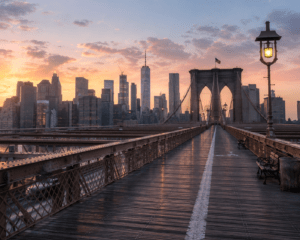
11. Brooklyn Bridge Walk
Cost: Free | Booking: None | Best time: Early morning, Manhattan to Brooklyn direction
Walk from Manhattan to Brooklyn, not the other way. The view opens up as you walk, ending with the full Manhattan skyline behind you. Takes 30–45 minutes. Arrive before 8 AM to avoid the cyclist traffic.
12. Wall Street and the Charging Bull
Cost: Free | Booking: None | Best time: Weekday morning for the full financial district atmosphere
Most people come for the Charging Bull. Stay for Bowling Green Park, the Federal Hall steps (where Washington was inaugurated), and the Trinity Church graveyard where Alexander Hamilton is buried. The graveyard is genuinely unexpected.
13. The Oculus at Westfield World Trade Center
Cost: Free | Booking: None | Best time: Sunny midday
Santiago Calatrava’s white-ribbed train station is either stunning architecture or an expensive eyesore, depending on who you ask. That’s valid for both sides. But the interior on a sunny day — when light pours through the central skylight — is a legitimate photograph.
Manhattan — Uptown and Central Park
14. Central Park — The Parts That Aren’t Just “Central Park”
Cost: Free | Booking: None | Best time: Morning or late afternoon
Belvedere Castle. The Ramble. Strawberry Fields. Conservatory Garden (northeast corner, almost no one goes there). The Reservoir jogging path. Central Park is 840 acres. Most visitors see about 40 of them.
Pick a section, not the whole park.
15. The Frick Collection
Cost: $22 | Booking: Recommended | Best time: Weekday afternoon
The Frick is a mansion. A Gilded Age industrialist’s private home, converted into one of the most intimate art collections in the world. Vermeer, Rembrandt, El Greco — in rooms with working fireplaces and garden views. The scale of it is the experience. Nothing about it feels like a conventional museum.
16. Museum of Natural History
Cost: $28 suggested | Booking: Walk-in fine | Best time: Weekday morning
The dinosaur halls are legitimately excellent. The blue whale suspended in the Ocean Life hall is one of those things that stops adults in their tracks. If you’re traveling with kids, budget 4 hours minimum.
17. The Guggenheim
Cost: $30 | Booking: Recommended | Best time: Weekday
Frank Lloyd Wright’s spiral building is an experience regardless of what’s showing inside. Ride to the top, walk down through the rotating exhibitions. The building is the art. Or maybe I should say it this way: the building is also the art.
Brooklyn
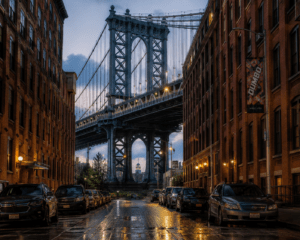
18. DUMBO
Cost: Free to explore | Best time: Morning
The Manhattan Bridge framing of the Empire State Building — the one everyone has seen in a photo — is on Washington Street between Front and Water. You now know exactly where to stand. Go before 10 AM.
19. Brooklyn Museum
Cost: $20–$25 | Booking: Walk-in fine | Best time: First Saturday of the month (free until midnight)
The First Saturday monthly event at the Brooklyn Museum is free, includes live music and programming, and runs until midnight. It’s one of the best-kept secrets for budget travelers and arguably the most authentically New York evening on this list.
20. Smorgasburg
Cost: Free entry; food $8–$18 per item | Booking: None | Best time: Saturdays 11 AM–6 PM, April–October
The largest open-air food market in America, held every Saturday in Prospect Park and Sunday in Williamsburg. According to Eater NY, over 100 vendors participate each season. The Original Ramen Burger was invented here. Come with $30 in cash and no dietary restrictions.
21. Prospect Park
Cost: Free | Best time: Weekend morning
Designed by the same team as Central Park (Olmsted and Vaux), Prospect Park is what those designers said was their better work. It’s less crowded, more local, has a boathouse, a zoo, and weekend LeFrak Center ice skating in winter. If you’re staying in Brooklyn, skip the Central Park trip and come here.
22. Brooklyn Botanic Garden
Cost: $20 | Booking: Timed entry required in spring | Best time: Late April for cherry blossoms, but any season works
I’ve seen conflicting data on this — some sources call it underrated, others say it’s become as crowded as any major attraction in spring. My read: the cherry blossom festival in late April is genuinely worth the crowds once. Every other time of year, you’ll have much of it to yourself.
23. Industry City
Cost: Free to explore | Best time: Weekend afternoon
A converted 35-acre industrial complex in Sunset Park with studios, food halls, whisky distilleries, and makers markets. Less polished than Chelsea Market, more interesting. The Japanese food hall alone is worth the subway ride.
Queens
24. Flushing — The Other Chinatown
Cost: Free to explore; meals $10–$20 | Best time: Weekend lunch
Flushing Meadows is home to one of the largest and most authentic Chinese food communities outside of mainland China. The New World Mall food court is the most referenced — but the Golden Shopping Mall basement has the widest variety. No English menus at many places. That’s the point.
25. Museum of the Moving Image
Cost: $20 | Booking: Walk-in fine | Best time: Weekday
This Astoria museum covers the technical and cultural history of film and television. Interactive exhibits let you dub your voice into movie scenes, add sound effects to silent films, and explore animation frame by frame. Underrated doesn’t cover it.
26. Noguchi Museum
Cost: $10 | Booking: Walk-in | Best time: Weekday afternoon
Isamu Noguchi’s own converted factory in Long Island City, housing his sculpture collection. Quiet, meditative, exceptional. It’s the kind of place where you stay longer than you planned because there’s nothing telling you to leave.
The Bronx
27. The Bronx Zoo
Cost: $39.99 (pay what you wish on Wednesdays) | Booking: Online | Best time: Weekday
The largest metropolitan zoo in the United States. The Congo Gorilla Forest alone covers 6.5 acres. Wednesday’s suggested-donation entry is one of the better value hacks in the city.
28. Arthur Avenue — The Real Little Italy
Cost: Free to explore; meals $15–$40 | Best time: Weekend lunch
Manhattan’s Little Italy is, frankly, mostly for tourists. Arthur Avenue in the Bronx is where Italian-American families have been shopping and eating since the 1900s. Eataly gets the press. Arthur Avenue deserves it.
Experiences That Cross Neighborhoods
29. NYC Explorer Pass (Go City)
If you’re hitting 4+ paid attractions, the NYC Explorer Pass from Go City typically saves 40–50% versus individual ticket prices. It covers Top of the Rock, the Met, 9/11 Museum, and 25+ other options. The math only works if you plan to use at least 4 inclusions.
Quick Comparison: NYC Observation Decks
| Option | Best For | Key Benefit | Limitation |
|---|---|---|---|
| Top of the Rock | Skyline photos | Empire State Building in the view | $40–$50 cost |
| One World Observatory | Height experience | Western Hemisphere’s highest | Downtown only |
| Edge at Hudson Yards | Modern architecture fans | Tilted glass floor, unique angle | $40+, less iconic view |
| Empire State Building | Classic NYC bucket list | Most recognizable name | You can’t see it from it |
30. Airbnb Experiences NYC
Airbnb Experiences in NYC include things like private pizza-making classes in a Brooklyn apartment, sunrise photography walks led by working photographers, and cocktail workshops in speakeasy-style bars. Cost: $30–$120. Most can be booked 24 hours out. Worth browsing before you finalize your trip calendar.
31. The Infatuation’s NYC Restaurant Picks
The Infatuation is a restaurant recommendation platform founded by two former music industry employees who were tired of Yelp. Their NYC guides are neighborhood-specific, opinionated, and updated regularly. For food experiences specifically, their lists outperform every other source I’ve used consistently.
Look — if you’re trying to plan dinner in a neighborhood you’ve never been to, here’s what actually works: pull up The Infatuation, filter by neighborhood, sort by “neighborhood favorites” not “most popular,” and pick the one that fits your budget and group size.
32. Free NYC: What Actually Doesn’t Cost Anything
The city’s genuinely free experiences are better than most cities’ paid ones. Short list:
- Staten Island Ferry (free, spectacular harbor views)
- Brooklyn Bridge Walk (free)
- The High Line (free)
- Governors Island (free ferry on weekends; the island itself has art installations, hammocks, and zero cars)
- Shakespeare in the Park at the Delacorte Theater in Central Park (free tickets, same-day lottery via the TodayTix app)
- First Saturday at Brooklyn Museum (free until midnight)
- Grand Central Terminal’s Whispering Gallery (free; stand in opposite corners of the lower passage and whisper — physics does the rest)
33. Governors Island
Cost: Free ferry on weekends | Booking: None | Best time: Saturday morning, late May through October
This one gets mentioned and then skipped. Don’t skip it. Governors Island is a car-free island off Lower Manhattan with sweeping harbor views, art installations, food vendors, and hammock groves. The ferry runs from Brooklyn Bridge Park and the Battery Maritime Building. It closes at 6 PM.
34. Jazz in Greenwich Village
Cost: Cover charge + drink minimum ($30–$60 total) | Booking: Required | Best time: Late Friday or Saturday
The Village Vanguard has been running since 1935. Blue Note is the better-known name. Both are real. Both are small rooms where you’re 20 feet from musicians who’ve played Carnegie Hall. The cover charge feels expensive until you’re in the room.
35. A Sunday Morning in Any Brooklyn Neighborhood You Haven’t Heard Of
Cost: A MetroCard | Best time: Sunday before noon
Carroll Gardens. Bay Ridge. Ridgewood (technically Queens). Park Slope before the brunch crowd arrives. The city’s best neighborhoods are the ones that don’t appear on anyone’s top-10 list yet. Take the subway somewhere unfamiliar. Get a coffee. Sit outside. Watch the city exist for its own residents, not its visitors.
That’s the experience no article can give you. But it’s worth naming.
What Most NYC Travel Guides Get Wrong
Most NYC guides are organized by attraction type — museums, parks, food, nightlife. That’s useful for a database. It’s useless for planning a day.
What most guides skip is the neighborhood logic. Manhattan below 14th Street operates differently than Midtown. Midtown operates differently than the Upper West Side. Brooklyn is not one place. You don’t experience New York by category — you experience it by moving through physical space.
Some experts argue that any NYC guide is inherently outdated — restaurants close, exhibitions change, venues shift hours. That’s valid for hyper-specific recommendations. But if you’re dealing with the foundational geography of how neighborhoods connect and which experiences anchor each one, that logic holds for years. This guide is built on the stable layer, not the ephemeral one.
What I can’t tell you: which restaurants will still be open when you arrive, or which exhibitions will be showing at the museums. Check The Infatuation and each venue’s website within a week of your trip.
How to Plan Your NYC Days Without Losing Your Mind
To actually plan an NYC trip using this guide, follow these steps:
- Pick your base neighborhood or borough — this determines your daily radius
- Choose 2–3 anchor experiences per day, not 6 — NYC travel days always run longer than planned
- Organize anchors geographically so they’re within walking distance or one subway stop
- Book all ticketed attractions at least 3 days in advance — same-day availability for Top of the Rock, 9/11 Museum, and the Guggenheim is not guaranteed
- Leave one afternoon with no plan — the unplanned afternoon is always the story you tell
The NYC subway connects everything. An unlimited 7-day MetroCard costs $34 (as of 2026). Buy it at any station on arrival.
Voice Search Q&A
Q: What’s the best free thing to do in NYC? A: The Staten Island Ferry is free both ways and gives you unobstructed views of the Statue of Liberty and Manhattan skyline. It runs 24 hours a day, seven days a week.
Q: How do I avoid crowds at NYC attractions? A: Go early — before 10 AM at outdoor spots, and on weekday mornings for museums. Most NYC attractions are 40–60% less crowded on Tuesday and Wednesday versus Saturday.
Q: Should I buy an NYC Explorer Pass? A: Only if you plan to visit 4 or more paid attractions. Go City’s NYC Explorer Pass typically saves 40–50% in that case. For 1–3 attractions, individual tickets are more cost-effective.
Q: Why does Brooklyn feel so different from Manhattan? A: Brooklyn’s neighborhoods each developed as independent communities before being annexed into New York City in 1898. DUMBO, Park Slope, Williamsburg, and Sunset Park are geographically close but culturally distinct — different demographics, different food scenes, different energy entirely.
Q: When should I visit NYC for the best experience? A: Late April through early June, and mid-September through October. Weather is mild, major outdoor programming is active, and crowds are lower than July–August. According to NYC Tourism + Conventions data, summer is peak season — meaning peak prices and peak crowds simultaneously.
1 thought on “35 Best Experiences in NYC You Shouldn’t Miss in 2026”