
NYC’s Top 10 Places to See: What’s Actually Worth Your Time as a First-Timer
This guide covers Manhattan’s most essential tourist attractions for first-time visitors with 3–7 days in the city. It does NOT address outer-borough deep dives, nightlife, or dining recommendations — those deserve their own articles.
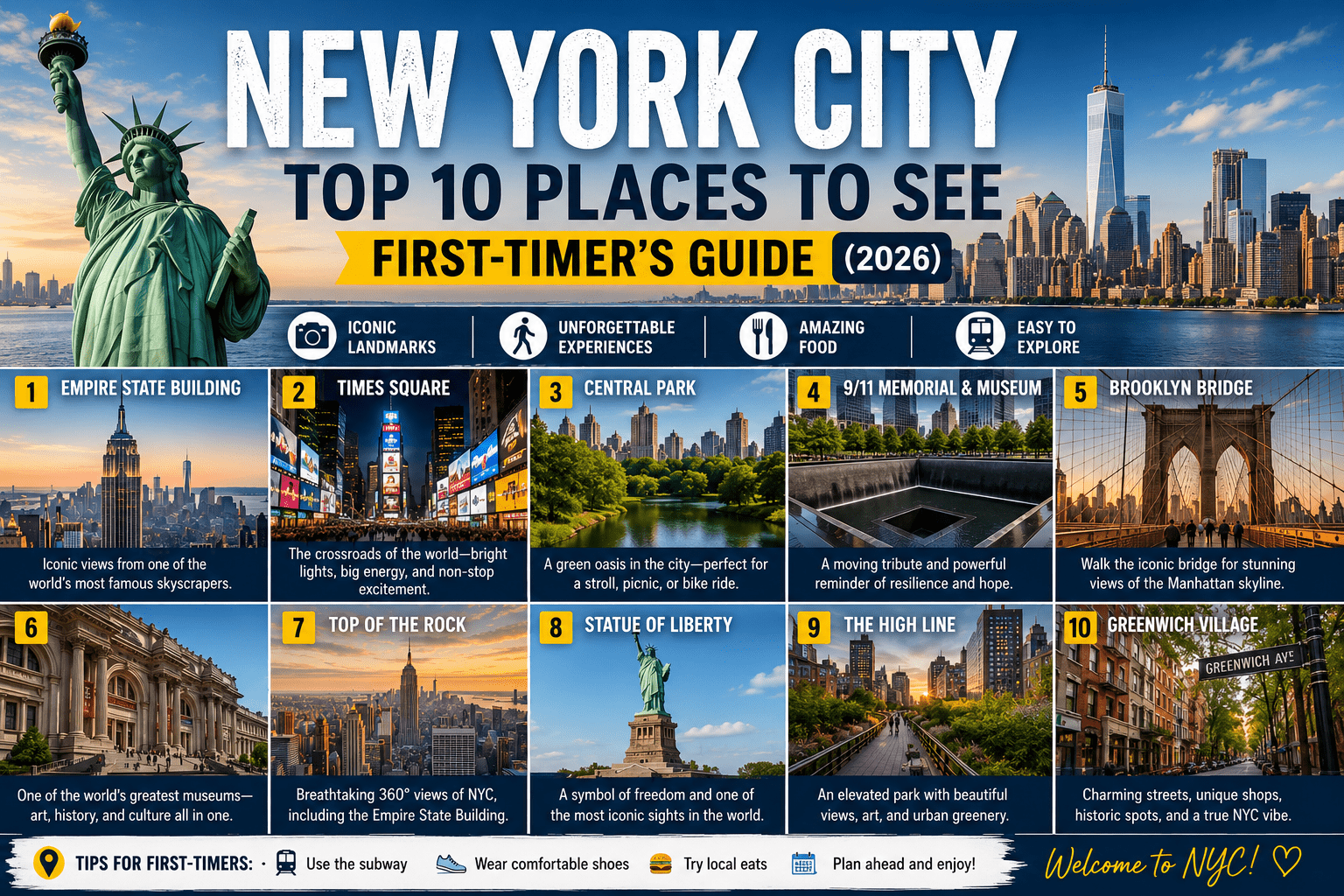
New York City’s top 10 places to see include the Statue of Liberty, Central Park, the Empire State Building, Times Square, the Metropolitan Museum of Art, the High Line, the Brooklyn Bridge, the 9/11 Memorial, Rockefeller Center’s Top of the Rock, and the Museum of Modern Art. Each one offers something genuinely distinct — this guide tells you exactly how long to spend at each, what it costs, and which ones to pair on the same day.
New York City welcomed 64.5 million visitors in 2024, a 3.7% increase from the previous year — and most of them had no plan. They showed up at the Empire State Building at noon on a Saturday, waited 90 minutes, and used half their sightseeing day in a queue. Don’t be that person.
This works best if you have 4–6 days. If you only have 48 hours, focus on items 1, 3, 5, and 7 — you can cover those in two strategic days.
How to Stop Wasting Days Crossing the City
Before the list, one thing most guides completely skip: geography.
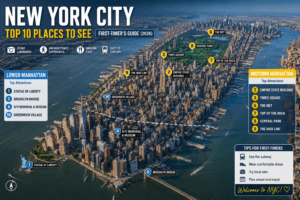
NYC’s top attractions cluster into two zones. Lower Manhattan holds the Statue of Liberty, the Brooklyn Bridge, and the 9/11 Memorial — all within walking distance of each other. Midtown holds Times Square, the Empire State Building, Rockefeller Center, and MoMA. Central Park and the Met sit just north of Midtown on the Upper East Side, and the High Line runs along the West Side from Chelsea up to Hudson Yards.
Here’s the thing: if you don’t plan by neighborhood, you’ll spend three hours a day on the subway just moving between things you could’ve seen back-to-back. Group your days like this — Lower Manhattan day, Midtown day, Upper East Side + park day. That’s it. The rest is detail.
1. Statue of Liberty and Ellis Island
Zone: Lower Manhattan | Time needed: 4–5 hours | Cost: Ferry tickets from ~$24 (National Park Service ferry) or ~$30+ via private operators
The Statue of Liberty isn’t just a photo opportunity. It’s the thing most international visitors say they felt most unexpectedly moved by. Standing at the base — not from the water, but actually on the island — changes the experience completely.
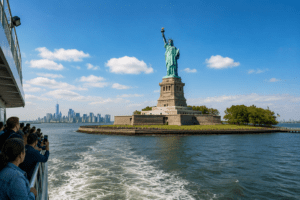
The patinaed copper gift from France was completed in the U.S. in 1886 and sits on Liberty Island. You can visit the grounds and museum for free with your ferry ticket, but access to the crown requires a separate timed reservation that books up weeks in advance. Book through nps.gov only — third-party sites charge unnecessary markups for the same access.
Quick note: the free Staten Island Ferry gives you a solid view of the statue from the water at zero cost. If your budget is tight, that’s a legitimate alternative.
What most guides skip: Pair Ellis Island in the same trip. The immigration museum there is genuinely absorbing — plan 1.5 hours for it. Many visitors skip it because they’re tired after Liberty Island. Don’t.
2. Central Park
Zone: Upper Manhattan (runs from 59th to 110th Street) | Time needed: 2–4 hours | Cost: Free to enter
Central Park’s 843 acres see 42 million visits per year. It was designed in 1858, and it’s still one of the most intelligently laid-out urban parks in the world.
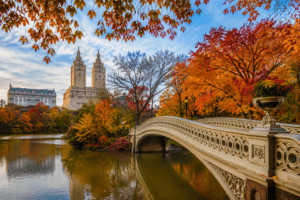
Most people enter at the south end near 59th Street, wander around Sheep Meadow for 40 minutes, and call it done. That’s the tourist version. The real version means finding Bow Bridge, Bethesda Fountain, and the Conservatory Garden — none of which you’ll stumble into by accident.
Walking the entire perimeter takes about 3 hours; 2 hours is enough to hit the key landmarks. If you’re visiting in winter, Wollman Rink is worth the detour. In summer, the free Shakespeare in the Park performances at the Delacorte Theater are one of NYC’s best-kept secrets — though they book out fast. The newly renovated Delacorte Theater reopened in August 2025 and is celebrating its grand reopening for Summer 2026, with accessible ticketing available via the TodayTix app.
Pair this with: The Metropolitan Museum of Art sits directly on the park’s east edge at 82nd Street. Do both on the same afternoon.
To visit Central Park efficiently as a first-timer:
- Enter at 72nd Street on the west side
- Walk east across the park to Bethesda Fountain (15 minutes)
- Continue north along the lake to Bow Bridge (10 minutes)
- Exit east on 79th Street toward the Met
3. Empire State Building
Zone: Midtown | Time needed: 1.5–2 hours | Cost: ~$44–$49 for the 86th floor; ~$64–$69 for both decks (book online in advance)
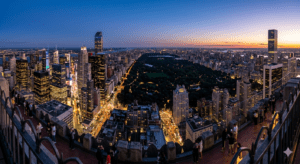
The Empire State Building opened May 1, 1931, after taking only one year and 45 days to complete, and currently stands as the 6th tallest building in the U.S. at 1,454 feet from ground to the top of its antenna.
I’ve seen conflicting opinions here — some travel writers argue Top of the Rock at Rockefeller Center offers better views because you can see the Empire State Building itself from there. That’s valid for photographers. But if you’re visiting NYC for the first time, the Empire State Building is the one that carries the emotional weight. It’s the one you’ve seen in every film. Being on that open-air 86th-floor deck at night — it’s not something you forget.
CityPASS NYC offers savings of up to 42% at top attractions with nine days to use your tickets, with admission including the Empire State Building and American Museum of Natural History, plus your choice of three additional attractions. If you’re planning to visit 4+ paid attractions, CityPASS or the NYC Explorer Pass via Go City are worth running the numbers on before you book anything individually.
Don’t bother: The 102nd floor upgrade is $20 extra. The view difference is marginal. Save it.
4. Times Square
Zone: Midtown | Time needed: 30–45 minutes | Cost: Free
Here’s the honest take most guides won’t give you: Times Square is not an attraction, it’s an experience. You visit it once, you absorb it, and then you mostly avoid it for the rest of your trip.
Times Square attracts as many as 400,000 people every day — 460,000 on peak summer days. It’s genuinely overwhelming at full volume. The best time to experience it is either early morning (before 8am, when it’s eerily quiet and you can actually see the architecture) or late night after 10pm when the lights hit differently.
Or maybe I should say it this way: Times Square is the city’s front door. You walk through it, you acknowledge it, and then you go find the actual NYC.
What to actually do there: Look up at the billboards, walk the full block from 42nd to 47th Street, and then get out. Don’t eat here — the restaurants are tourist-priced and mediocre.
5. The Metropolitan Museum of Art
Zone: Upper East Side | Time needed: 3–5 hours (minimum 2 hours) | Cost: $30 adults; pay-what-you-wish for NY state residents
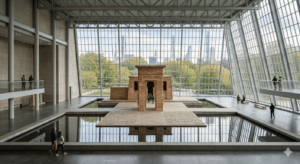
The Met is not a museum you can do in an afternoon. It’s one of the largest art museums in the world, and trying to see all of it is a mistake that leaves people feeling nothing. Pick two or three sections and go deep: Egyptian Art (including the Temple of Dendur), European Paintings, and the Arms and Armor collection are the three that consistently make people stop mid-step and stare.
With everything from Egyptian mummies to Post-Impressionist paintings, there’s something for everyone — though that description almost undersells it. The Temple of Dendur alone, a real ancient Egyptian temple relocated stone by stone inside a glass-enclosed wing, is one of the most surreal things you’ll see anywhere.
Counter-intuitive insight: Most people assume the Met is for art lovers. The data — and the reviews — say otherwise. It consistently ranks as a favorite among visitors who “don’t usually like museums.” The scale and variety make it accessible in a way most galleries aren’t.
6. The High Line
Zone: West Side, Chelsea to Hudson Yards (34th Street) | Time needed: 1–1.5 hours | Cost: Free
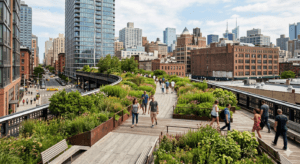
The High Line is a 1.45-mile elevated park built on a former freight rail line running above Tenth and Eleventh Avenues. It’s free, it’s beautiful, and it’s one of the few places in the city where you walk at second-story height while watching the street below.
Walk it south to north — start at the Gansevoort Street entrance in the Meatpacking District and end at the Hudson Yards development at 34th Street. The views of the Hudson River from the northern section are genuinely striking, and the plantings change by season in ways that make it worth visiting even in winter.
Pair this with: Hudson Yards and the Vessel (the honeycomb sculpture) are at the northern end. The Meatpacking District and Chelsea Market are at the south end. You could build a full half-day around this strip with minimal extra travel.
7. Brooklyn Bridge and DUMBO
Zone: Lower Manhattan/Brooklyn border | Time needed: 1–2 hours | Cost: Free
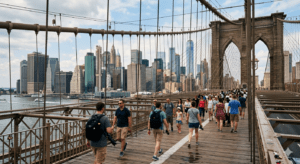
Walking the Brooklyn Bridge pedestrian path is one of the best free things you can do in NYC. It takes about 30 minutes to cross — and you should walk from the Manhattan side to the Brooklyn side, not the other way. The view of the Manhattan skyline opens up behind you as you walk toward Brooklyn, and it’s spectacular.
There is no entry fee for the Brooklyn Bridge itself, though guided bike tours are available if you’d prefer company.
Once you reach the Brooklyn side, you’re 5 minutes from DUMBO (Down Under the Manhattan Bridge Overpass) — one of NYC’s most photographed neighborhoods. The view down Washington Street with the Manhattan Bridge perfectly framed at the end is the photo you’ve seen a hundred times. It’s even better in person.
Pair this with: The 9/11 Memorial is a 20-minute walk back toward Lower Manhattan. This pairing makes for a natural, emotionally varied half-day.
8. The 9/11 Memorial and Museum
Zone: Lower Manhattan | Time needed: 2–3 hours | Cost: Memorial plaza is free; Museum is $33 adults
The memorial — two massive reflecting pools set in the footprints of the original towers — is free and open daily. Standing at the edge and reading the names is quiet, heavy, and important. It doesn’t require a museum ticket.
The museum below is a separate experience and a more significant time commitment. It’s extraordinarily well-curated, and some visitors find it emotionally exhausting. Plan accordingly — don’t schedule anything demanding immediately after.
What to know: The memorial plaza can be visited without entering the museum. Many people don’t realize this and either skip the whole site or pay for the museum when they only wanted the outdoor memorial.

9. Top of the Rock at Rockefeller Center
Zone: Midtown | Time needed: 1–1.5 hours | Cost: ~$40–$45 adults
Top of the Rock vs. Empire State Building: Top of the Rock is better for photography (you can see the Empire State Building from it). The Empire State Building is better for the symbolic experience. Pick one unless you’re using CityPASS, which includes both at a significant discount.
Rockefeller Center itself is worth spending 30 minutes exploring at street level — the Art Deco architecture of the plaza, the murals in the concourse, and the seasonal ice rink (free to watch, ticketed to skate) are all worth your time even without going up.
10. The Museum of Modern Art (MoMA)
Zone: Midtown | Time needed: 2–3 hours | Cost: $30 adults; free Friday evenings 5–9pm
MoMA holds some of the most recognizable works in 20th-century art: Van Gogh’s The Starry Night, Picasso’s Les Demoiselles d’Avignon, Warhol’s Campbell’s Soup Cans. These aren’t reproductions — they’re the actual paintings. People who don’t consider themselves art enthusiasts report being genuinely stopped by how different a famous work looks in person versus in print.
Friday evenings are free from 5pm. It’s crowded, but it’s free — and the atmosphere is more relaxed than you’d expect.
Pair this with: Times Square is a 10-minute walk east. MoMA makes for a good anchor on your Midtown afternoon.
Quick Comparison: Which Attractions Are Worth the Cost?
| Attraction | Best For | Key Benefit | Limitation |
|---|---|---|---|
| Empire State Building | First-timers wanting the iconic experience | Emotional weight, open-air 86th deck | Lines can be long without timed entry |
| Top of the Rock | Photographers | Empire State Building in the frame | Less iconic in terms of history |
| Statue of Liberty | Anyone with a half-day | Gets you off the island of Manhattan | Needs advance ferry booking |
| The Met | Art/culture lovers and skeptics alike | Depth and variety unmatched in NYC | Easy to spend more time than planned |
| MoMA | Modern art, design, and architecture fans | Sees the actual originals | Smaller in scale than The Met |
Saving Money: Do the Passes Actually Work?
Look — if you’re visiting 4 or more paid attractions, run the numbers before you book anything individually.
CityPASS NYC offers savings of up to 42% at top attractions, with nine days to use your tickets. Admission includes the Empire State Building and American Museum of Natural History, plus your choice of three from the 9/11 Memorial and Museum, Circle Line Sightseeing Cruises, Guggenheim Museum, Top of the Rock, ferry access to the Statue of Liberty, and the Intrepid Museum.
The NYC Explorer Pass (Go City) is more flexible — you choose a set number of attractions and the pass is valid for 30 days. It’s better for flexible travelers who haven’t fully planned their itinerary. For most first-timers with a firm schedule, CityPASS gives better value. But it’s worth checking current prices on both before you commit; the math changes based on which specific attractions you’re planning.
Q&A: What First-Timers Actually Want to Know
Q: What’s the best single day trip for a first-timer in NYC with only one day? A: Start at the Brooklyn Bridge in the morning, walk into DUMBO for photos, take the subway to the High Line, end at the Empire State Building at dusk. That’s a day that covers free, iconic, and paid experiences efficiently.
Q: How do I get around between attractions without spending a fortune on cabs? A: Use the MTA subway. A single ride is $2.90, or get an OMNY card and tap with a contactless credit card — the weekly fare cap means you’ll never pay more than $34 in a week regardless of how many rides you take. The MTA app shows real-time arrivals.
Q: Should I buy attraction tickets in advance or can I buy on the day? A: Buy the Empire State Building and Statue of Liberty ferry tickets in advance — lines without timed entry can run 60–90 minutes on peak days. Central Park, High Line, Brooklyn Bridge, and the 9/11 Memorial plaza need nothing booked ahead. The Met and MoMA are manageable walk-in on weekday mornings.
Q: Why does Times Square disappoint so many visitors? A: Because it’s been built up as the centerpiece of NYC, when it’s actually just a very dense commercial intersection. It’s impressive once. What makes NYC genuinely remarkable is the variety of neighborhoods, food, and cultural institutions — not one loud corner of Midtown.
Q: When should I visit NYC for the best experience without the worst crowds? A: September and October give you good weather, manageable crowds, and the best light for photography. Summer and December are the busiest periods, while January and February see fewer crowds and the best combination of low prices on flights, hotels, and Broadway shows.
The One Thing That Makes the Difference
Everybody comes to NYC with a list. The travelers who leave satisfied aren’t the ones who checked off the most items — they’re the ones who didn’t try to rush every item.
Give yourself permission to sit on a bench in Central Park for 20 minutes and do nothing. Stand on the Brooklyn Bridge longer than you planned. Let the city interrupt your schedule once or twice.
NYC rewards that. It almost always does.