
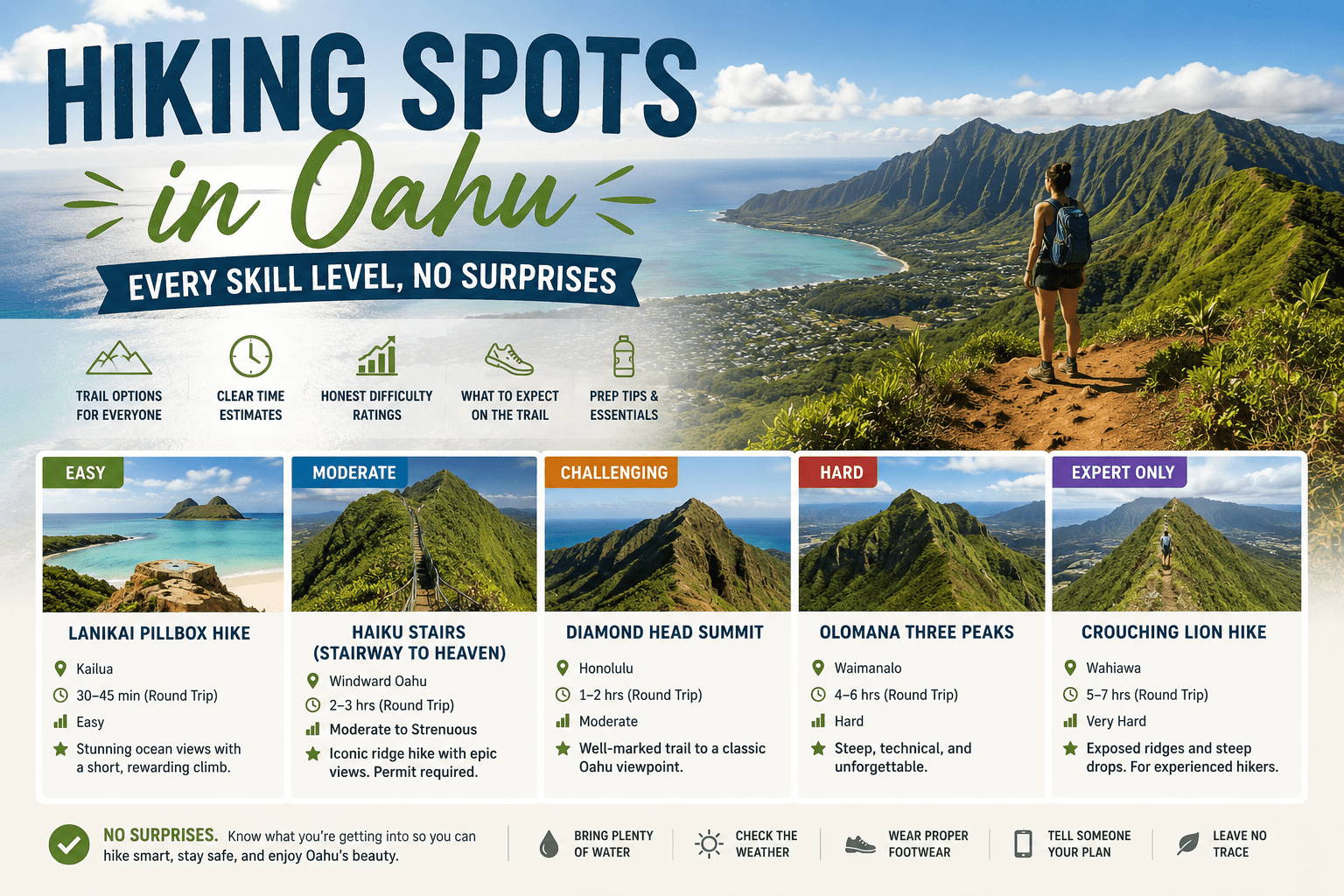
Hiking Spots in Oahu — Every Skill Level, No Surprises
Oahu’s trails range from paved lighthouse walks to ridge scrambles that’ll test experienced hikers. The island has it all — but the part most guides skip is what separates a great day outdoors from a search-and-rescue call.
According to Hawaii’s Department of Land and Natural Resources (DLNR), Oahu records over 200 trail rescue incidents annually, with the majority involving visitors who simply didn’t know what they were walking into. Not extreme athletes. Regular tourists.
This guide won’t do that to you.
What Most Oahu Hiking Guides Get Wrong (Read This First)
Hiking spots in Oahu refers to the network of state, city, and federally managed trails spread across the island — from coastal walks to Ko’olau ridge routes. Most are free and open year-round, but a handful require advance permits, and several are currently closed or restricted.
Here’s the thing: permit requirements aren’t buried in fine print. They’re enforced at the trailhead. Show up without one and you’re turned away — or fined.
Trails that currently require permits or reservations (as of May 2026):
- Lulumahu Falls (Nu’uanu Valley) — reservation and permit required through the DLNR Division of Forestry and Wildlife.
- Kuaokala Trail — access via the Air Force Ka’ena Point Tracking Station gate. Separate permit needed. Apply through DLNR.
- Poamoho Trail — currently closed. No permit applications accepted.
Quick note: The Haiku Stairs (“Stairway to Heaven”) remain illegal to access. The Honolulu City Council voted for demolition in 2021, a $2.6 million contract was awarded in 2024, and a court injunction halted it mid-demolition. The stairs are still standing — but trespassing carries real fines. Don’t let a viral photo tempt you.
For real-time closures, bookmark two sources: hawaiitrails.ehawaii.gov (the state’s official Nā Ala Hele trail database) and dlnr.hawaii.gov/dsp for state park notices. AllTrails user reviews often catch trail conditions — mud slides, downed trees, flash flood closures — before official sources update.
This works best if you’re visiting for at least 3 days. If you have a single afternoon, skip to the Easy section.
Easy Hiking Spots in Oahu (No Experience Needed)
Some of the island’s most rewarding views come on its easiest trails. Don’t mistake “easy” for “not worth it.”
Makapu’u Point Lighthouse Trail is the most accessible hike on the island. The main path is fully paved — stroller and wheelchair accessible — and climbs 500 feet over 2 miles round trip. The view from the top takes in the Ko’olau Range, Rabbit Island, and open ocean. Start before 8 AM to beat heat and crowds. One scheduling note: the DLNR is closing the trail until 11 AM on maintenance Tuesdays through late May 2026, so check before you go.
Kaena Point Trail sits at the westernmost tip of Oahu and runs roughly 5 miles round trip along flat, coastal terrain. It’s the easiest long trail on the island. The payoff is genuine wildness — Hawaiian monk seals haul out on the rocks, Laysan albatross nest nearby, and the crowds thin fast once you’re past the first mile. Note: the Keawa’ula (south side) access road remains closed due to repairs as of May 2026. Use the Mokule’ia (north side) trailhead instead. That section is open to pedestrians.
Manoa Falls Trail covers 1.6 miles round trip and ends at a 150-foot waterfall. It’s the quintessential beginner hike. Two things the brochures mention last: the trail is frequently muddy and genuinely slippery after rain, and leptospirosis is a real risk in standing water near the falls. Don’t wade in. There’s a $5 parking fee at the upper lot; parking in the lower neighborhood avoids the charge.
Look — if you’re traveling with kids under 10 or anyone with mobility concerns, Makapu’u or Kaena Point (north side) are your best calls. Manoa gets slick.
Moderate Oahu Hiking Trails With Stunning Views
Featured Snippet Block — How To Choose a Moderate Oahu Trail: To pick the right moderate hike in Oahu, follow these steps:
- Check current closures at hawaiitrails.ehawaii.gov before leaving your hotel.
- Start hiking before 7 AM — heat and crowds peak between 9 AM and noon.
- Bring at least 2 liters of water per person regardless of trail length.
- Download AllTrails offline maps before you lose cell signal on the ridge.
Diamond Head Summit Trail is the most recognized hike on Oahu. The trail is 1.6 miles round trip, gains 560 feet, and passes through the volcanic crater interior. Parking requires advance reservation through the Hawaii State Parks system. Koko Crater and Diamond Head are the two highest-volume rescue sites on the island — mostly from heat exhaustion. The trail has zero shade. A mid-2025 safety renovation sealed hazardous bunker shafts near the summit after an incident involving a child; the updated viewing platform installed in 2023 remains in good shape.
Lanikai Pillboxes on the windward side is short — under a mile — but the ascent is steep and uneven. The panoramic view of Kailua and Lanikai beaches from the old military bunkers is, without exaggeration, one of the best on the island. Getting there is the real challenge: parking in the Lanikai neighborhood is extremely limited. Most hikers park near Kailua Beach Park and walk in. Go at sunrise. The light is better anyway.
Or maybe I should say it this way — Lanikai at midday is a different hike entirely. Hot, crowded, and the view competes with a hundred other people’s phones. Sunrise version: completely different experience.
Ka’au Crater is the step up for hikers who want something more technical without committing to a full ridge traverse. The loop involves stream crossings, rope sections, and three waterfalls. It’s not officially maintained — meaning trail conditions vary significantly. Check AllTrails reviews posted within the last two weeks before attempting it.
Difficult Hiking Spots in Oahu for Experienced Hikers
Hard trails exist. Here’s what they actually demand.
Koko Crater Railway Trail follows an old military tramway up 1,050 wooden railway ties at a relentless grade. It’s 1.8 miles round trip but gains over 1,000 feet. No switchbacks. No shade. The Honolulu Magazine covered a recent renovation of the trail; conditions have improved. Still — Koko Crater lands in the top two rescue sites on the island. Start at dawn or stay home.
Moanalua Valley to Haiku Valley is a full-day commitment: roughly 10 miles round trip with significant elevation change, stream crossings, and technical scrambles near the top. This is where preparation genuinely matters. Bring trekking poles, a rain layer, and tell someone your plan. The trailhead requires a bit of navigation — the Hawaii Trail and Mountain Club website has reliable access notes.
I’ve seen conflicting data on the best season for ridge hikes — some sources say summer for drier conditions, others point to winter for cooler temperatures. My read is that early spring (March–April) hits the best balance: drier than winter, cooler than summer, and trail vegetation is often clearer. But check conditions within 48 hours either way.
Most people assume the difficult trails are dangerous because of the climbing. The data says otherwise. Dehydration, starting too late in the day, and underestimating descent time account for most incidents. The ascent feels manageable; knees turn to jelly on the way down.
Hidden Hiking Trails in Oahu Off the Beaten Path
The most crowd-free trails on Oahu tend to be the ones with a small procedural barrier — a permit, an unusual trailhead, a less-indexed name.
Judd Trail in Nu’uanu Valley is a 1.5-mile loop through dense ironwood and bamboo. It doesn’t appear on most curated lists. There’s a swimming hole — skip it (leptospirosis risk, same as Manoa). The trail itself is quiet, shaded, and completely unlike the exposed ridgeline hikes that dominate Oahu’s reputation.
Lulumahu Falls sits in the same Nu’uanu Valley watershed. It requires a permit (linked above), which is exactly why it stays uncrowded. The waterfall drops into a narrow gorge and the permit process is straightforward — it just filters out casual traffic.
Kuaokala Trail offers some of the best panoramic views on the island — the Waianae Coast, the ocean, and Kaena Point below — and almost nobody’s on it because access goes through the Air Force gate. The permit process is DLNR-managed. It’s worth the extra step.
Oahu Hiking Safety Tips — What to Do When Things Go Wrong
Featured Snippet Block — Definition: Oahu hiking safety refers to the preparation and real-time decisions that prevent trail emergencies on the island’s diverse terrain. Flash flooding, heat exposure, and leptospirosis from freshwater contact are the three risks most specific to Hawaii that mainland hikers consistently underestimate.
Flash floods are not gradual. They arrive without visible rain at the trailhead — the storm can be miles away on the ridge. If water in a stream changes color or rises suddenly, move uphill immediately. Don’t wait to see how bad it gets.
Some experts argue that AllTrails ratings are sufficient for trail-difficulty assessment. That’s valid for the most-visited trails with thousands of recent reviews. But if you’re looking at a trail with fewer than 50 reviews or reviews older than three months, those ratings can be dangerously stale. Cross-reference with the official Nā Ala Hele database.
What most guides skip: Cell signal fails on most ridge trails within 10 minutes of the trailhead. Download offline maps before you leave. The Outerspatial app carries official Nā Ala Hele trail data and works without signal.
For emergencies: Hawaii emergency services are reached at 911. The DLNR Division of Forestry and Wildlife can be reached through dlnr.hawaii.gov for non-emergency trail conditions.
Quick Comparison — Oahu Hikes at a Glance
| Trail | Best For | Key Benefit | Limitation |
|---|---|---|---|
| Makapu’u Lighthouse | Families, first-timers | Fully paved, ocean views | Steep grade, periodic closures |
| Kaena Point | Easy long walks, wildlife | Flat terrain, monk seals | North trailhead only (May 2026) |
| Diamond Head | Most visitors | Iconic crater interior | Reservation required, no shade |
| Lanikai Pillboxes | Sunrise photography | Best beach panorama on island | Parking nearly impossible |
| Koko Crater Railway | Fitness-focused hikers | Intense elevation gain, fast | Top rescue site — heat risk |
| Lulumahu Falls | Permit holders wanting solitude | Uncrowded, waterfall payoff | Permit required in advance |
| Kuaokala Trail | Experienced, permit-ready | Unmatched panoramic views | Air Force gate permit needed |
Getting There — Logistics Most Articles Ignore
Renting a car is effectively required for most trails outside of Diamond Head and Manoa Falls. TheBus (Oahu’s public transit) reaches Diamond Head and Manoa Valley; getting to Kaena Point, Lanikai, or Koko Crater by bus is theoretically possible but practically miserable.
Parking at Diamond Head and Makapu’u fills by 7:30 AM on weekends. For Lanikai, park at Kailua Beach Park and bike or walk the 1.5 miles in. It’s not optional — residents have towed tourist vehicles aggressively.
Kualoa Ranch on the windward side offers guided hiking experiences for visitors who want a structured option. The ranch provides access to valleys that aren’t otherwise open to the public. It’s not cheap — but the logistics are handled, and the valley terrain is legitimately different from anything on the public trail network.
Voice Search Q&A
Q: What’s the best easy hike in Oahu for beginners? A: Makapu’u Point Lighthouse Trail. It’s fully paved, stroller-accessible, and ends with ocean and mountain views. Two miles round trip, no experience needed.
Q: How do I get a permit to hike in Oahu? A: Apply through dlnr.hawaii.gov/dofaw/permits for trails like Lulumahu Falls and Kuaokala. Diamond Head parking reservations go through the Hawaii State Parks system separately.
Q: Should I hike Diamond Head or Koko Crater? A: Diamond Head if you want the classic experience and a manageable climb. Koko Crater if you want a serious workout. Both are top rescue sites — start before 7 AM either way.
Q: Why does Haiku Stairs keep appearing in Oahu hiking lists if it’s closed? A: Most lists are outdated. The stairs have been illegal to access since 2021. A demolition contract was issued in 2024 but halted by court injunction. Do not attempt access — fines are enforced.
Q: When should I hike in Oahu to avoid crowds? A: Weekday mornings before 7 AM. Trails like Diamond Head and Lanikai Pillboxes are genuinely overwhelming by 9 AM on weekends. Early spring (March–April) has the best weather-to-crowd ratio.