
27 Best Things to Do in Manhattan for First-Time Visitors (2026)
Manhattan doesn’t ease you in. It hits you immediately — the noise, the density, the sheer speed of everything happening on a single block. For first-timers, that energy is thrilling and completely paralyzing at the same time.
Most travel guides don’t help. They dump 50 attractions in no particular order, call it a list, and leave you figuring out why you’re stuck in a line that wraps around the Empire State Building at 3pm on a Saturday.
This guide does things differently. The 27 experiences below are grouped by neighborhood logic so you can build real walking days — not just skim a list. Where timing matters, we say so. Where something isn’t worth the money, we say that too.
Quick answer: Things to do in Manhattan refers to the full range of cultural, culinary, outdoor, and entertainment experiences available across the island’s distinct neighborhoods — from world-class museums on the Upper East Side to food halls in Chelsea and live jazz in the West Village. The island packs more variety per square mile than almost any destination on earth.
According to NYC Tourism + Conventions’ 2026 Annual Report, New York City welcomed 65 million visitors in 2025, generating $84.7 billion in economic impact. Manhattan accounts for the majority of those visits — and for most of the frustration when people don’t plan ahead.
This guide covers day-trip and multi-day planning for first-time Manhattan visitors. It does not cover outer boroughs, New Jersey day trips, or nightlife-only itineraries.
How to Actually Use This Guide
Manhattan is a long, narrow island running north to south. The neighborhoods stack vertically — Downtown at the bottom, Midtown in the middle, Uptown toward the top. This matters more than most travel writers let on.
Most first-timers bounce between all three zones in a single day. That’s 4–6 miles of walking or constant subway juggling. The smarter move: pick one zone per day.
Here’s the thing: east-west blocks in Manhattan are long — sometimes 4x longer than north-south blocks. “A few blocks” east can be a 15-minute walk. Know the difference before you commit to a route.
To plan a Manhattan day trip, follow these steps:
- Pick one zone — Downtown (below 14th St), Midtown (14th–59th St), or Uptown (59th St and above)
- Anchor your day around one major paid attraction, then add 2–3 free stops nearby
- Book ticketed venues at least 48 hours ahead in peak season
- Eat at neighborhood spots between stops — don’t backtrack for food
- Start before 10am; crowds hit by 11am and stay all day
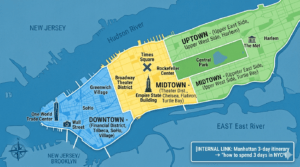
Downtown Manhattan: History, Views & the Best Free Experiences
Downtown gives you the oldest and newest parts of the city in one walkable corridor — colonial-era streets sitting directly below the glass towers of the new World Trade Center complex.
1. One World Trade Center & the 9/11 Memorial
The reflecting pools are free and open daily. They’re two of the largest man-made waterfalls in North America, set into the exact footprints of the Twin Towers. You don’t need a museum ticket to visit them.
What most guides skip: the outdoor plaza is architecturally stunning and almost always quieter than you’d expect, even in peak summer. If budget is tight, skip the museum and spend 30 minutes at the pools instead. The weight of the place doesn’t require an entrance fee.

2. The Staten Island Ferry — Free Skyline Views
Free. Runs 24 hours. Gives you an unobstructed view of the Statue of Liberty and the Lower Manhattan skyline from the water.
The Statue of Liberty ferry costs $24 and books out weeks in advance in summer. The Staten Island Ferry gives you 80% of the visual payoff at zero cost. That math is easy.
3. The Brooklyn Bridge Walk
Start from City Hall Park on the Manhattan side. Walk across. The views looking back at the Downtown skyline are the best free skyline shot most visitors take.
Go before 9am or after 5pm. Midday, the pedestrian path is genuinely crowded — cyclists weaving through, tourists stopping mid-stride, delivery bikes honking. It’s less peaceful than the Instagram version suggests.
4. South Street Seaport & the Financial District
The Seaport has been significantly renovated in recent years. There’s waterfront dining, a seasonal market, and the Tin Building — a food hall from chef Jean-Georges Vongerichten with vendors across multiple levels. Wall Street, the Charging Bull, and the Fearless Girl statue take about 90 minutes to walk.
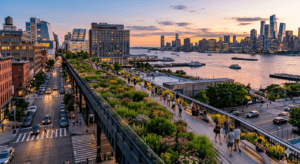
5. The High Line — Start at the Southern End
An elevated park built on a defunct freight rail line, running from Gansevoort Street in the Meatpacking District up to 34th Street. Start at the south end for Hudson River views and the best landscaping sections.
Some longtime New Yorkers argue the High Line has become too polished and too crowded to feel authentic. That’s a fair criticism. But for a first-time visitor, the perspective it gives you over the Hudson and West Chelsea is unlike anything else in the city — go on a weekday morning and it’s actually quiet.
Midtown Manhattan: The Big Landmarks, Done Right
Midtown is where most first-timers spend most of their time — and where most of them burn out. The density of famous things is real. So is the foot traffic. Strategy matters here more than anywhere else on the island.
6. Central Park — Beyond the Obvious
843 acres. Free. The most visited urban park on earth. But “go to Central Park” is useless advice without specifics. Here’s where to actually spend your time:
- Bethesda Fountain and Terrace — the iconic arched underpass and fountain, worth 30 minutes
- The Ramble — a naturalistic woodland section in the middle of the park, almost always quieter than main paths
- Strawberry Fields — small memorial to John Lennon, near the West 72nd St entrance
- The Great Lawn — best for a picnic on a clear day; no formal attractions, just open grass
- The Reservoir — a 1.6-mile loop with northern Manhattan views, popular with runners
Skip the horse-drawn carriages. They’re slow, expensive, and controversial.
7. Top of the Rock vs Empire State Building
This is the question every first-timer asks. The answer depends entirely on what you want to take home.
Quick Comparison: Rooftop Observation Decks
| Option | Best For | Key Benefit | Avg. Cost |
|---|---|---|---|
| Top of the Rock (30 Rock) | Skyline photography | Empire State Building appears in your shot | ~$40 |
| Empire State Building | Iconic NYC experience | 360° views; globally recognized landmark | ~$44 |
| One World Observatory | Lower Manhattan + harbor | Tallest point; best water views | ~$46 |
| Summit One Vanderbilt | Premium immersive experience | Glass art installation; most modern feel | ~$49 |
| Staten Island Ferry | Budget view | Free; water-level skyline perspective | Free |
Top of the Rock vs Empire State Building: Top of the Rock is better suited for photography because it puts the Empire State Building in your skyline shot — you can’t photograph what you’re standing on. The Empire State works better when the iconic experience itself is the point. The key difference is what you want to take home: a photo that includes the skyline, or the memory of standing on a landmark.
8. Times Square
Go once. At night. Don’t eat there — restaurants charge tourist prices for mediocre food. Take your photos, absorb the sensory overload for 20 minutes, and leave.
That’s the genuine advice, even if it sounds dismissive. Times Square is a real experience. It’s just not a lingering one.
9. The Museum of Modern Art (MoMA)
MoMA’s permanent collection includes Van Gogh’s The Starry Night, Monet’s water lilies series, and Picasso’s Les Demoiselles d’Avignon. Adult tickets run about $30. Friday evenings (5–9pm) are free for New York State residents. For out-of-towners, a weekday morning is the move — fewer tour groups, same collection.
10. Rockefeller Center
Even without going to Top of the Rock, Rockefeller Center is worth wandering. The Art Deco architecture is genuinely impressive. The seasonal ice rink (October–April) is one of those quintessential New York scenes. And the NBC Studio Tour is worth it if you watch late-night television.
11. The New York Public Library Main Branch
Free. The Rose Main Reading Room on the third floor — 297 feet long, with 52-foot painted ceilings — is one of the most spectacular interiors in New York City.
Almost everyone walks past the building without going in.
12. Grand Central Terminal
Not just a train station. The main concourse ceiling is a painted constellation map. The Whispering Gallery near the Oyster Bar lets two people on opposite ends of an arched corridor hear each other clearly even in a crowd. Free to visit. Worth 30 minutes.
13. The Intrepid Sea, Air & Space Museum
An aircraft carrier turned museum, docked on the Hudson River at Pier 86. Includes a Concorde supersonic jet and the Space Shuttle Enterprise on the flight deck. Tickets around $36 for adults. Strong pick for aviation fans and families with kids.
Chelsea, the Village & SoHo: Where New Yorkers Actually Spend Their Time
If Midtown is Manhattan for tourists, this zone is Manhattan for everyone else. The neighborhoods are walkable from each other and packed with independent restaurants, galleries, and bookstores that don’t show up on generic top-10 lists.
The foot traffic is lighter here. The food is better. The energy is more street-level.
14. Chelsea Market
A converted factory building housing 35+ food vendors and shops. Los Tacos No. 1 consistently draws a line — worth it. The Lobster Place does excellent seafood at reasonable prices for Manhattan. Go hungry, plan 90 minutes.
15. Chelsea Gallery District
West Chelsea around 10th and 11th Avenues between 20th and 29th Streets has the highest concentration of contemporary art galleries in New York. Most are free to enter. Thursday evenings often have openings. It’s one of those Manhattan experiences that’s completely free, genuinely interesting, and feels nothing like a tourist attraction.
16. The Whitney Museum of American Art
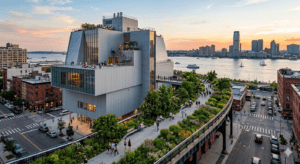
Located at the southern end of the High Line in the Meatpacking District. Focused entirely on American art from the 20th century to today. The Edward Hopper collection is exceptional. The rooftop terrace has Hudson River views included with admission (~$30).
17. Washington Square Park & Greenwich Village
The arch. The chess players. The street performers. NYU students moving in every direction. Washington Square Park is one of the most alive public spaces in the city — and it’s free.
Greenwich Village surrounding it rewards an hour of wandering: record shops, independent coffee, jazz clubs that have held the same space for decades. Blue Note and Village Vanguard both book serious acts.
18. The Strand Bookstore
18 miles of books — their actual claim, and the store earns it. Rare and collectible books upstairs, a massive sidewalk bargain cart outside, and staff recommendation shelves that are reliably excellent. Near Union Square. Worth 45 minutes minimum.
19. SoHo Architecture Walk
SoHo has the world’s largest collection of cast-iron buildings — a distinctive 19th-century style that gives the neighborhood its industrial-meets-elegant character. The shopping is expensive, but the streets are free. Broadway, Prince, and Spring Streets are the core.
Uptown & the Upper East Side: World-Class Museums at a Slower Pace
Or maybe I should say it this way: Uptown Manhattan feels like a different city. Less noise, wider sidewalks, a noticeably slower rhythm. The museum density along Museum Mile — eight major institutions within a single mile on Fifth Avenue — is extraordinary by any global standard.
20. The Metropolitan Museum of Art
The largest art museum in the United States. You could spend three full days and still not finish. Suggested admission is $30 for adults; pay-what-you-wish for New York State residents.
What most guides skip: the rooftop bar (open May–October) has cocktails and some of the best skyline views in the city, included with your museum admission. The Egyptian Wing — including a fully reconstructed ancient Temple of Dendur — is consistently overlooked because visitors head straight for European paintings. Don’t overlook it.
21. The Guggenheim Museum
Frank Lloyd Wright’s spiraling building is itself the attraction. The permanent collection features Kandinsky, Picasso, and Chagall, and the rotating exhibitions tend to be ambitious. Tickets around $30. The architecture is worth seeing even from the sidewalk if you don’t go in.
22. The American Museum of Natural History
The dinosaur halls are spectacular. The Hall of Ocean Life, with a 94-foot blue whale suspended from the ceiling, is one of the great rooms in New York City. Plan two to three hours minimum. Strong for all ages.
23. Central Park Zoo
Small, walkable, and genuinely charming. Snow leopards, sea lions, and a tropical rainforest section. Adults around $14. Takes about two hours. A strong add-on if you’re already on the Upper East Side.
24. Harlem — Food, Culture & the Apollo
Harlem is undervisited by first-timers, and that’s a real loss. Sylvia’s Restaurant has been a Harlem institution since 1962 — the fried chicken and waffles are not a tourist gimmick. The Apollo Theater offers tours and live shows. Marcus Samuelsson’s Red Rooster does a weekend brunch that consistently delivers.
Food Experiences & Markets That Belong on Every Manhattan Trip
25. Smorgasburg (April–October, Seasonal)
Look — if you’re visiting between April and October, here’s what actually works for a lunch stop: Smorgasburg. It’s an open-air market with 100+ local NYC food vendors, running seasonally at multiple locations. The Williamsburg Sunday location draws the biggest crowd and the best variety. Get there before noon.
26. Eataly NYC
An Italian food market and restaurant complex with two Manhattan locations — Flatiron (near Madison Square Park) and downtown near One World Trade. Buy cheese and bread for a Central Park picnic, or sit down for a full pasta lunch. The Flatiron location has a rooftop beer garden.
27. A Broadway Show
TKTS booths in Times Square sell same-day tickets at 20–50% off face value for evening performances. The line moves faster than it looks. For first-timers, a musical tends to have a lower barrier to entry than a straight play.
Practical Tips Before You Go
Some travel guides push the NYC Explorer Pass as a must-buy. That’s valid for visitors hitting five or more paid attractions in three days. But if you’re mixing in free experiences — the High Line, Central Park, the Ferry, gallery walks — you might not break even. Run the numbers against your actual itinerary first.
Quick note: the subway is the fastest and cheapest way to move between zones. A single ride is $2.90 with an OMNY contactless tap. Taxis and rideshares make sense late at night or with heavy luggage — not during daytime Midtown crosstown trips when traffic is genuinely brutal.
- Wear real walking shoes — plan for 8–12 miles on any active Manhattan day
- Book major ticketed attractions 48–72 hours ahead in summer; popular time slots sell out
- Restaurants near tourist sites charge a premium — walk two blocks off the main drag and prices drop noticeably
- The MTA website has a real-time subway status checker worth bookmarking before you arrive
- Tipping is standard in NYC: 18–20% at sit-down restaurants, $1–2 per drink at bars
This guide works best for first-time visitors planning 2–4 days in Manhattan. It won’t address multi-week stays, niche interests like architecture-only tours, or visitors who need accessible route planning.
What People Actually Ask Before Visiting Manhattan
Q: What’s the best free thing to do in Manhattan? The Staten Island Ferry gives you water-level views of the Statue of Liberty and the Lower Manhattan skyline at no cost. It runs 24 hours and is one of the most accessible experiences in the city.
Q: How do I get around Manhattan without a car? The subway covers the entire island and runs around the clock. A single ride is $2.90 with contactless payment. For short hops within a neighborhood, walking is often faster than waiting for a train.
Q: Should I buy the NYC Explorer Pass or pay per attraction? Only if you’re visiting five or more paid attractions in three days and won’t spend much time at free spots. Run the math against your specific itinerary — the pass doesn’t break even for every visitor.
Q: Why does Times Square feel disappointing in person? It’s genuinely overwhelming but also genuinely small. The famous intersection covers about two blocks. Most visitors expect a larger area. See it at night for the full effect and don’t plan to linger.
Q: When should I visit Manhattan to avoid the worst crowds? Late January through early March is the quietest period. Hotels are cheaper, lines are shorter, and the city is fully operational. Summer (June–August) is peak season — busiest, hottest, and most expensive.