
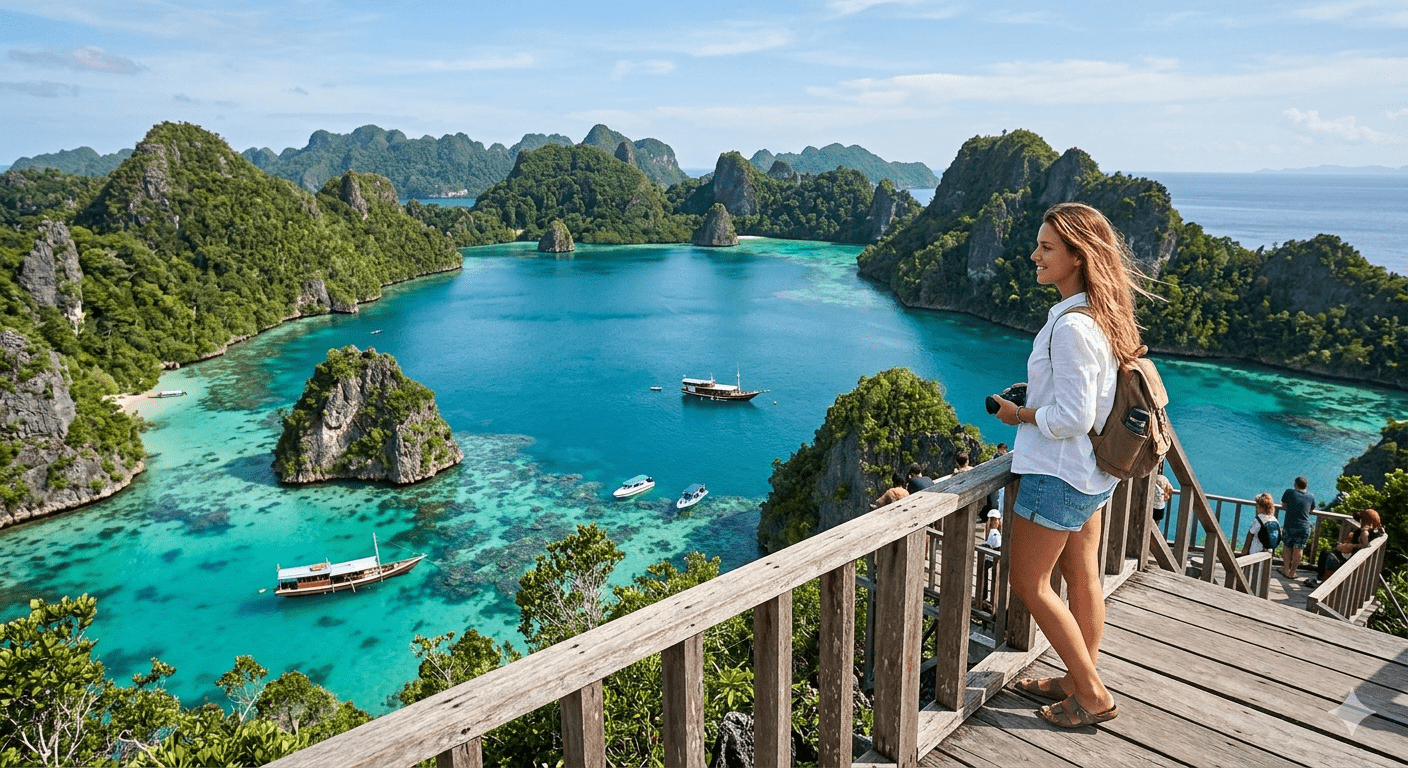
What Is Misool Island? (And Why It’s Not Like the Rest of Raja Ampat)
Misool island Indonesia is one of four major islands in the Raja Ampat archipelago, located in the remote West Papua province, roughly 150 km south of Sorong. Unlike the more-visited northern islands around Waisai, Misool has stayed genuinely off the main tourist circuit — not because it’s inaccessible, but because most travel content frames it as a luxury-only destination.
That framing is wrong.
Yes, Misool Resort is one of the most famous eco-resorts in Southeast Asia. But you can also get there on a public ferry, stay in a village homestay, and spend a fraction of what resort guests pay. The marine biodiversity you’d be swimming in is the same either way — according to Conservation International’s research, Raja Ampat contains over 75% of the world’s known coral species, and Misool’s southern reefs are widely considered the most pristine section of the whole archipelago.
What most guides skip is the middle ground: the independent traveler who isn’t booking a $1,500-per-night resort but also isn’t roughing it without a plan.
Featured Snippet Block A — Definition: Misool island Indonesia is a remote island in the southern Raja Ampat archipelago, West Papua, accessible by public ferry from Sorong. It is known for its karst limestone scenery, stingless jellyfish lake, heart-shaped lagoons, and some of the most biodiverse coral reefs on Earth.
How to Get to Misool Indonesia (Step by Step, With Real Costs)
No airport exists on Misool. There’s no shortcut. The journey starts in Sorong — and honestly, that’s part of the appeal.
Step 1 — Fly into Sorong (SOQ) Sorong’s Domine Eduard Osok Airport connects to Jakarta, Makassar, Manado, and Bali via Garuda Indonesia, Batik Air, and Lion Air. A Jakarta–Sorong flight runs roughly 4–6 hours depending on layovers. Budget IDR 1,200,000–2,500,000 (approximately $75–$155 USD) for a return fare booked 3–4 weeks ahead.
Step 2 — Get to the Port From Sorong airport to Pelabuhan Rakyat (the public port) takes 15–30 minutes by taxi — around IDR 100,000–150,000. If you’re joining an open trip package, transfers are usually included. Confirm this before you arrive.
Step 3 — Cross to Misool Two options here, and this is where travelers split:
Public ferry runs several times per week and takes 8–10 hours. It’s slow, sometimes crowded, and completely worth it if you’re budget-conscious. Fares are typically IDR 150,000–300,000 each way. Schedules shift seasonally, so confirm directly at the port or through your homestay in advance.
Private speedboat or chartered open trip gets you there faster (4–5 hours) but costs significantly more — IDR 500,000–1,500,000 per person depending on group size and operator.
Step 4 — Transfer to Your Accommodation Once you dock at Misool’s main pier, you may need a smaller boat transfer to reach your specific resort, bungalow, or homestay. Budget IDR 50,000–200,000 for this last leg. Ask your accommodation ahead of time — most will arrange it if you give them your arrival details.
Featured Snippet Block B — How-To: To get to Misool island Indonesia from anywhere in the world, follow these steps:
- Fly to Sorong (SOQ) via Jakarta, Bali, or Makassar
- Take a taxi to Pelabuhan Rakyat (Sorong public port), 15–30 minutes
- Board the public ferry to Misool — runs several times per week, 8–10 hours
- Arrange a small boat transfer from Misool’s dock to your accommodation
Best Time to Visit Misool
October to April. That’s the window most guides agree on, and the data supports it.
Seas in southern Raja Ampat are calmer during these months, underwater visibility peaks at 20–30 metres, and the heart-shaped lagoon is actually navigable by small boat. The wet season (roughly May–September) brings swell, reduced visibility, and some homestays close entirely. I’ve seen conflicting data on the exact shoulder months — some sources mark April as still excellent, others say it deteriorates quickly after mid-March. My read is that March is the safer cutoff if diving visibility is your priority.
Quick note: Misool sits further south than Waisai, which means it gets more direct exposure to the southern swell. Even within the “good” season, a few rough days are normal.
Peak season runs November through February. Accommodation books out fast, especially homestays — more on that below.
Where to Stay in Misool: A Realistic Breakdown
Look — if you’ve been searching for Misool accommodation and every result sends you to a $1,000+/night resort, here’s what actually exists across the full range.
Misool Resort (Luxury) The flagship. Overwater bungalows, world-class house reef, conservation-focused. Rates sit around $1,200–$1,800 USD per person per night all-inclusive. Genuinely extraordinary for divers who want zero logistics overhead. The resort also runs a protected marine area spanning over 300,000 acres — it’s not just a hotel, it’s a conservation operation.
Most independent travelers, though, aren’t the target market here.
Yellowe Drilling Camp (Mid-Range) A simpler alternative that still gives you direct access to Misool’s dive sites. Basic bungalows, meals included in most packages. Far cheaper than the resort, and the diving quality isn’t compromised. This is the option most mid-budget travelers overlook entirely.
Village Homestays (Budget) Several fishing villages around Misool offer rooms — expect bucket showers, limited electricity (usually generator hours in the evening), and meals that are whatever the family cooked that day. Prices range from IDR 200,000–500,000 per night including food. No ATMs on Misool, so bring all your cash from Sorong. Carry small IDR denominations — IDR 10,000, 20,000, and 50,000 notes.
Or maybe I should say it this way — the homestays aren’t a consolation prize. Travelers who’ve stayed in village homestays consistently report that the direct community connection and early-morning boat access to snorkel spots are things the resort simply can’t replicate.
Quick Comparison — Misool Accommodation Options
| Option | Best For | Key Benefit | Limitation |
|---|---|---|---|
| Misool Resort | Luxury divers, all-inclusive | World-class reef, conservation base | $1,200–$1,800/night |
| Yellowe Drilling Camp | Mid-budget travelers | Dive access, simpler logistics | Basic facilities |
| Village Homestays | Budget / cultural immersion | Authentic experience, low cost | No ATMs, limited power |
| Liveaboard (Arenui / Damai) | Serious divers, full coverage | Maximum dive sites, mobile | Expensive, fixed itinerary |
Misool Island Diving and Snorkeling
This is why people come.
Misool’s southern reefs are among the least disturbed in the entire Raja Ampat system. The karst topography creates walls, overhangs, and caverns that concentrate marine life in ways that genuinely surprise even experienced divers. Common sightings include wobbegong sharks, pygmy seahorses, manta rays at cleaning stations, and vast schools of fish that haven’t yet learned to scatter from humans.
Some experts argue that Waigeo (northern Raja Ampat) offers comparable diving. That’s valid for certain pelagic encounters. But if you’re chasing biodiversity density, reef health, and the sense that you’re seeing something few people have — Misool is the answer.
You don’t need to be an advanced diver. Many snorkel spots, including the famous jellyfish lake (stingless jellyfish — you can swim through them) and the shallow reefs around the homestay villages, are accessible with basic ability. The heart-shaped lagoon is a surface experience entirely.
Raja Ampat Dive Lodge operates in the region and offers dive packages that don’t require committing to a full resort stay — worth researching if you want guided dives without the luxury price point.
Featured Snippet Block C — Comparison: Liveaboard vs. resort-based diving in Misool: A liveaboard (such as the Arenui or Damai) is better suited for serious divers wanting maximum site coverage across all of Raja Ampat because it moves nightly to new locations. Resort or homestay-based diving works better when you want to repeat favourite sites and have a land base. The key difference is mobility versus depth of stay.
Practical Tips: The Things Most Articles Don’t Tell You
Cash is everything. There are no ATMs on Misool. None. Exchange money in Sorong — ideally in the city centre rather than at the airport where rates are worse. Carry IDR in small denominations.
Malaria is still present. A BMC Medicine study from 2025 confirmed malaria transmission remains active in Misool and surrounding areas. Sleep under a mosquito net, use repellent consistently, and consult your doctor about prophylaxis before you go. Most overwater homestays are breezy and have fewer mosquitoes than the jungle-covered larger islands — but don’t skip precautions.
The Raja Ampat entry permit is required. As of 2025, the fee sits at approximately IDR 1,000,000 (~$62 USD) for international visitors. It covers the entire archipelago including Misool. You’ll typically pay this at the port in Sorong or upon arrival — confirm with your accommodation which point they expect it.
Connectivity is basically zero. Some resorts have satellite Wi-Fi that works intermittently. Homestays generally don’t. Get comfortable with offline maps (download Misool on Maps.me or Google Maps before you leave Sorong) and tell someone your itinerary.
The permit and the remoteness are features, not bugs. The entry fee actively limits visitor numbers. That’s why the reef looks the way it does.
How Much Does a Misool Trip Cost? (Budget Breakdown)
Here’s a realistic range depending on travel style:
Budget traveler (homestay + public ferry): Sorong flights (return, from Jakarta): IDR 1,500,000–2,500,000 Ferry Sorong–Misool (return): IDR 300,000–600,000 Homestay with meals (7 nights): IDR 1,400,000–3,500,000 Raja Ampat permit: IDR 1,000,000 Boat excursions (3–4 trips): IDR 600,000–1,200,000 Total: roughly IDR 5,000,000–9,000,000 (~$310–$560 USD) for a week
Mid-range traveler (Yellowe Drilling Camp + speedboat): Expect to double that budget — roughly $800–$1,200 USD for a week including flights from Jakarta.
Liveaboard (Arenui / Damai class): Packages typically start at $3,500–$6,500 USD for 7–10 days, including everything from the moment you board in Sorong.
The budget numbers above assume you’re comfortable with basic conditions. They’re not extreme — plenty of travelers pull this off annually.
Voice Search Q&A
Q: What’s the best time to visit Misool island Indonesia? A: October through April, when seas are calm and underwater visibility peaks at 20–30 metres. March is the safer cutoff for optimal diving conditions before southern swell picks up.
Q: How do I get to Misool without a liveaboard? A: Fly to Sorong, travel to Pelabuhan Rakyat port, and take the public ferry — it runs several times per week and takes around 8–10 hours. Budget IDR 150,000–300,000 each way.
Q: Should I stay at Misool Resort or a homestay? A: Depends entirely on budget and priorities. The resort offers world-class diving and full conservation infrastructure. Homestays give authentic community access at a fraction of the cost — both put you on the same reefs.
Q: Why does Misool have no ATMs? A: Misool’s infrastructure is intentionally limited to manage visitor impact. Exchange and withdraw all IDR cash in Sorong before the crossing — carry enough for your entire stay plus a buffer.
Q: When should I book Misool accommodation? A: For peak season (November–February), book homestays and mid-range options 2–3 months ahead. They fill up. Misool Resort and liveaboards typically book 6+ months in advance for peak periods.